
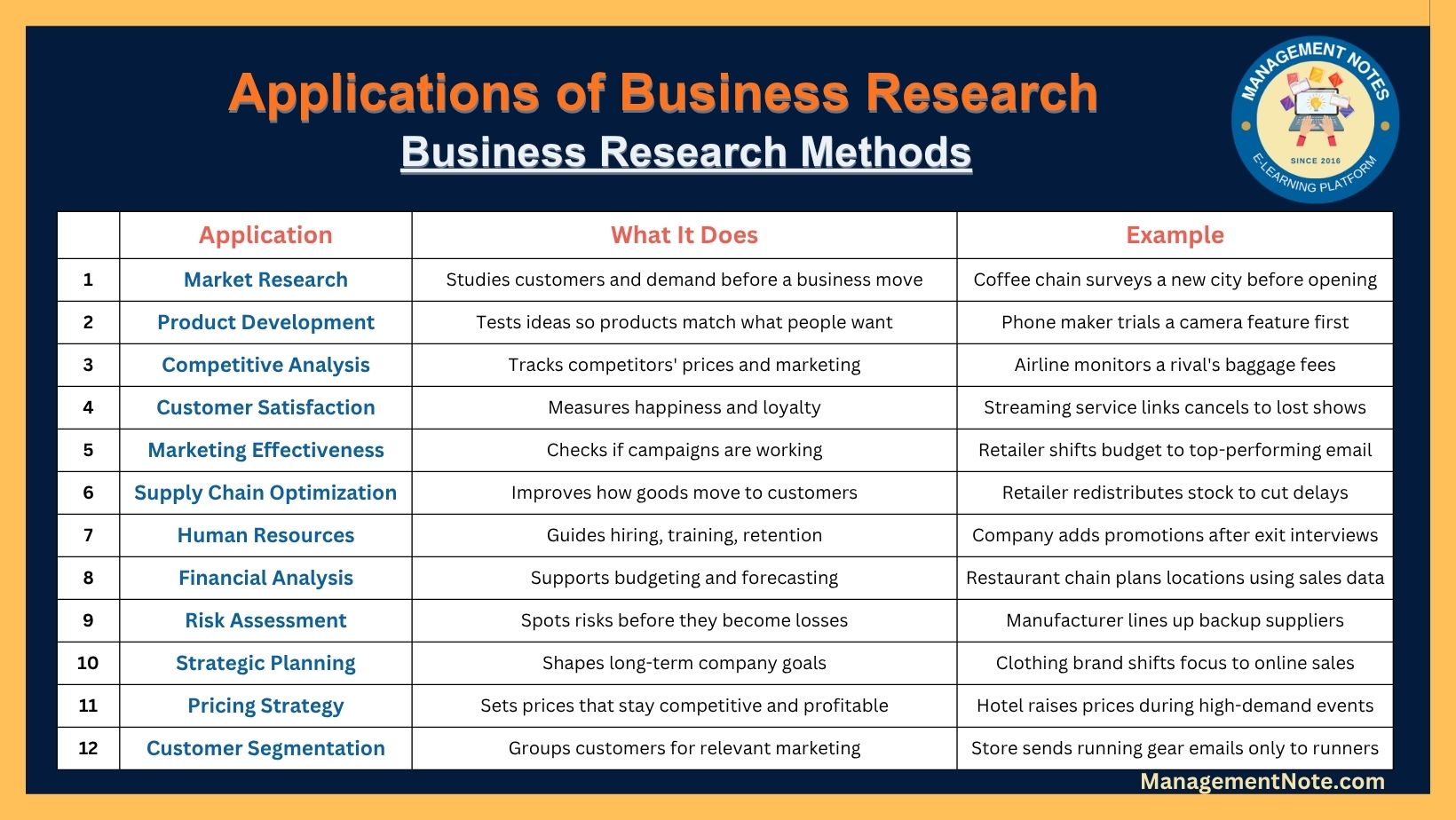
Applications of Business Research: 12 Key Uses, Types, and Real Examples (2026 Guide) | Business Research Methods
Business research is the process of collecting, studying, and using data to help a company make better decisions. It looks at things like customer needs, market trends, competitors, and company operations. Business research is not just a school topic. It is a real tool that companies of every size use every day to grow, save money, and beat their competition.
In fact, the global market research industry is now a massive business on its own. Industry estimates place the worldwide market research services sector at roughly $96 to $150 billion in 2026, depending on how the sector is measured, with the United States alone accounting for more than half of global market research spending. This shows just how much companies rely on research to guide their choices.
What Is Business Research?
Business research is a planned and organized way of gathering facts and data to solve a business problem or answer a business question. It is not guesswork. It follows clear steps: define the problem, collect data, study the data, and then use the findings to make a decision.
Business research can look at almost any part of a company, including:
- Marketing and sales
- Finance and budgets
- Human resources
- Production and supply chains
- Customer service
- Company strategy
Companies use business research so they can make choices based on facts instead of guesses or gut feelings.
Types of Business Research
Most business research falls into two main types: qualitative research and quantitative research. Many companies use both together to get a full picture.
| Feature | Qualitative Research | Quantitative Research |
|---|---|---|
| Main goal | Understand the “why” behind behavior | Measure the “how many” or “how much” |
| Data type | Words, opinions, stories | Numbers and statistics |
| Common methods | Interviews, focus groups, case studies | Surveys, experiments, data analysis |
| Best for | Exploring feelings, motivations, and new ideas | Testing ideas at scale and finding patterns |
| Sample size | Small groups | Large groups |
A company might use qualitative research first to understand why customers feel a certain way, then use quantitative research to check if that feeling is common across all customers.
Why Business Research Matters
Business research helps companies avoid costly mistakes. Instead of launching a product and hoping it works, a company can test the idea first. Instead of guessing what customers want, a company can ask them directly.
Modern business research has also changed with technology. Many teams now use data analytics, AI tools, and even synthetic data alongside traditional surveys and interviews to speed up decisions and lower research costs.
12 Major Applications of Business Research
Below are the 12 biggest ways companies use business research today.
1) Market Research

Market research is the most common use of business research. It helps a business understand its customers, its market size, and its competition before making a move. This application usually comes first, before a company spends any real money, because it tells the business if an idea is worth pursuing at all.
How it works:
- Companies run surveys to ask a large group of people about their needs, habits, and opinions.
- They hold focus groups, which are small group discussions, to get deeper, more personal feedback.
- They study market size and growth data to see if a market is big enough and growing fast enough to be worth entering.
- They track buying patterns, such as when, where, and how often customers shop.
Why it matters: Without market research, a company is basically guessing. Entering a market with no demand, or setting a price customers will not pay, can waste large amounts of money in a short time.
Real-life example: A coffee shop chain surveys people in a new city before opening a store there. The survey asks how often people buy coffee, how much they usually spend, and which nearby brands they already like. This tells the company if there is enough demand and what prices local customers expect to pay before a single dollar is spent on rent or staff.
2) Product Development and Innovation

Business research helps companies build products that people actually want, instead of products the company only thinks people want. This lowers the chance that a new product fails after launch, which is one of the most expensive mistakes a business can make.
How it works:
- Concept testing shows early product ideas to a small group of customers to get their honest reaction before any real building starts.
- Prototype evaluation lets real users try an early, unfinished version of a product so the company can fix problems early.
- Beta testing releases a near-final version to a limited group of users in real conditions before the full public launch.
Why it matters: Building a product without research is expensive to reverse. Research at each stage catches problems while they are still cheap and easy to fix.
Real-life example: A phone maker tests a new camera feature with a small group of users before adding it to every phone model. If users find the feature confusing or unnecessary, the company can redesign or drop it before millions of phones are produced.
3) Competitive Analysis

Business research is used to study competitors closely, so a company always knows where it stands in its market. This includes competitor pricing, marketing messages, product quality, customer service, and online reviews.
How it works:
- Companies track competitor pricing to see if their own prices are too high, too low, or about right.
- They study competitor marketing campaigns to spot what messages and channels are working for others in the industry.
- They read competitor customer reviews to find common complaints, which point to gaps the company itself could fill.
Why it matters: A business that ignores its competitors can be blindsided by a rival’s new product, price cut, or marketing push. Ongoing competitive research helps a company react quickly and stay relevant.
Real-life example: A budget airline studies a rival’s baggage fees and seat prices every month. When the rival drops prices on a shared route, the airline can respond fast instead of losing customers for weeks before noticing.
4) Customer Satisfaction and Loyalty

Business research measures how happy customers are with a company’s product or service, and it identifies exactly why some customers stay loyal while others leave for a competitor.
How it works:
- Companies send satisfaction surveys, often using a simple 1-to-10 score, right after a purchase or support call.
- They monitor online reviews and social media comments to catch problems in real time, not months later.
- They study repeat purchase data to see which customers keep coming back and which ones quietly stop buying.
Why it matters: It usually costs far more to win a new customer than to keep an existing one. Research that catches unhappy customers early gives a company the chance to fix the problem before that customer leaves for good.
Real-life example: A subscription streaming service notices through survey data that many customers cancel after their favorite shows leave the platform. Using this insight, the company negotiates to keep popular shows longer and reduces its cancellation rate.
5) Marketing and Advertising Effectiveness

Companies use research to check if their ads and marketing campaigns are actually working, instead of just assuming a campaign is successful because it looks good.
How it works:
- Teams track reach and engagement, meaning how many people saw the ad and how many actually interacted with it.
- They measure conversion rates, which show how many people who saw the ad actually made a purchase.
- They calculate return on investment (ROI) by comparing how much was spent on the campaign to how much revenue it brought in.
Why it matters: Marketing budgets are limited. Research shows which channels, such as social media, email, or search ads, bring the best results, so money is not wasted on campaigns that do not work.
Real-life example: A retail brand runs the same sale on both Instagram ads and email newsletters. Research shows the email campaign brings in three times more sales per dollar spent, so the company shifts more of its budget toward email for the next sale.
6) Supply Chain Optimization

Business research is used to study how goods move from suppliers to customers, from raw materials all the way to the final delivery. This helps companies cut costs and speed up delivery times.
How it works:
- Companies analyze supplier performance data to find delays or quality issues before they cause bigger problems.
- They study inventory levels to avoid having too much unsold stock or too little stock to meet demand.
- They map out the delivery process to find slow steps that can be shortened or automated.
Why it matters: A slow or broken supply chain leads to empty shelves, late deliveries, and frustrated customers. Research-driven supply chains are more efficient and more able to handle sudden changes in demand.
Real-life example: A furniture retailer uses sales and shipping data to notice that one product is often out of stock in certain regions. Adjusting how inventory is distributed across warehouses cuts delivery delays for that product significantly.
7) Human Resources Management

Business research plays a large role in hiring, training, and keeping employees satisfied at work. Good people decisions rely on real data, not just manager opinions.
How it works:
- Employee surveys measure job satisfaction, workload, and how employees feel about management.
- Exit interviews ask departing employees why they are leaving, which often reveals problems current staff will not mention.
- Performance reviews track how well employees are meeting their goals over time.
Why it matters: Replacing an employee is costly and time-consuming. Research that spots dissatisfaction early helps a company fix problems and keep its best people.
Real-life example: A company notices through exit interviews that several employees left because of limited growth opportunities. In response, the company builds a clearer promotion path, which reduces turnover in the following year.
8) Financial Analysis and Decision-Making

Business research supports financial planning by studying past performance, forecasting future revenue, and estimating upcoming costs.
How it works:
- Analysts review historical financial data to spot trends in sales, spending, and profit.
- They build revenue forecasts to predict how much money the company expects to make in future months or years.
- They run cost estimates for new projects to see if they are financially worth pursuing.
Why it matters: Financial decisions made without research can lead to overspending, missed opportunities, or a company running out of cash. Research-backed forecasts make budgeting far more reliable.
Real-life example: A restaurant chain studies three years of sales data before deciding how many new locations it can afford to open next year without risking its cash flow.
9) Risk Assessment and Management

Business research is used to spot risks before they become real problems. This includes financial risks, market risks, legal risks, and operational risks.
How it works:
- Companies run risk analysis to rank which threats are most likely and most damaging.
- They study market and economic data to prepare for downturns or sudden shifts in demand.
- They review past incidents, both their own and their competitors’, to avoid repeating known mistakes.
Why it matters: Businesses that plan for risk in advance can react quickly when problems happen, instead of scrambling after the damage is already done.
Real-life example: A manufacturer that depends on one overseas supplier researches backup suppliers in other countries. When a shipping delay hits the main supplier, the company can switch quickly instead of stopping production.
10) Strategic Planning

Business research feeds directly into a company’s long-term strategy. By studying market trends, customer behavior, and industry changes, leaders can set clear goals instead of relying on guesswork.
How it works:
- Leaders study industry trend reports to understand where the whole market is heading.
- They review internal performance data to see which parts of the business are growing and which are struggling.
- They use competitor and customer research together to decide where the company should focus over the next several years.
Why it matters: A strategy built without research is really just a guess dressed up as a plan. Research-based strategy gives a company a realistic roadmap for growth.
Real-life example: A clothing brand notices through research that online sales are growing much faster than in-store sales across its industry. This leads the company to invest more heavily in its website and app instead of opening new physical stores.
11) Pricing Strategy and Revenue Management

Business research helps companies set the right price for their products or services, one that is competitive but still profitable.
How it works:
- Companies study customer price sensitivity, meaning how much a price change affects buying decisions.
- They track competitor pricing to avoid pricing themselves out of the market.
- They use demand data to adjust prices in real time, a method known as yield management, which is common in hotels and airlines.
Why it matters: Pricing too high can drive customers away, while pricing too low can hurt profits. Research-based pricing finds the balance that keeps both customers and the business happy.
Real-life example: A hotel raises its room prices during a major local event when demand is high, then lowers prices during slow weeks to keep occupancy up. This pricing pattern is based directly on demand research.
12) Customer Segmentation and Personalization

Business research helps companies group customers based on shared traits, such as age, location, income, or buying habits. This lets a business send the right message to the right group instead of one generic message to everyone.
How it works:
- Companies analyze customer data to find natural groups, or segments, within their customer base.
- They build targeted marketing messages for each segment based on what that group actually cares about.
- They use personalization tools to recommend products or content based on a customer’s past behavior.
Why it matters: Personalized marketing tends to get better engagement and higher sales than generic, one-size-fits-all campaigns, because customers respond more to messages that feel relevant to them.
Real-life example: An online store sends different emails to two customer groups: one group that mostly buys running shoes gets emails about new running gear, while a group that buys hiking boots gets emails about hiking equipment instead of a single generic newsletter sent to everyone.
The Business Research Process (Step by Step)
Most business research follows these basic steps:
- Define the problem. Decide exactly what question the research needs to answer.
- Review existing information. Check reports, past studies, or company data that already exists.
- Choose a research method. Pick between qualitative, quantitative, or a mix of both.
- Collect the data. Run surveys, interviews, or experiments.
- Analyze the results. Look for patterns, trends, and clear answers.
- Report and apply the findings. Share the results with decision-makers and use them to take action.
Business Research Vs. Market Research
People often confuse these two terms. Here is the difference in simple terms.
| Feature | Business Research | Market Research |
|---|---|---|
| Scope | Covers the whole company: finance, HR, operations, strategy | Focuses only on customers and the market |
| Goal | Improve overall business decisions | Understand customer demand and market trends |
| Example question | Should we open a new office location? | Do customers want this new product feature? |
Market research is actually one part of the bigger field of business research.
Frequently Asked Questions
What is business research in simple words?
Business research is the process of collecting and studying data to help a company make smarter decisions. It looks at customers, competitors, money, staff, and company operations.
What are the main types of business research?
The two main types are qualitative research, which studies opinions and reasons, and quantitative research, which studies numbers and statistics. Most companies use a mix of both.
Why is business research important for small businesses?
Small businesses often have limited money, so making the wrong decision can be costly. Business research helps small business owners test ideas, understand customers, and avoid expensive mistakes before spending money.
What is an example of business research?
A common example is a company sending out a customer survey before launching a new product. Another example is a business studying its competitors’ prices before setting its own prices.
What is the difference between business research and market research?
Market research focuses only on customers and the market. Business research is broader and can also cover finance, human resources, supply chains, and company strategy.
How is AI changing business research in 2026?
Many research teams now use AI tools and data analytics to collect and study data faster. Some companies also use synthetic data, which is computer-generated data that mimics real survey responses, to test ideas quickly before running full studies.
Related Posts
- Significance of Research – Business Research Methods | Management Notes
- Descriptive/ Univariate Hypothesis – Concept, Characteristics, Example, Application | Business Research Methodology

I am Bijisha, an enthusiast with a profound eagerness for learning. I hold a Bachelor’s degree in Business Administration(BBA) from Apex College. I am constantly driven by a relentless curiosity and a genuine desire to expand my knowledge horizons.
- Top 10 Best Books for Hospitality Management - December 9, 2023
- Top 10 Best Sociology Books for Beginners - December 5, 2023
- Top 10 Best Psychology Books on Human Behavior - December 3, 2023


