
Individualism Vs. Collectivism: Meaning, Key Differences, Examples, and Business Impact (2026 Guide) | International Business
Individualism is a value system where a person’s own goals, rights, and choices come first. Collectivism is a value system where the goals and needs of the group, such as the family, company, or nation, come before the needs of one person.
Countries like the United States, the United Kingdom, Australia, and Canada score as highly individualistic. Countries like Guatemala, Ecuador, China, and South Korea score as highly collectivist.
This guide explains the meaning of both terms, the real differences between them, country examples with data, and how they shape business, teams, and daily life.
What Is Individualism?
Individualism is the belief that a person’s life belongs to that person alone. It says a person has the right to make their own choices, act on their own judgment, keep what they earn, and follow their own goals. In an individualist culture, people are raised to think for themselves and stand on their own from a young age.
Key traits of individualism include:
- People use “I” more than “we” when talking about themselves.
- Personal achievement and self-reliance are valued highly.
- Privacy is important, and people expect time alone.
- Relationships are more loose and can change over time.
- Success is often judged by personal effort, not group status.
- Children are raised to become independent adults.
Real-life example: In the United States, a student who wins an award is usually praised as an individual (“She worked hard and earned it”). Career choices, where to live, and who to marry are seen as personal decisions, not family decisions.
Summary Table: Individualism at a Glance
| Feature | Individualism |
|---|---|
| Core idea | The person comes first |
| Common pronoun used | “I” |
| Decision maker | The individual |
| Value placed on | Personal freedom and achievement |
| Family ties | Close family only (parents, children) |
| Typical countries | United States, United Kingdom, Australia, Canada, Netherlands |
| Workplace style | Rewards based on personal performance |
What Is Collectivism?
Collectivism is the belief that a person’s life belongs first to the group they are part of, such as the family, tribe, company, or country. It says a person’s duty is to support the group’s well-being, even if that means giving up some personal wants. In a collectivist culture, people are raised to think of the group before themselves.
Key traits of collectivism include:
- People use “we” more than “I” when talking about themselves.
- Group harmony and loyalty are valued highly.
- Privacy is less common, since life is shared with the group.
- Relationships are long-term and depend on group membership.
- Success is often judged by how well the group does, not just one person.
- Children are raised to respect elders and support the family unit.
Real-life example: In many parts of South Asia, Latin America, and East Asia, a person’s career or marriage choice is often discussed with the whole family first, because the outcome is seen as something that affects everyone, not just the individual.
Summary Table: Collectivism at a Glance
| Feature | Collectivism |
|---|---|
| Core idea | The group comes first |
| Common pronoun used | “We” |
| Decision maker | The family or group |
| Value placed on | Group harmony and loyalty |
| Family ties | Extended family and community |
| Typical countries | Guatemala, Ecuador, Indonesia, China, South Korea |
| Workplace style | Rewards based on group or team performance |
Individualism vs Collectivism: Key Differences (Comparison Table)
The table below shows how individualism and collectivism differ across common areas of life. This table is often searched as “difference between individualism and collectivism” or “individualism vs collectivism table.”
| Basis | Collectivism | Individualism |
|---|---|---|
| Definition | The group is seen as more important than the person, because being part of a society means helping keep order and the greater good, even when it is hard on one person. | The person is seen as more important than the group, because each individual is the basic unit of value and decision-making. |
| Self-image | Frequent use of “we” | Frequent use of “I” |
| Communication style | In-group and out-group communication are treated very differently | Communication style stays fairly similar with in-groups and out-groups |
| Privacy | Little room for privacy; people are rarely alone | Privacy is expected and respected |
| Dependency | Group awareness comes first; mutual ties and duties are stressed | People are self-aware and act independently |
| Friendship | Friendships are often tied to group membership (family, caste, community) | Friendship is seen as a personal choice and basic human need |
| Main source of information | Social networks and personal contacts | Mass media, online research, and personal choice of sources |
| Career mobility | Lower job mobility; people often stay with one employer or group longer | Higher job mobility; people change jobs more often to chase personal goals |
| Main goal | Harmony and agreement within the group | Personal growth and self-fulfillment |
| Decision-making | Made by the family, elders, or group leaders | Made by the individual |
| Reward system at work | Rewards shared with the team or group | Rewards linked to personal performance |
| View of conflict | Conflict is avoided to protect group harmony | Conflict is often addressed directly and openly |
| Per capita GDP trend | Tends to be lower on average | Tends to be higher on average |
Individualism and Collectivism Around the World (Country Data)
The most common way to measure this idea across countries is the Individualism Index, created by researcher Geert Hofstede. It gives each country a score from 0 (highly collectivist) to 100 (highly individualist), based on large surveys done across many nations.
This score is one of the most searched data points related to this topic, often searched as “most individualistic country in the world” or “Hofstede individualism score by country.”
Most Individualistic Countries (Tier 1, English-Speaking Nations Score Highest)
| Country | Individualism Score |
|---|---|
| United States | 91 |
| Australia | 90 |
| United Kingdom | 89 |
| Canada | 80 |
| Netherlands | 80 |
| Hungary | 80 |
| New Zealand | 79 |
| Italy | 76 |
| Belgium | 75 |
Most Collectivist Countries
| Country | Individualism Score |
|---|---|
| Guatemala | 6 |
| Ecuador | 8 |
| Panama | 11 |
| Venezuela | 12 |
| Colombia | 13 |
| Indonesia | 14 |
| Pakistan | 14 |
| South Korea | 18 |
| China | 20 |
Middle-Range Countries
| Country | Individualism Score |
|---|---|
| Germany | 67 |
| Switzerland | 68 |
| Spain | 51 |
| India | 48 |
| Japan | 46 |
| Argentina | 46 |
| Turkey | 37 |
| Brazil | 38 |
Why this matters for tier-1 search audiences:
People searching from the United States, United Kingdom, Canada, and Australia usually come from cultures that score highest on individualism. This explains why direct communication, personal branding, self-help content, and “do it yourself” advice perform so well with audiences in these countries.
It also explains why marketing, HR policy, and negotiation styles that work in these nations may fail in more collectivist markets like China, South Korea, or Latin America, and need to be adjusted.
A note on newer research:
A 2025 study published in the Journal of Personality and Social Psychology (Akaliyski, Vignoles, Welzel, and Minkov) found that Hofstede’s original individualism scores, which came from IBM employee surveys done in the 1960s and 1970s, may overstate individualism in English-speaking countries by around 27 points and understate it in East Asian countries by around 22 points.
Newer models, such as the Minkov-Kaasa model built on the World Values Survey, are now used alongside Hofstede’s original framework for a more current picture. This means Hofstede’s numbers are still widely used and useful for general comparison, but they should be treated as a starting point, not the final word.
Summary Table: Global Patterns
| Region Type | General Tendency | Example Countries |
|---|---|---|
| Western, English-speaking, tier-1 countries | Strongly individualistic | United States, United Kingdom, Australia, Canada |
| Northern and Western Europe | Mostly individualistic | Netherlands, Belgium, Denmark, Sweden |
| East Asia | Mostly collectivist | China, South Korea, Taiwan, Vietnam |
| South Asia | Mixed, leaning collectivist | India, Pakistan, Bangladesh |
| Latin America | Strongly collectivist | Guatemala, Ecuador, Panama, Colombia |
| Africa | Mostly collectivist | Ghana, Burkina Faso, Sierra Leone |
Individualism Vs Collectivism in International Business and Management
This cultural difference has a direct effect on how companies manage teams, run marketing campaigns, and negotiate deals across borders.
Workplace and HR: In individualist workplaces, such as those common in the US and UK, performance reviews focus on personal output, and pay raises are often tied to individual results. In collectivist workplaces, such as those common in Japan or Colombia, team results and seniority carry more weight, and singling out one worker for praise can feel awkward to the group.
Marketing: A phone brand advertising in the United States may show one person using the phone to save time and boost personal success. The same brand advertising in China may show a group of friends or family sharing an experience together, because that message fits a collectivist audience better.
Negotiation: In individualist cultures, negotiators often get straight to the point and focus on facts and numbers. In collectivist cultures, negotiators usually spend more time building trust and personal relationships before discussing business terms.
Hiring practices: In individualist cultures, hiring a relative for a job is often viewed as unfair (nepotism). In collectivist cultures, hiring someone the family already trusts is often viewed as smart and safe, since the group already knows the person’s character.
Summary Table: Business Impact
| Business Area | Individualist Approach | Collectivist Approach |
|---|---|---|
| Performance reviews | Based on personal results | Based on team results |
| Pay structure | Individual bonuses | Group or team bonuses |
| Marketing message | “For you” and personal benefit | “For your family or group” |
| Negotiation style | Direct, fact-based, fast | Relationship-based, slower |
| Hiring style | Skill-based, open hiring | Trust-based, network hiring |
| Meeting style | Individuals share opinions openly | Group works toward agreement first |
Advantages and Disadvantages of Individualism
| Advantages | Disadvantages |
|---|---|
| Encourages personal growth and innovation | Can lead to loneliness and weak community ties |
| Rewards effort and skill directly | Can create high competition and stress |
| Protects personal freedom and choice | Can weaken support systems for the sick or elderly |
| Supports entrepreneurship and new ideas | Can make teamwork harder in some settings |
Advantages and Disadvantages of Collectivism
| Advantages | Disadvantages |
|---|---|
| Builds strong community and family support | Limits personal freedom and choice |
| Reduces loneliness through group bonds | Can slow down new ideas due to fear of change |
| Improves teamwork and shared responsibility | Individual talent may go unrecognized |
| Provides a safety net through group loyalty | Can pressure people to hide personal problems |
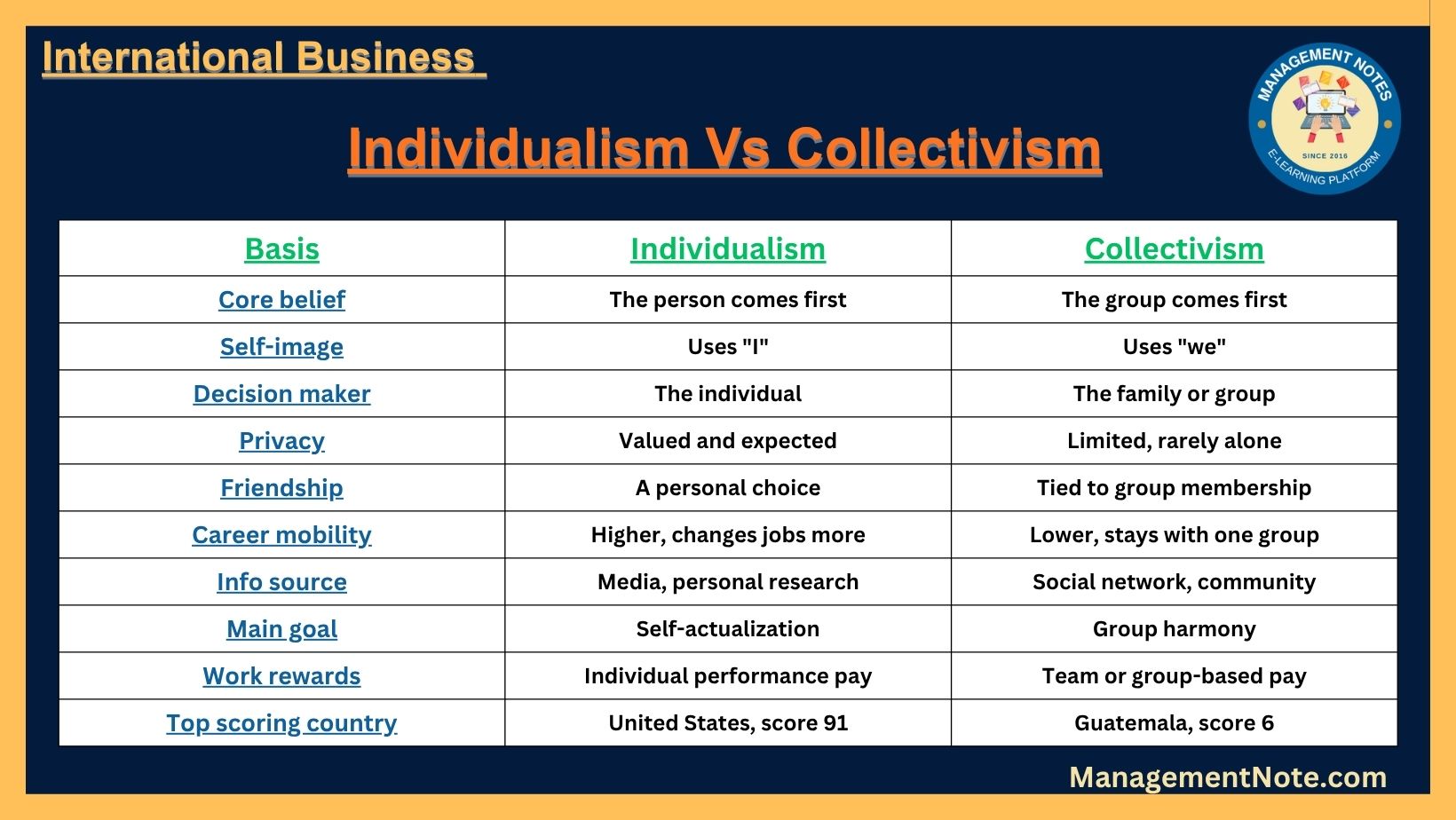
Master Summary Table: Individualism Vs Collectivism
| Basis | Individualism | Collectivism |
|---|---|---|
| Core belief | The person’s life belongs to the person | The person’s life belongs to the group |
| Pronoun used | “I” | “We” |
| Privacy | Valued and expected | Limited, rarely alone |
| Friendship | A personal choice | Tied to group membership |
| Decision-making | Individual | Group or family |
| Career mobility | Higher | Lower |
| Information source | Media and personal research | Social network and community |
| Main goal | Self-actualization | Group harmony |
| Highest scoring countries | United States (91), Australia (90), United Kingdom (89) | Guatemala (6), Ecuador (8), Panama (11) |
| Per capita GDP trend | Tends to be higher | Tends to be lower |
| Business reward style | Individual performance pay | Team or group-based rewards |
Frequently Asked Questions
What is the main difference between individualism and collectivism?
Individualism puts the needs and rights of one person first. Collectivism puts the needs and goals of the group, such as family, company, or nation, first.
Which country is the most individualistic in the world?
Based on Hofstede’s Individualism Index, the United States has the highest score at 91, making it the most individualistic country measured.
Which country is the most collectivist in the world?
Guatemala has the lowest individualism score at 6, making it the most collectivist country measured in Hofstede’s research.
Is the United States individualistic or collectivist?
The United States is strongly individualistic. It scores 91 out of 100 on the Individualism Index, one of the highest scores of any country.
What are some simple examples of individualism and collectivism?
An example of individualism is choosing a career path based only on personal interest. An example of collectivism is choosing a career path after talking it over with the whole family and picking what benefits the household.
Can a country show both individualism and collectivism?
Yes. Most countries show a mix, but they lean more toward one side. For example, Japan has a middle score of 46, showing a mix of group loyalty at work with personal ambition in other areas of life.
How does individualism vs collectivism affect business and management?
It changes how companies reward staff, run marketing campaigns, negotiate deals, and hire workers. Businesses that understand this difference can adjust their approach for each market instead of using one style everywhere.
Is Hofstede’s theory on individualism and collectivism still accurate today?
It is still widely used, but newer 2025 research suggests his original scores may overstate individualism in English-speaking countries and understate it in East Asian countries. Many researchers now use newer models alongside Hofstede’s framework for a more current view.
Similarly, You may like:

MBA- Finance Specialization
I am Smirti Bam, an enthusiastic edu blogger with a passion for sharing insights into the dynamic world of business and management through this website.
I hold a MBA degree from Presidential Business School, Kathmandu, and a BBA degree with a specialization in Finance from Apex College,
- Moonlighting Vs Freelancing: Meaning, Differences & Risks Explained | Human Resource Management (HRM) - September 14, 2026
- Employee Retention Vs. Employee Engagement: Key Differences Explained | Human Resource Management - September 6, 2026
- Talent Acquisition Vs Talent Management: What Is the Difference? - September 2, 2026


