
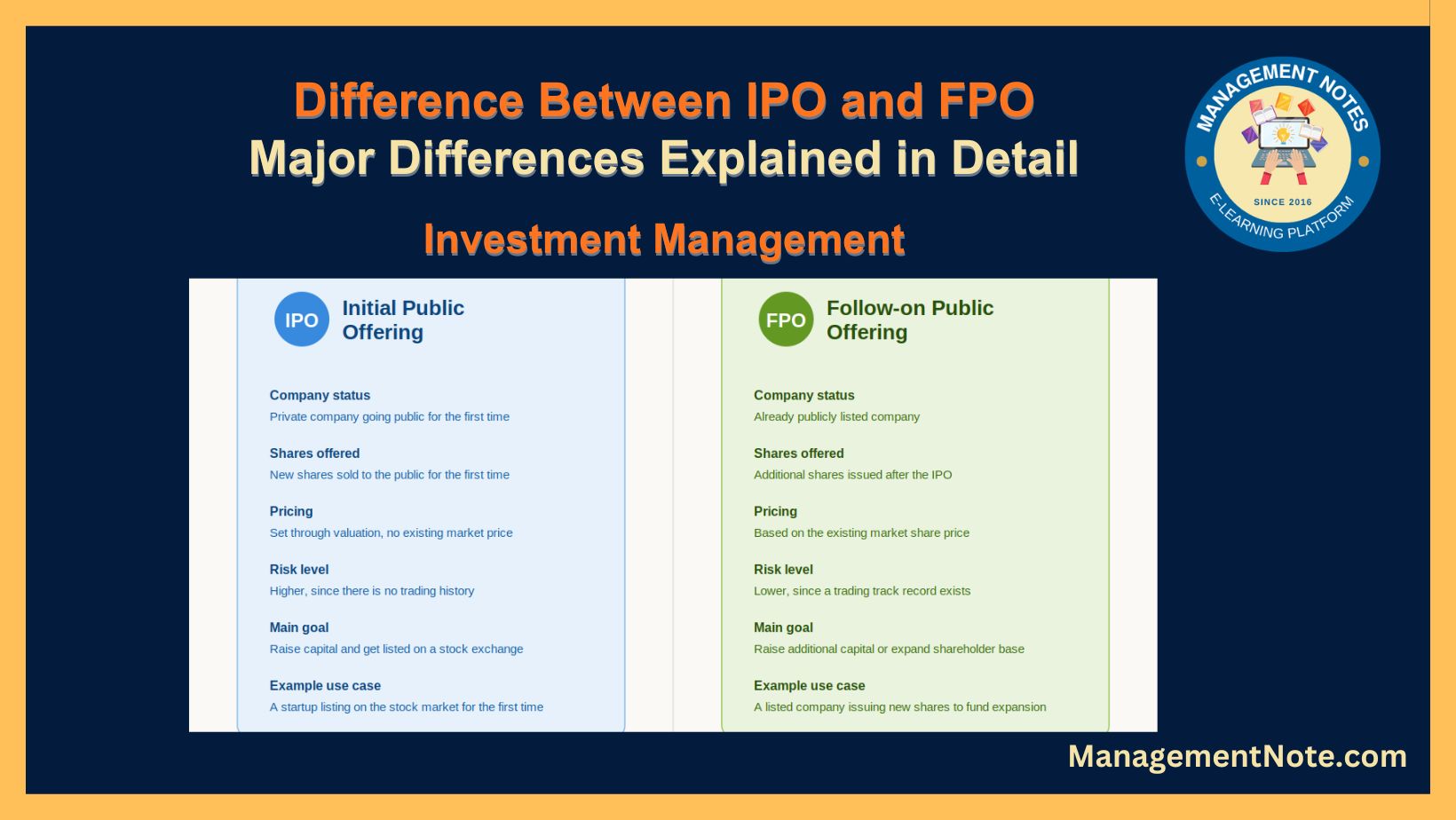
Difference Between IPO and FPO: 10 Major Differences Explained (2026 Guide) | Investment Management
If you are learning about the stock market, one of the first questions you may ask is, “What is the difference between IPO and FPO?”
An Initial Public Offering (IPO) is the first time a private company offers its shares to the public and gets listed on a stock exchange.
A Follow-on Public Offering (FPO) is when a company that is already listed on a stock exchange issues additional shares to raise more money.
Both IPOs and FPOs help companies raise capital, but they serve different business purposes. Understanding IPO vs FPO can help investors make better investment decisions.
What Is an IPO?
An Initial Public Offering (IPO) is the process through which a private company sells its shares to the public for the first time. After an IPO, the company’s shares can be traded on a stock exchange.
Companies launch an IPO to:
- Raise funds for business growth
- Expand operations
- Repay debt
- Increase brand recognition
- Become a publicly traded company
Example
Suppose XYZ Pvt. Ltd. wants to expand its factories. It offers shares to the public for the first time through an IPO and gets listed on the stock exchange.
What Is an FPO?
A Follow-on Public Offering (FPO) is the issue of additional shares by a company that is already listed on the stock exchange.
Companies use an FPO when they need more capital after the IPO.
Companies launch an FPO to:
- Raise additional funds
- Expand existing business
- Launch new projects
- Reduce debt
- Improve financial stability
Example
If XYZ Ltd. has already completed its IPO and later wants funds to build another manufacturing plant, it may issue an FPO.
IPO vs FPO: 10 Major Differences
| Basis of Comparison | IPO (Initial Public Offering) | FPO (Follow-on Public Offering) |
|---|---|---|
| 1. Meaning | First public issue of shares by a private company. | Additional issue of shares by an already listed company. |
| 2. Company Status | Company is not yet listed before the IPO. | Company is already listed on the stock exchange. |
| 3. Main Purpose | Raise capital, increase public ownership, and get listed. | Raise additional capital for expansion, debt repayment, or new projects. |
| 4. Investor Risk | Higher risk because the company has no public trading history. | Lower risk because investors can review the company’s past performance. |
| 5. Regulatory Process | More detailed and strict regulatory requirements. | Comparatively simpler and faster process. |
| 6. Profit Potential | May offer higher returns but comes with higher risk. | Usually provides moderate returns with comparatively lower risk. |
| 7. Share Issuance | Shares are issued to the public for the first time. | New or existing shares are offered after listing. |
| 8. Market Reputation | Investors rely mainly on the company’s prospectus and future plans. | Investors can study financial statements, stock performance, and company history. |
| 9. Types | Fixed Price Issue and Book Building Issue. | Dilutive FPO and Non-dilutive FPO. |
| 10. Suitable For | Investors seeking high-growth opportunities. | Investors looking for companies with an established market record. |
Types of IPO
There are two main types of IPO.
1) Fixed Price Issue
In a Fixed Price Issue, the company decides the share price before the public issue begins. Investors know the exact price they need to pay.
2) Book Building Issue
In a Book Building Issue, the company announces a price band instead of a fixed price. Investors bid within that range, and the final issue price is decided based on demand.
Types of FPO
There are two types of FPO.
1) Dilutive FPO
A Dilutive FPO occurs when a company issues new shares to raise additional funds. Since the total number of shares increases, the ownership percentage of existing shareholders may decrease.
2) Non-Dilutive FPO
A Non-dilutive FPO happens when existing shareholders, such as promoters or directors, sell their shares to the public. No new shares are created.
Advantages of IPO
- Raises large amounts of capital.
- Helps expand business operations.
- Improves company reputation.
- Increases public visibility.
- Creates liquidity for shareholders.
Advantages of FPO
- Provides additional funds for business growth.
- Helps repay existing loans.
- Supports expansion into new markets.
- Usually involves lower investment risk than an IPO.
- Strengthens the company’s financial position.
IPO vs FPO: Which Is Better?
There is no single answer to whether an IPO or an FPO is better.
- An IPO may provide higher growth opportunities, but it also carries greater uncertainty because the company is entering the public market for the first time.
- An FPO generally offers lower risk because investors can review the company’s financial performance and stock market history before investing.
The better choice depends on your investment goals, risk tolerance, and research.
Frequently Asked Questions (FAQs)
What is the main difference between IPO and FPO?
An IPO is the first public issue of shares by a private company, while an FPO is an additional issue of shares by a company that is already listed on a stock exchange.
Is an IPO riskier than an FPO?
Yes. IPOs generally involve higher risk because there is no public trading history. FPOs are usually less risky because investors can evaluate the company’s past performance.
Can a company issue more than one FPO?
Yes. A listed company can issue multiple FPOs whenever it needs additional capital and meets regulatory requirements.
What are the two types of IPO?
The two types of IPO are:
- Fixed Price Issue
- Book Building Issue
What are the two types of FPO?
The two types of FPO are:
- Dilutive FPO
- Non-dilutive FPO
Conclusion
Understanding the difference between IPO and FPO is important for every investor. An IPO allows a private company to enter the stock market for the first time, while an FPO enables an already listed company to raise additional funds.
Although IPOs may offer higher growth opportunities, they also involve greater uncertainty. FPOs generally provide investors with more information about the company’s performance, making investment decisions easier.
Before investing in either option, always study the company’s financial health, business model, and future growth plans.
References
Brealey, R. A., Myers, S. C., Allen, F., & Mohanty, P. (2023). Principles of corporate finance (14th ed.). McGraw Hill.
Ross, S. A., Westerfield, R. W., Jordan, B. D., & Lim, J. (2022). Fundamentals of corporate finance (13th ed.). McGraw Hill.
Securities and Exchange Board of India. (2025). Issue of Capital and Disclosure Requirements (ICDR) Regulations. https://www.sebi.gov.in
National Stock Exchange of India Limited. (2025). Initial Public Offerings (IPO). https://www.nseindia.com
Bombay Stock Exchange. (2025). Primary Market. https://www.bseindia.com
Investopedia. (2025). Initial Public Offering (IPO). https://www.investopedia.com/terms/i/ipo.asp
Investopedia. (2025). Follow-on Public Offering (FPO). https://www.investopedia.com
Similarly,
- Public Offering Vs Private Placement
- Traditional Financing Vs Microfinancing
- Microcredit Vs Microfinance
- Direct Finance Vs Indirect Finance
- Investment Vs Speculation
- Public Limited Company Vs Private Limited Company
- IPO Vs SPAC
You may also like:

MBA- Finance Specialization
I am Smirti Bam, an enthusiastic edu blogger with a passion for sharing insights into the dynamic world of business and management through this website.
I hold a MBA degree from Presidential Business School, Kathmandu, and a BBA degree with a specialization in Finance from Apex College,
- Employee Retention Vs. Employee Engagement: Key Differences Explained | A Complete Guide - September 6, 2026
- Talent Acquisition Vs Talent Management: What Is the Difference? - September 2, 2026
- Headhunting vs Recruitment: Major Differences Explained | Human Resource Management - August 31, 2026


Great info. Lucky me I found your blog by accident (stumbleupon).I’ve bookmarked it for later!
3800 UK joiners Mobiles all scarped from Yell.com Updated every 40 days $15 fast delivery