
Short-Term Vs Long-Term Financing: Full Guide With Examples and Comparison (2026) | Corporate Finance
Every business needs money to run and grow. But not all funding works the same way. Some funds must be paid back fast. Some can take years to repay. This is where short-term financing and long-term financing come in.
This guide explains what each type of financing means, how they differ, what types exist, and which one fits your business needs.
What Is Short-Term Financing?
Short-term financing is money a business or a person borrows for a short period. This period is usually one year or less. Companies use it to cover day-to-day needs like paying suppliers, buying stock, or covering payroll during a slow month.
Short-term financing shows up on the balance sheet as a current liability. It is mostly used to pay for current assets, such as inventory or accounts receivable, not for buying buildings or machines.
Example: A clothing store needs extra stock before the holiday season. It takes a 90-day loan from its bank to buy inventory. Once the holiday sales come in, the store repays the loan. This is short-term financing in action.
What Is Long-Term Financing?
Long-term financing is money borrowed or raised for a period of more than one year. Some long-term loans can run for 10, 20, or even 30 years. Businesses use this type of financing for big goals, such as buying land, building a factory, or expanding into a new market.
Long-term financing appears on the balance sheet as a non-current (long-term) liability or as equity, depending on the source. It is used to fund fixed assets and major growth plans, not everyday costs.
Example: A manufacturing company wants to build a new factory. It takes a 15-year bank loan to pay for the land and construction. This is long-term financing because the repayment period stretches far beyond one year.
Short-Term vs Long-Term Financing: Quick Snapshot
| Basis | Short-Term Financing | Long-Term Financing |
|---|---|---|
| Repayment period | 1 year or less | More than 1 year (often 5 to 30 years) |
| Main use | Working capital, day-to-day costs | Fixed assets, expansion, big projects |
| Cost | Usually cheaper overall, but higher interest rate | Usually more expensive overall due to longer time, but can carry lower rates |
| Risk | Higher risk of repayment pressure and rate changes | Lower risk of sudden repayment pressure |
| Flexibility | More flexible, easy to adjust | Less flexible, harder to change once set |
| Approval process | Faster, simpler paperwork | Slower, detailed review and paperwork |
| Collateral | Often not required | Often required (assets, property) |
| Balance sheet listing | Current liability | Long-term liability or equity |
Types of Short-Term Financing

Businesses have several options when they need funds for less than a year. Below are the most common types of short-term financing used across the United States, the United Kingdom, Canada, and Australia.
1. Trade Credit: This is when a supplier lets a buyer pay for goods later instead of paying cash right away. It is the most common and cheapest form of short-term financing because it usually costs nothing if paid on time.
2. Bank Overdraft: A bank lets a business withdraw more money than it has in its account, up to an agreed limit. It is useful for sudden, small cash gaps.
3. Short-Term Bank Loans: A lump sum loan that must be repaid, usually within a few months to a year. It often carries a fixed interest rate.
4. Line of Credit: A flexible pool of money a business can draw from whenever needed, up to a set limit. Interest is charged only on the amount used.
5. Commercial Paper: An unsecured, short-term note issued by large, financially strong companies to raise quick cash, usually maturing in 270 days or less.
6. Invoice Factoring and Invoice Discounting:A business sells its unpaid customer invoices to a finance company for quick cash, instead of waiting 30 to 90 days for customers to pay.
7. Inventory Financing: A loan secured against unsold stock. The inventory itself acts as collateral.
8. Business Credit Cards: Useful for small, quick purchases. They carry higher interest rates if the balance is not paid off monthly.
Key Summary Table: Types of Short-Term Financing
| Type | How It Works | Typical Term | Collateral Needed | Best For |
|---|---|---|---|---|
| Trade credit | Buy now, pay supplier later | 30 to 90 days | No | Everyday purchases |
| Bank overdraft | Withdraw beyond account balance | On demand | No | Small, sudden cash gaps |
| Short-term bank loan | Lump sum, fixed repayment | Up to 1 year | Sometimes | One-time short need |
| Line of credit | Draw funds as needed, repeatable | Revolving | Sometimes | Ongoing cash flow gaps |
| Commercial paper | Unsecured note from strong companies | Up to 270 days | No | Large, credit-worthy firms |
| Invoice factoring | Sell unpaid invoices for cash | Immediate | No (invoices act as security) | Waiting on customer payments |
| Inventory financing | Loan against stock on hand | Up to 1 year | Yes (inventory) | Product-based businesses |
| Business credit card | Revolving small purchases | Monthly cycle | No | Small, quick expenses |
Types of Long-Term Financing

When a business needs funds for years, not months, it turns to long-term financing. These sources are grouped into two broad categories: debt (money that must be repaid with interest) and equity (money raised by selling ownership shares).
1. Term Loans: A loan from a bank repaid over a set number of years, often 5 to 12 years. It can be secured or unsecured.
2. Bonds and Debentures: A company borrows money from investors and promises to pay it back on a fixed date, usually 10 to 30 years later, with regular interest payments.
3. Mortgage Loans: A loan secured against real estate, such as an office, factory, or warehouse. If the borrower fails to pay, the lender can seize the property.
4. Equity Financing (Common Stock): The business sells ownership shares to investors. There is no fixed repayment, but shareholders get voting rights and a share of future profits.
5. Preferred Stock: A hybrid between debt and equity. It pays a fixed dividend and has priority over common stock if the company is sold or closed, but usually does not carry voting rights.
6. Retained Earnings: Profits the company keeps instead of paying out as dividends. This is an internal, no-cost source of long-term funding.
7. Leasing: Instead of buying equipment or property outright, a business pays to use it over a long period, often several years.
Key Summary Table: Types of Long-Term Financing
| Type | How It Works | Typical Term | Repayment Required | Best For |
|---|---|---|---|---|
| Term loans | Bank loan repaid over years | 5 to 12 years | Yes, fixed schedule | Equipment, expansion |
| Bonds/debentures | Borrow from investors | 10 to 30 years | Yes, at maturity plus interest | Large, established companies |
| Mortgage loans | Loan secured by real estate | 10 to 30 years | Yes | Buying land or buildings |
| Common stock (equity) | Sell ownership shares | Permanent | No fixed repayment | Long-term growth capital |
| Preferred stock | Hybrid debt/equity shares | Permanent or callable | Fixed dividend, not principal | Investors wanting steady income |
| Retained earnings | Reinvest company profits | Ongoing | No | Self-funded growth |
| Leasing | Pay to use an asset long term | 3 to 20+ years | Yes, lease payments | Equipment or property use without full purchase |
Combined Summary Table: All Types of Financing at a Glance
| Category | Type | Term Length | Main Purpose |
|---|---|---|---|
| Short-term | Trade credit | 30 to 90 days | Daily purchases |
| Short-term | Bank overdraft | On demand | Sudden cash gaps |
| Short-term | Short-term bank loan | Up to 1 year | One-time short need |
| Short-term | Line of credit | Revolving | Ongoing working capital |
| Short-term | Commercial paper | Up to 270 days | Large firm quick funding |
| Short-term | Invoice factoring | Immediate | Unlock unpaid invoices |
| Short-term | Inventory financing | Up to 1 year | Stock purchases |
| Short-term | Business credit card | Monthly | Small expenses |
| Long-term | Term loans | 5 to 12 years | Equipment, expansion |
| Long-term | Bonds/debentures | 10 to 30 years | Large capital projects |
| Long-term | Mortgage loans | 10 to 30 years | Real estate purchase |
| Long-term | Common stock | Permanent | Growth capital |
| Long-term | Preferred stock | Permanent/callable | Investor income, hybrid funding |
| Long-term | Retained earnings | Ongoing | Internal, no-cost funding |
| Long-term | Leasing | 3 to 20+ years | Long-term asset use |
Advantages and Disadvantages of Short-Term Financing
Advantages
- Faster approval, often within days.
- Lower total cost since the loan is repaid quickly.
- Easier to qualify for, with fewer documents.
- Flexible, since the amount borrowed can change with need.
Disadvantages
- Interest rates can be higher and change often.
- Requires frequent renewal, which takes time.
- A slow season can make repayment hard.
- Not suitable for buying long-life assets like buildings.
Advantages and Disadvantages of Long-Term Financing
Advantages
- Stable, predictable payments over many years.
- Frees up cash flow for daily operations.
- Matches funding with the life of big assets like machines or buildings.
- Often comes with lower ongoing interest rate risk.
Disadvantages
- Slower approval process, taking weeks or months.
- Usually needs collateral or a strong credit history.
- Comes with restrictive terms, called covenants, that limit certain business decisions.
- Higher total interest paid over the life of the loan.
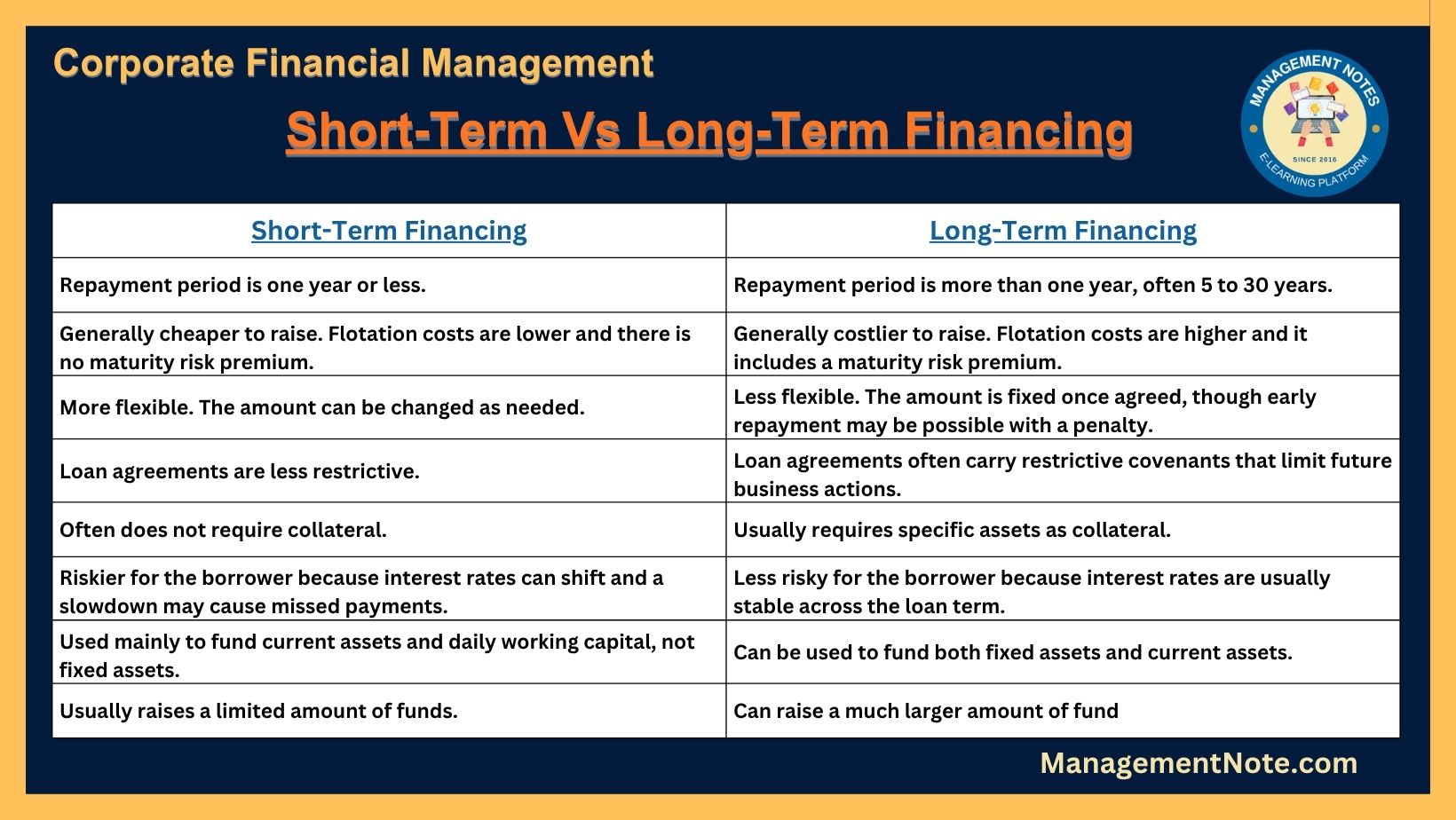
Detailed Comparison Table: Short-Term Vs Long-Term Financing
| S.No. | Short-Term Financing | Long-Term Financing |
|---|---|---|
| 1 | Repayment period is one year or less. | Repayment period is more than one year, often 5 to 30 years. |
| 2 | Generally cheaper to raise. Flotation costs are lower and there is no maturity risk premium. | Generally costlier to raise. Flotation costs are higher and it includes a maturity risk premium. |
| 3 | More flexible. The amount can be changed as needed. | Less flexible. The amount is fixed once agreed, though early repayment may be possible with a penalty. |
| 4 | Loan agreements are less restrictive. | Loan agreements often carry restrictive covenants that limit future business actions. |
| 5 | Often does not require collateral. | Usually requires specific assets as collateral. |
| 6 | Riskier for the borrower because interest rates can shift and a slowdown may cause missed payments. | Less risky for the borrower because interest rates are usually stable across the loan term. |
| 7 | Used mainly to fund current assets and daily working capital, not fixed assets. | Can be used to fund both fixed assets and current assets. |
| 8 | Usually raises a limited amount of funds. | Can raise a much larger amount of funds. |
How to Choose Between Short-Term and Long-Term Financing
A simple rule used by finance managers is the matching principle. This means the length of the financing should match the life of what it is paying for.
- If the need is short, like buying stock for a sale, use short-term financing.
- If the need is long, like buying a building that will last 20 years, use long-term financing.
Ask these questions before choosing:
- How soon do I need the funds?
- What am I using the funds for, daily costs or a big asset?
- How much risk can my business handle if interest rates change?
- Do I have collateral to offer?
- How fast do I need approval?
Real-Life Example: Choosing the Right Financing
A small bakery wants to do two things this year. First, it needs $10,000 to buy extra flour and sugar before a busy holiday season. Second, it wants to open a new branch, which will cost $200,000 for the building and ovens.
For the flour and sugar, the bakery uses a short-term line of credit. It borrows only when needed and repays it within a few months after holiday sales come in.
For the new branch, the bakery applies for a 10-year SBA loan. This spreads the large cost over many years, matching the loan term to the long life of the building and equipment.
This example shows why businesses often use both types of financing together, not just one.
Frequently Asked Questions
What is the main difference between short-term and long-term financing?
Short-term financing is repaid within one year and covers daily needs. Long-term financing is repaid over more than one year and covers big investments like buildings or equipment.
Which is riskier, short-term or long-term financing?
Short-term financing carries more risk for the borrower because interest rates and repayment demands can change quickly. Long-term financing is more stable but carries a higher total cost over time.
What are examples of short-term financing?
Trade credit, bank overdrafts, short-term bank loans, lines of credit, commercial paper, invoice factoring, inventory financing, and business credit cards.
What are examples of long-term financing?
Term loans, bonds, mortgage loans, common stock, preferred stock, retained earnings, and leasing.
Is a mortgage short-term or long-term financing?
A mortgage is long-term financing. It is usually repaid over 10 to 30 years and is secured against real estate.
Can a business use both short-term and long-term financing at the same time?
Yes. Most businesses use a mix. Short-term financing covers daily cash needs, while long-term financing funds major growth plans.
Why is short-term financing usually cheaper than long-term financing?
It is cheaper overall because it is repaid quickly, has lower setup costs, and does not include a maturity risk premium, even though its interest rate can look higher on paper.
What is the matching principle in financing?
It is the idea that the length of financing should match the life of the asset or need it pays for. Short needs get short-term funds. Long needs get long-term funds.
Short-Term Vs Long-Term Financing MCQs
Q1. Which of the following is an example of short-term financing?
a) Debenture b) Mortgage loan c) Trade credit d) Common stock
Answer: c) Trade credit. Trade credit lets a buyer pay a supplier later, usually within 30 to 90 days. The other three options all run for many years, which makes them long-term sources.
Q2. On a company’s balance sheet, short-term financing is recorded as a:
a) Fixed asset b) Current liability c) Owner’s equity d) Long-term liability
Answer: b) Current liability. Anything that must be repaid within one year is grouped as a current liability. Long-term financing, by contrast, is recorded as a long-term liability or as equity.
Q3. Which statement about the cost of financing is correct?
a) Long-term financing is always cheaper than short-term financing b) Short-term financing usually costs less overall, even though its interest rate looks higher c) Both types always cost the same d) Short-term financing never carries any interest
Answer: b. Short-term financing often has a higher quoted rate, but since it is repaid quickly and skips extra costs like a maturity risk premium, its total cost is usually lower. Long-term financing can carry a lower annual rate but a higher total cost over time.
Q4. Compared with long-term financing, short-term financing usually carries:
a) Decreased interest rate risk and increased credit risk b) Increased interest rate risk and increased credit risk c) Increased interest rate risk and decreased credit risk d) Decreased interest rate risk and decreased credit risk
Answer: c. Short-term financing needs frequent renewal, which exposes it to sudden interest rate swings. Long-term financing locks in funding for years, which lowers the risk that a lender will refuse to renew it, even though more can go wrong for the borrower over a longer period.
Q5. A company wants to buy a factory that will operate for 25 years. Which type of financing fits best?
a) A bank overdraft b) A business credit card c) A long-term bank loan or bond d) Trade credit
Answer: c) A long-term bank loan or bond. This follows the matching principle. The length of the financing should match the useful life of the asset it pays for. A 25-year asset needs long-term funding, not a short-term source.
Q6. Which of these is used to cover a temporary rise in inventory before a busy season?
a) A 20-year mortgage b) Common stock c) A short-term line of credit d) A corporate bond
Answer: c) A short-term line of credit. The need is temporary and will be resolved once the season’s sales bring in cash, so a short-term source is the right fit. A 20-year mortgage or a bond would lock the business into years of unnecessary repayment.
Q7. Which of the following best describes long-term financing?
a) Funds repaid within 90 days, used for daily expenses b) Funds repaid over more than one year, used for major investments c) Funds that never need to be repaid under any circumstance d) Funds only available to individuals, not businesses
Answer: b. Long-term financing runs for more than a year, often 5 to 30 years, and is used for big goals like buying property, equipment, or expanding operations.
Q8. Why do long-term loans usually require collateral more often than short-term loans?
a) Because long-term loans involve larger amounts and longer repayment periods, which raises lender risk b) Because short-term loans are illegal without collateral c) Because collateral is only needed for personal loans, not business loans d) There is no real difference in collateral requirements
Answer: a. A lender takes on more risk when money is tied up for many years, so it usually asks for collateral, such as property or equipment, to protect against default. Short-term loans are repaid quickly, so lenders are often willing to skip this requirement.
Conclusion
Both short-term and long-term financing play important roles in running a business. Short-term financing keeps daily operations moving, while long-term financing builds the future through big investments.
The right mix depends on what the money is for, how long it is needed, and how much risk a business can handle. Smart business owners rarely pick just one. They use both together to stay steady today and grow tomorrow.
References
- U.S. Small Business Administration (SBA), current loan program data
- Britannica Money, Business Finance: Short-Term Financing
- OpenStax Introduction to Business (Lumen Learning), Obtaining Short-Term Financing and Raising Long-Term Financing
- Bankrate, SBA Loan Rates 2026
- NerdWallet, SBA Loan Rates 2026
- Prudential Private Capital (PGIM), The Benefits of Long-Term vs. Short-Term Financing
You May Also Like:
You may also like:

MBA- Finance Specialization
I am Smirti Bam, an enthusiastic edu blogger with a passion for sharing insights into the dynamic world of business and management through this website.
I hold a MBA degree from Presidential Business School, Kathmandu, and a BBA degree with a specialization in Finance from Apex College,
- Onboarding Vs. Orientation: Key Differences, Benefits, Process & Best Practices | Human Resource Management (HRM) - September 24, 2026
- Moonlighting Vs Freelancing: Meaning, Differences & Risks Explained | Human Resource Management (HRM) - September 14, 2026
- Employee Retention Vs. Employee Engagement: Key Differences Explained | Human Resource Management - September 6, 2026


I like your writing