
Corporate Social Responsibility (CSR): Meaning, Types, and Real Examples | Business Management & Society
Corporate social responsibility (CSR) is the idea that a business owes something back to the people and places it affects. This includes shareholders, customers, workers, the government, and the community. A company that practices CSR does not just chase profit. It also protects the environment and supports the well-being of society.
Corporate social responsibility means a business takes care of its shareholders, customers, employees, government, and community, not just its profits.
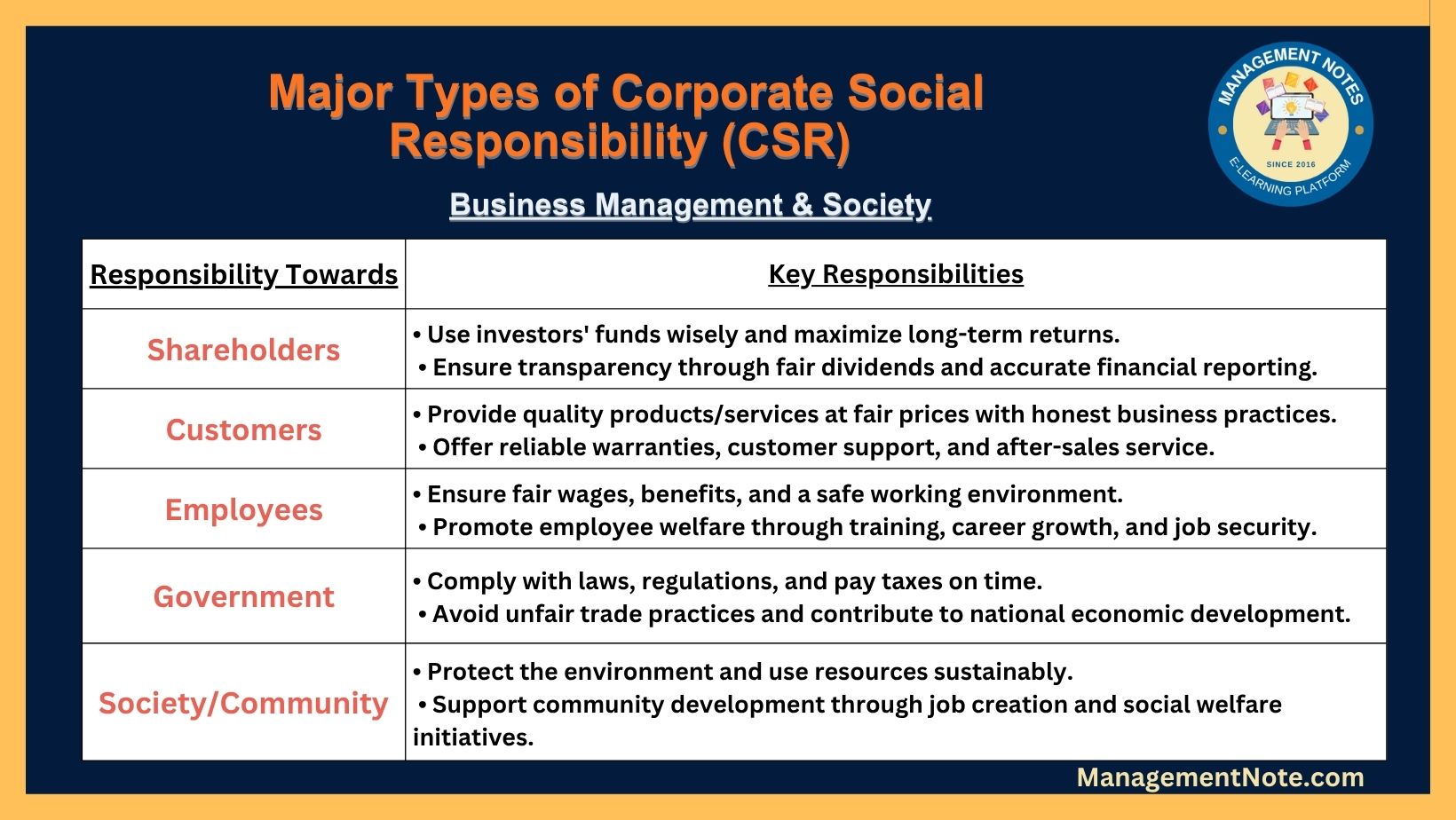
There are five main types of CSR: responsibility to shareholders, responsibility to customers, responsibility to employees, responsibility to government, and responsibility to society. Companies that follow CSR build more trust, keep customers longer, and lower business risk.
What Is Corporate Social Responsibility?
CSR is a business approach where a company balances making money with doing good. This can mean cutting pollution, paying fair wages, giving back to local communities, or being honest with customers and investors.
Governments, watchdog groups, and everyday shoppers now expect this kind of behavior from big and small businesses alike.
Below are the five major areas of corporate social responsibility.
1. Responsibility Toward Shareholders
Shareholders put their own money into a business and take on financial risk. In return, they expect the company to grow and pay them back fairly.

A responsible company should:
- Use investor money wisely and avoid waste
- Pay fair dividends (a share of profits paid to investors)
- Offer fair interest on money the company borrows from investors
- Share clear, up-to-date financial reports
- Grow the value of the investment over time
- Let shareholders take part in major planning and policy decisions
Example: A publicly traded company that holds regular shareholder meetings and publishes honest quarterly earnings reports is meeting this responsibility.
2. Responsibility Toward Customers
Customers are the reason a business exists. Without happy customers, no company can survive long term.

A responsible company should:
- Sell quality products at a fair price
- Keep enough stock so customers can get what they need
- Treat buyers with respect and honesty
- Avoid unfair tricks like price gouging or hoarding goods (black marketing)
- Offer solid after-sales support and customer service
Example: A phone brand that offers a real warranty, honest advertising, and quick repair service is practicing customer-focused CSR.
3. Responsibility Toward Employees
A company’s success depends on its workers. Employees are not just staff. They are one of the business’s most valuable assets.

A responsible company should:
- Offer secure, meaningful jobs
- Pay fair wages and benefits
- Provide welfare support like health coverage, education help, or recreation programs
- Build a safe, positive workplace
- Invest in training and career growth
Example: A company that offers paid parental leave, safety training, and clear paths for promotion is investing in employee-focused CSR.
4. Responsibility Toward Government
Businesses operate under laws set by the government. In return, the government protects the business environment and keeps the market fair.

A responsible company should:
- Follow all local, state, and federal laws
- Pay required taxes on time, such as income tax and sales tax
- Avoid monopolies and unfair trade practices
- Support national efforts like reducing unemployment and poverty
Example: A company that reports its earnings honestly and pays taxes without delay is fulfilling its duty to the government.
5. Responsibility Toward Society or Community
A business does not operate in a bubble. It exists inside a community, and its long-term success depends on that community doing well too.

A responsible company should:
- Create local jobs
- Protect the environment and natural resources
- Use community resources responsibly
- Support local programs and charities
- Respect local culture and social values
Example: A manufacturer that funds a local school program or reduces factory emissions is showing community-focused CSR.
Comparison Table: The 5 Types of CSR
| Type of CSR | Who Benefits | Main Actions |
|---|---|---|
| Shareholder Responsibility | Investors | Fair dividends, honest reports, growing investment value |
| Customer Responsibility | Buyers | Quality goods, fair pricing, good service |
| Employee Responsibility | Workers | Fair pay, safety, training, benefits |
| Government Responsibility | The state | Paying taxes, following laws, avoiding unfair practices |
| Society Responsibility | The community | Local jobs, environmental care, community programs |
Why CSR Matters: The Numbers
CSR is not just a feel-good idea. It affects real business results.
- Nearly 90% of S&P 500 companies published a CSR report in 2019, up from about 20% in 2011, showing how fast CSR reporting has grown among major US firms (Harvard Business School Online, 2021).
- A large share of consumers say it is no longer acceptable for companies to focus on profit alone, without also thinking about society (Harvard Business School Online, 2021).
- Companies with strong CSR programs often see better customer loyalty and stronger brand trust (Corporate Finance Institute, 2023).
Frequently Asked Questions
What is corporate social responsibility in simple terms?

Corporate social responsibility is when a business looks after the people and environment connected to it, not just its profits. This includes shareholders, workers, customers, the government, and the local community.
What are the 4 main types of corporate social responsibility?

Many experts group CSR into four categories: environmental responsibility, ethical responsibility, philanthropic responsibility, and economic responsibility. This guide expands on that idea by breaking CSR down by who it serves: shareholders, customers, employees, government, and society.
Why is CSR important for a business?

CSR builds trust with customers, attracts better employees, lowers legal and reputation risks, and can improve long-term profit. It also helps a company stay in line with government rules and community expectations.
What is an example of corporate social responsibility?

Common examples include paying fair wages, reducing factory pollution, donating to local schools, offering honest product warranties, and publishing clear financial reports for investors.
Is CSR the same as ESG?

No. CSR is a broader idea about a company’s social duties. ESG stands for Environmental, Social, and Governance, and it is a more structured framework investors use to measure a company’s CSR performance with specific metrics.
Who benefits from corporate social responsibility?

Shareholders, customers, employees, the government, and the wider community all benefit from strong CSR practices. Even the company benefits through better reputation and lower risk.
(Disclaimer: This article is for general informational purposes only. It is not legal, financial, or investment advice. Businesses should consult a qualified professional before making decisions based on CSR practices, tax rules, or investment strategy.)
References
Corporate Finance Institute Team. (2023, November 17). Corporate social responsibility (CSR). Corporate Finance Institute. https://corporatefinanceinstitute.com/resources/esg/corporate-social-responsibility-csr/
Harvard Business School Online. (2021, June 15). 15 eye-opening corporate social responsibility statistics. Harvard Business School Online Blog. https://online.hbs.edu/blog/post/corporate-social-responsibility-statistics
Reckmann, N. (2023, September 5). What is corporate social responsibility? Business News Daily. https://www.businessnewsdaily.com/4679-corporate-social-responsibility.html

MBA- Finance Specialization
I am Smirti Bam, an enthusiastic edu blogger with a passion for sharing insights into the dynamic world of business and management through this website.
I hold a MBA degree from Presidential Business School, Kathmandu, and a BBA degree with a specialization in Finance from Apex College,
- Onboarding Vs. Orientation: Key Differences, Benefits, Process & Best Practices | Human Resource Management (HRM) - September 24, 2026
- Moonlighting Vs Freelancing: Meaning, Differences & Risks Explained | Human Resource Management (HRM) - September 14, 2026
- Employee Retention Vs. Employee Engagement: Key Differences Explained | Human Resource Management - September 6, 2026


Black on black in the Charg I’m creepin’ Rub me the right way, you might get a genie B.o.B, black Houdini