
Managerial Skills – Technical Skill, Human Skill and Conceptual Skill | Principles of Management
In the dynamic landscape of modern business, effective management is more than a title, it is a set of developed abilities that enable leaders to make sound decisions, guide teams, and achieve organizational goals.
The foundation of successful management lies in managerial skills, which equip managers to tackle challenges, inspire performance, and drive growth.
This comprehensive article explores the three primary managerial skills (Technical Skill, Human Skill, and Conceptual Skill) within the framework of the Principles of Management, enriched with insights from multiple credible sources and structured to support both learning and search engine optimization.
What Are Managerial Skills?
Managerial skills are defined as the abilities that managers use to perform their roles effectively in planning, organizing, leading, and controlling organizational resources.
These skills are not innate; rather, they can be developed through education, practical experience, and intentional practice. Katz’s seminal work on managerial skills remains a cornerstone in management studies, establishing that managers must cultivate a balance of essential skill sets to perform effectively at various levels of responsibility.
Managerial skills are crucial because they determine how effectively a manager implements strategies, leads teams, and navigates the complexity of organizational environments.
These skills influence not only performance outcomes but also employee satisfaction and organizational adaptability.
3 Core Managerial Skills
1)Technical Skill
Technical skill refers to a manager’s proficiency in applying knowledge, tools, techniques, and procedures that are necessary to perform specialized tasks related to a particular field or function.

This skill involves:
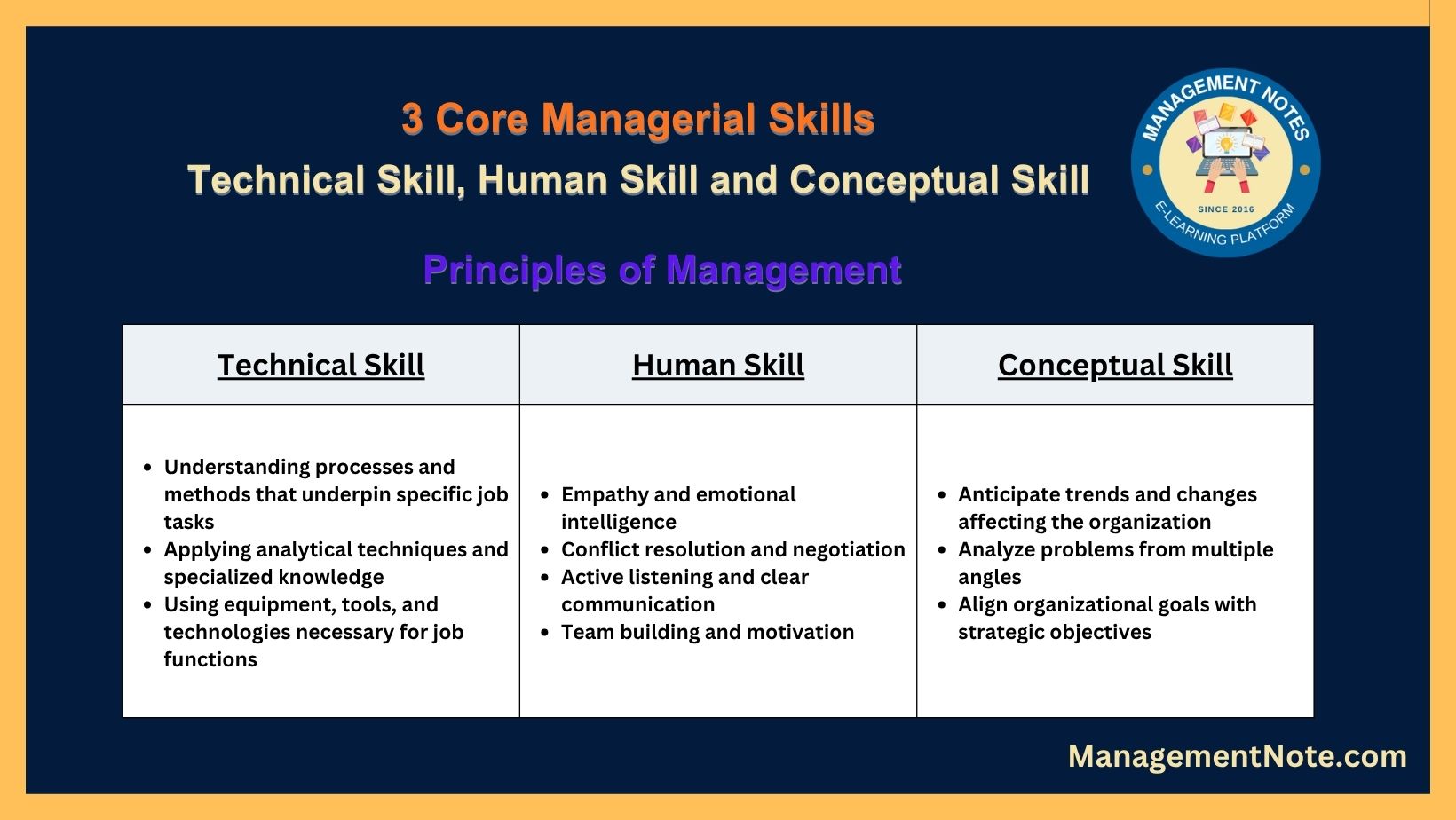
- Understanding processes and methods that underpin specific job tasks
- Applying analytical techniques and specialized knowledge
- Using equipment, tools, and technologies necessary for job functions
Technical skills enable managers to guide, train, and support employees effectively. These skills are most vital for first‑line and lower‑level managers, who are directly involved in operational tasks and close to the workflow of teams.
For example, a manufacturing supervisor must know the mechanics of production equipment, while an IT manager needs expertise in networking and system administration.
In both cases, technical skills help managers understand the “how” of work activities, which builds credibility and enhances their ability to lead personnel successfully.
2) Human Skill
Human skill, often called interpersonal or people skill, is the ability to understand, communicate with, motivate, and lead others. This skill reflects a manager’s capacity to work with individuals and groups within the workplace.

Human skills include:
- Empathy and emotional intelligence
- Conflict resolution and negotiation
- Active listening and clear communication
- Team building and motivation
This set of skills is vital at all levels of management, but is most emphasized in middle management, where interaction with employees, superiors, and subordinates is frequent.
Managers with strong human skills are able to foster collaboration, encourage trust, and build cohesive teams, which ultimately enhances productivity and morale.
Effective human skills also empower managers to navigate interpersonal conflicts, respond constructively to feedback, and support employee growth—making them indispensable in today’s team‑centric work environments.
3) Conceptual Skill
Conceptual skill is the ability to think strategically, analyze complex situations, and understand how different parts of an organization interrelate. It involves seeing the broader context in which the organization operates, including how internal processes link with external environments.

This skill enables managers to:
- Anticipate trends and changes affecting the organization
- Analyze problems from multiple angles
- Align organizational goals with strategic objectives
Conceptual skills are especially critical for top‑level managers, such as CEOs and executives, who are responsible for long‑term vision, strategic planning, and organizational direction.
These skills help leaders make decisions that balance organizational interests with stakeholder needs and external market forces.
For example, conceptual skills allow top managers to forecast future challenges, integrate cross‑departmental insights, and design adaptive strategies to navigate shifting market conditions.
Relative Importance of Skills Across Management Levels
The emphasis placed on each managerial skill varies according to the level of management within an organization:
- Lower‑level managers: Rely heavily on technical skills and need solid human skills, while conceptual skills are used less often.
- Middle managers: Require a balanced mix of technical, human, and conceptual skills to translate strategy into operational action.
- Top managers: Focus predominantly on conceptual and human skills, using technical skills less frequently due to delegation.
Visualizing this progression helps clarify why skill development must evolve as managers advance in their careers: initial emphasis on learning how work is done shifts toward shaping how the organization works as a whole.
Why Managerial Skills Matter?
Managerial skills are not static; they influence how managers adapt to challenges, guide teams, and create value. Organizations with skilled managers are better positioned to:
- Navigate complexity and change
- Foster innovation and organizational learning
- Improve employee engagement and retention
- Enhance operational performance and strategic alignment
The interplay between technical knowledge and interpersonal insight means that a manager’s effectiveness often extends beyond task completion to team alignment and future‑focused decision‑making.
Developing Technical Skills
To strengthen technical skills, managers can:
- Participate in specialized training and certification programs
- Engage in hands‑on professional experiences
- Stay updated with industry‑specific technologies and tools
These actions help managers maintain competence in evolving work practices, especially in technical domains where advancements occur rapidly.
Enhancing Human Skills
Human skill development often involves:
- Practicing active listening and empathy
- Pursuing leadership and communication workshops
- Soliciting and applying feedback for continuous improvement
Managers with high human competency are better equipped to resolve conflicts, motivate teams, and build sustainable work cultures.
Building Conceptual Skills
Conceptual skills are developed through:
- Strategic thinking exercises and scenario planning
- Exposure to senior leadership challenges
- Cross‑functional collaboration and big‑picture analysis
These activities help managers step beyond routine tasks and contribute meaningfully to an organization’s long‑term success.
Intersection With Artificial Intelligence
The rise of Artificial Intelligence (AI) is influencing how managerial skills are practiced. While AI tools can automate routine tasks and provide data‑driven insights, they do not replace the core competencies of human managers:
- Technical skills evolve to include AI tool literacy
- Human skills gain importance in areas where AI cannot replicate emotional intelligence and motivation
- Conceptual skills are strengthened by interpreting nuanced strategic insights from complex datasets
In this way, AI augments managerial effectiveness rather than diminishing the value of foundational skills.
Final Note:
Managerial skills—technical, human, and conceptual—remain essential pillars of effective leadership within the Principles of Management. Each skill set serves a distinct purpose:
- Technical skills ground managers in the practical execution of tasks.
- Human skills enable leaders to inspire and empower people.
- Conceptual skills guide strategic vision and long‑term decisions.
Understanding these skills, their development, and their application at various management levels is critical to building leadership capacity in any organization.
References
Holmberg‑Wright, K., & Hribar, T. (2019). Soft skills‑The missing piece for entrepreneurs to grow a business. American Journal of Management, 16(1), 11‑18.
OpenStax. (2018). Managerial skills. In Introduction to Business. Rice University.
CivilServiceIndia. (n.d.). Managerial skills, managerial functional skills.
CEOpedia. (n.d.). Managerial skill.
Management Student Manual (Nevada POST). (n.d.). Managerial skills summary.
UKEssays. (n.d.). Importance of management skills.

MBA- Finance Specialization
I am Smirti Bam, an enthusiastic edu blogger with a passion for sharing insights into the dynamic world of business and management through this website.
I hold a MBA degree from Presidential Business School, Kathmandu, and a BBA degree with a specialization in Finance from Apex College,
- Onboarding Vs. Orientation: Key Differences, Benefits, Process & Best Practices | Human Resource Management (HRM) - September 24, 2026
- Moonlighting Vs Freelancing: Meaning, Differences & Risks Explained | Human Resource Management (HRM) - September 14, 2026
- Employee Retention Vs. Employee Engagement: Key Differences Explained | Human Resource Management - September 6, 2026


You made some really good facts here. I am going to try and follow your site because you have definately shown me a few important things fella. Peace and blessing!!