
What Is a Sole Proprietorship? Definition, Characteristics, Pros and Cons (2026 Guide)
A sole proprietorship is a business owned and run by one person. There is no legal line between the owner and the business. This makes it the simplest and most common business type in the United States. According to the U.S. Small Business Administration, a sole proprietorship is an unincorporated business owned by one person, and it is the easiest business structure to set up (U.S. Small Business Administration, n.d.).
The person who runs this kind of business is called a sole trader or sole proprietor. Many small shops, freelancers, consultants, and home-based businesses use this structure because it is cheap and simple to start.
This structure is by far the most common in the country. The U.S. Census Bureau reported 30,427,808 nonemployer businesses (mostly sole proprietorships) in 2023, up from 29,811,495 in 2022, bringing in nearly $1.8 trillion in revenue, which was 6.4% of the nation’s GDP that year (U.S. Census Bureau, 2026).
The Small Business Administration’s Office of Advocacy found that small businesses make up 99.9% of all U.S. businesses, and nonemployer firms alone account for about 84% of that total (U.S. Small Business Administration, Office of Advocacy, 2025).
In this guide, you will learn the main characteristics of a sole proprietorship, real IRS and Census data on how these businesses perform, the advantages and disadvantages, how sole proprietor taxes work in 2026, and answers to the most common questions people ask about this business type.
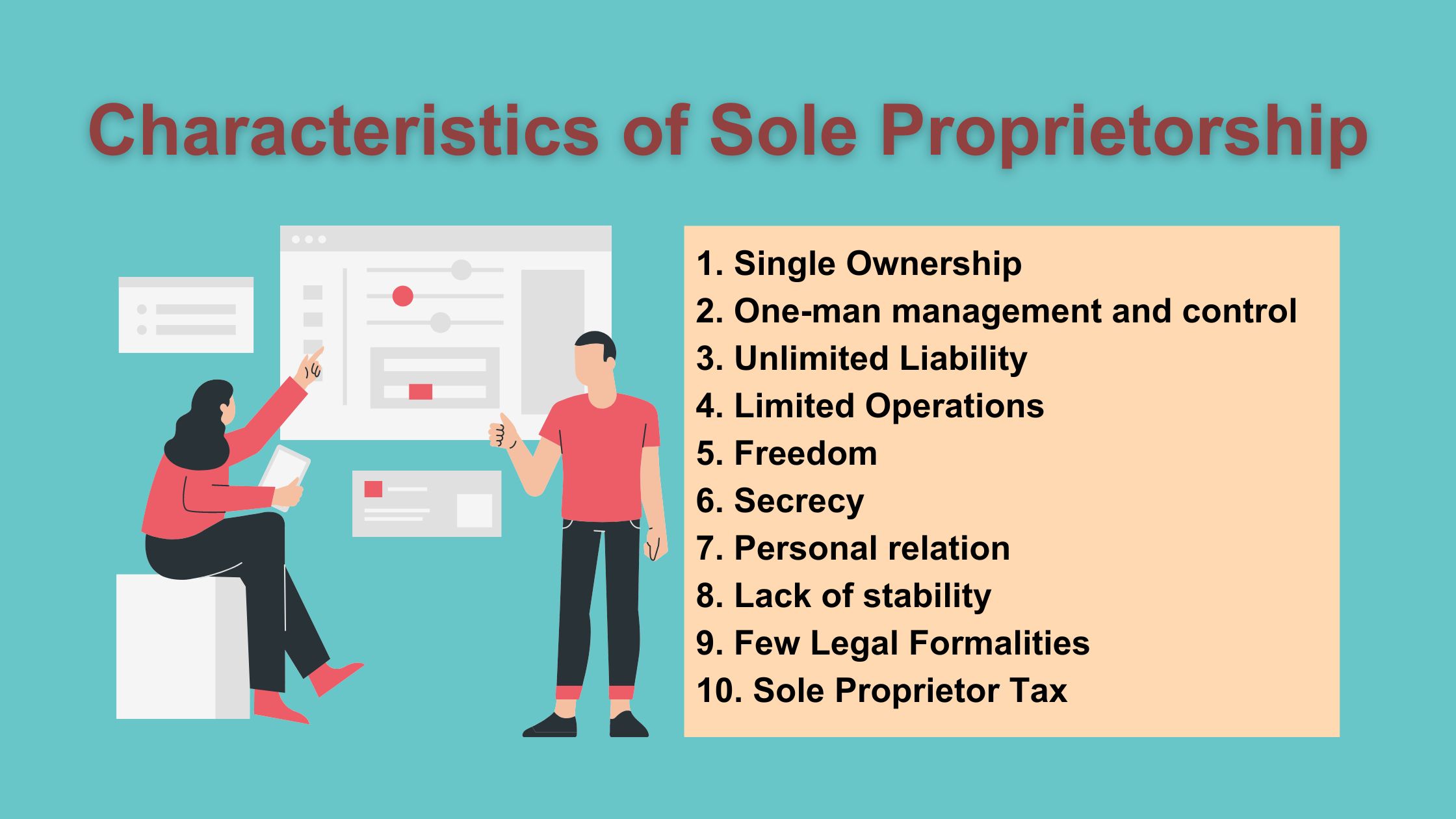
Key Characteristics of a Sole Proprietorship
1) Single Ownership
Only one person owns a sole proprietorship. That person puts in the money, either from savings or by borrowing it. Unlike a partnership or a corporation, where many people share ownership, a sole proprietorship has just one owner. This gives the owner full control over every decision.
2) One-Person Management and Control
The owner manages the whole business alone. There are no partners or shareholders to check with. This means the owner can make fast decisions and act on new ideas right away.
Quick decision-making is one of the biggest advantages of a sole proprietorship, especially for small businesses that need to adjust fast to market changes.
3) Unlimited Liability
This is the biggest risk of a sole proprietorship. The owner is personally responsible for all business debts. If the business cannot pay what it owes, creditors can go after the owner’s personal property, such as a house, car, or savings. This is called unlimited liability, and it is a key difference between a sole proprietorship and an LLC (Limited Liability Company), which protects personal assets.
- No sharing of profit or loss: The owner keeps all the profit but also carries all the loss alone.
- No separate legal entity: The law does not see the business and the owner as two different things. All contracts and debts are in the owner’s name.
4) Limited Operations
A sole proprietorship usually has limited money and limited staff. It often serves a local area only, since one person can only manage so much.
Many owners handle this by focusing on a niche market, such as a local bakery or a freelance graphic design service, where personal skill matters more than size.
5) Freedom and Flexibility
The owner can start or close the business anytime, with very little paperwork. They can grow, shrink, or change the business as they wish, as long as it follows the law.
This flexibility lets sole proprietors respond quickly to customer needs without waiting for approval from a board or partner.
6) Secrecy
A sole proprietor does not have to share financial reports in public, unlike corporations that must publish accounts. This lets the owner keep business plans, prices, and strategies private, which can help against competitors.
7) Personal Relationships
Sole proprietors often build close ties with their customers. A local doctor’s clinic or a neighborhood store is a good example. This personal touch can build trust and repeat business, and employees often feel more connected to a boss they see every day.
8) Lack of Stability
A sole proprietorship depends on one person. If the owner dies, retires, or becomes unable to work, the business usually ends too. This is different from a corporation, which can keep running even if ownership changes.
9) Few Legal Formalities
Starting a sole proprietorship is simple. In most U.S. states, you do not need to file special formation papers the way you do for an LLC or corporation.
You may still need a business license, a DBA (Doing Business As) name filing, and an Employer Identification Number (EIN) if you plan to hire workers (Internal Revenue Service, 2024).
10) Sole Proprietor Taxes
A sole proprietor is self-employed. This means:
- Business profit or loss is reported on the owner’s personal tax return, using Schedule C (Form 1040) (Internal Revenue Service, 2024).
- The business itself is not taxed separately. This is called pass-through taxation.
- The owner must also pay self-employment tax for Social Security and Medicare. For 2026, this tax stays at 15.3%, made up of 12.4% for Social Security and 2.9% for Medicare (Internal Revenue Service, 2024).
- The 12.4% Social Security part only applies up to the yearly wage base. For 2026, the Social Security Administration set this wage base at $184,500, up from $176,100 in 2025 (Social Security Administration, 2025). Earnings above this amount are not taxed for Social Security, though the 2.9% Medicare part has no cap.
- Owners earning more than $200,000 as a single filer (or $250,000 filing jointly) also owe an extra 0.9% Additional Medicare Tax on income above that level (Internal Revenue Service, 2024).
- The owner can deduct half of the self-employment tax on their personal return, which lowers taxable income.
- Owners can also deduct normal business expenses, such as home office costs, supplies, and business mileage, to lower taxable income further.
Sole Proprietorship Statistics (Verified Data)
Real numbers help show how big this business type is in the United States.
- 31.0 million tax returns reported sole proprietorship activity for tax year 2022, the most recent year with full IRS data (Dungan & Snyder, 2025).
- Total business receipts reached $2,080 billion in 2022, up 11.4% from the year before (Dungan & Snyder, 2025).
- Nonfarm sole proprietorship profits totaled $410.7 billion in 2022 (Dungan & Snyder, 2025).
- The construction sector brought in the most receipts of any industry, at $377.1 billion (Dungan & Snyder, 2025).
- By 2023, nonemployer businesses (mostly sole proprietors) grew to over 30.4 million, earning close to $1.8 trillion in total revenue (U.S. Census Bureau, 2026).
- Nonemployer businesses made up 78.4% of all U.S. business establishments in 2023 (U.S. Census Bureau, 2026).
These numbers show that sole proprietorships are not just a “starter” business type. They form the backbone of the U.S. small business economy.
Sole Proprietorship vs. LLC: Quick Comparison
| Feature | Sole Proprietorship | LLC |
|---|---|---|
| Ownership | One person | One or more people |
| Liability | Unlimited (personal assets at risk) | Limited (personal assets usually protected) |
| Setup cost | Very low | Moderate, with state filing fees |
| Paperwork | Minimal | State registration and annual reports |
| Taxes | Pass-through, Schedule C | Pass-through by default, can choose corporate tax |
| Business lifespan | Ends when owner stops | Can continue after ownership changes |
Real-Life Examples of Sole Proprietorships
- A freelance writer working from home
- A local hair salon owned by one stylist
- A independent plumber or electrician
- An online Etsy shop run by one person
- A small neighborhood grocery store
Advantages and Disadvantages of Proprietorship
Advantages
- Easy and cheap to start
- Full control over decisions
- Owner keeps all profits
- Simple tax filing
- High privacy
Disadvantages
- Unlimited personal liability
- Hard to raise large amounts of money
- Business ends if owner cannot continue
- Heavy workload falls on one person
- Limited growth compared to corporations
Frequently Asked Questions (FAQs)
What is a sole proprietorship in simple words?
A sole proprietorship is a business owned and run by just one person, with no legal separation between the owner and the business.
What are the main characteristics of a sole proprietorship?
The main characteristics are single ownership, one-person control, unlimited liability, easy setup, few legal rules, and pass-through taxation.
Is a sole proprietorship the same as being self-employed?
Yes. A sole proprietor is a type of self-employed person who owns an unincorporated business by themselves.
What is the biggest disadvantage of a sole proprietorship?
The biggest disadvantage is unlimited liability. The owner’s personal property can be used to pay business debts.
Do sole proprietors pay self-employment tax?
Yes. Sole proprietors pay self-employment tax for Social Security and Medicare, along with regular income tax on business profit.
Do I need to register a sole proprietorship?
In most states, you do not need to file formation papers, but you may need a business license or a DBA name filing if you use a name other than your own.
Can a sole proprietorship have employees?
Yes. A sole proprietor can hire employees. They will need an Employer Identification Number (EIN) from the IRS to do payroll.
What is the difference between a sole proprietorship and an LLC?
An LLC gives the owner limited liability, meaning personal assets are usually protected. A sole proprietorship does not offer this protection.
How does a sole proprietor pay taxes?
A sole proprietor reports business income and expenses on Schedule C, which is attached to their personal Form 1040 tax return.
Can a sole proprietorship become a corporation later?
Yes. Many businesses start as sole proprietorships and later convert to an LLC or corporation as they grow and need liability protection or outside investors.
How many sole proprietorships are there in the United States?
The U.S. Census Bureau counted over 30.4 million nonemployer businesses, most of them sole proprietorships, in 2023 (U.S. Census Bureau, 2026).
What is the Social Security wage base for self-employed people in 2026?
For 2026, the Social Security wage base is $184,500. Self-employed people pay 12.4% Social Security tax up to that amount, plus 2.9% Medicare tax with no cap (Social Security Administration, 2025).
References
Dungan, A., & Snyder, A. (2025). Sole proprietorship returns, tax year 2022. SOI Bulletin, 44(4). Internal Revenue Service. https://www.eitc.irs.gov/pub/irs-access/p1136_accessible.pdf
Internal Revenue Service. (2024). Sole proprietorships. U.S. Department of the Treasury. https://www.irs.gov/businesses/small-businesses-self-employed/sole-proprietorships
Social Security Administration. (2025, October 24). Social Security announces 2.8 percent benefit increase for 2026 [Press release]. https://www.ssa.gov/news/en/press/releases/2025-10-24.html
U.S. Census Bureau. (2026, May 4). Census Bureau provides resources, data tools, website for small businesses. https://www.census.gov/library/stories/2026/05/small-business-week.html
U.S. Small Business Administration, Office of Advocacy. (2025). 2025 small business profile: United States. https://advocacy.sba.gov/wp-content/uploads/2025/06/United_States_2025-State-Profile.pdf
U.S. Small Business Administration. (n.d.). Choose a business structure. https://www.sba.gov/business-guide/launch-your-business/choose-business-structure
Disclaimer: This article is for general informational purposes only and does not constitute legal, tax, or financial advice. Please consult a licensed accountant or attorney for guidance specific to your business.

MBA- Finance Specialization
I am Smirti Bam, an enthusiastic edu blogger with a passion for sharing insights into the dynamic world of business and management through this website.
I hold a MBA degree from Presidential Business School, Kathmandu, and a BBA degree with a specialization in Finance from Apex College,
- Moonlighting Vs Freelancing: Meaning, Differences & Risks Explained | Human Resource Management (HRM) - September 14, 2026
- Employee Retention Vs. Employee Engagement: Key Differences Explained | Human Resource Management - September 6, 2026
- Talent Acquisition Vs Talent Management: What Is the Difference? - September 2, 2026


Pingback: Characteristics of Partnership Business - Finance | Management Notes