
Terminal Warehouse Receipt Loans: The Complete Guide to Inventory Financing (2026 Update | Short Term Financing
A terminal warehouse receipt loan is a short term business loan backed by goods that are moved off the borrower’s property and stored inside a public warehouse (called a terminal warehouse). The public warehouse company checks the goods and gives a warehouse receipt.
This receipt is a legal paper that proves the goods exist and shows who owns them. The lender holds this receipt. The lender only lets the warehouse release the goods after the borrower pays back part of the loan.
Because the goods are stored far away from the borrower, the lender has more control and more safety than with most other types of inventory loans.
This guide explains what a terminal warehouse receipt loan is, how it is different from a field warehouse loan, and how it fits into the bigger picture of inventory financing.
What Is Inventory Financing?
Inventory financing is a way for a business to borrow money using its stock of goods as collateral. Collateral is something of value that a borrower promises to a lender. If the borrower cannot pay back the loan, the lender can take the collateral and sell it to get the money back.
Businesses use inventory financing when they need cash but do not want to sell their stock right away, or when they need money to buy more raw materials or finished goods. It is very common in industries such as:
- Retail and wholesale
- Manufacturing
- Agriculture and commodity trading
- Auto dealerships
- Import and export trading companies
Inventory financing is a form of short term financing and is often grouped under a wider banking term called asset based lending. In asset based lending, a company borrows against real business assets, such as inventory, equipment, or unpaid customer invoices (accounts receivable), instead of relying only on its credit history.
Lenders like inventory financing because it is secured. If the plan fails, they have something real to fall back on. But lenders also worry about a few things:
- Whether the goods can be sold quickly if needed
- Whether the value of the goods might drop
- Whether the goods are hard to track or count
- Whether the goods might be sold by the borrower without the lender knowing
Because of these worries, banks and finance companies created different types of inventory loans, each with a different level of control. The terminal warehouse receipt loan is the type that gives the lender the highest level of control and safety.
What Is a Warehouse Receipt?
A warehouse receipt is a document issued by a warehouse company after it receives and stores goods. It lists details such as:
- What the goods are
- How much of the goods there are
- The quality or grade of the goods
- Where the goods are stored
- Who owns the goods or has a claim on them
A warehouse receipt is called a document of title. This means the paper itself stands in for the goods. Whoever legally holds the receipt has a claim on the goods described in it.
In the United States, warehouse receipts are covered by Article 7 of the Uniform Commercial Code (UCC). This law explains how warehouse receipts work and how they can be used to move ownership or set up a loan without moving the physical goods.
Negotiable Vs Non-Negotiable Warehouse Receipts
There are two kinds of warehouse receipts, and the difference matters a lot for lenders.
Negotiable warehouse receipt: This receipt can be transferred to someone else just by signing it over (this is called endorsement) and handing it to them, similar to a check made out to “bearer.” Whoever holds a properly negotiated receipt can claim the goods. Because of this, negotiable receipts are widely accepted as loan collateral.
Non-negotiable warehouse receipt: This receipt names one specific person or company as the owner. It cannot be handed over to transfer ownership. To move the goods to someone else, the warehouse must be formally told and instructed to make the change.
Most warehouse receipts used for terminal warehouse receipt loans are negotiable, because this makes it easy and safe for the lender to control the goods.
The Main Types of Inventory Financing
Before going deeper into terminal warehouse receipt loans, it helps to see the full family of inventory financing methods. Banks and textbooks on corporate finance usually list these methods, ranked from the loosest control to the strictest control:
- Floating Lien (Blanket Inventory Lien)
- Chattel Mortgage
- Trust Receipt Financing (also called Floor Plan Financing)
- Field Warehouse Receipt Loan
- Terminal Warehouse Receipt Loan
Let’s look at each one closely. A short summary table follows each type so you can quickly compare them.
1) Floating Lien (Blanket Inventory Lien)
A floating lien is a claim placed by the lender over a company’s entire stock of inventory, without listing each item by name or serial number. As old inventory is sold and new inventory comes in, the lien automatically moves to cover the new stock too. This is sometimes called an “after acquired property” clause under UCC Article 9 in the US.
This method is used when goods are small, low in value per unit, or hard to track one by one, such as clothing, groceries, or small parts.
How it works:
- The lender and borrower sign a security agreement.
- The lender registers the claim (in the US, this is done with a UCC-1 filing).
- The borrower keeps full control of the stock and can sell it in the normal course of business.
- The lender’s claim automatically covers new stock as it arrives.
| Floating Lien: Key Summary | Details |
|---|---|
| Level of lender control | Lowest |
| Physical location of goods | Stay with the borrower |
| Best suited for | Businesses with many small, low value, fast moving items |
| Main risk to lender | Hard to check if the stock really matches the paperwork |
| Common legal tool (US) | UCC Article 9 filing (UCC-1) |
| Typical cost to borrower | Lower cost because lender has less oversight work |
2) Chattel Mortgage
A chattel mortgage is a loan secured against personal property that can be clearly identified, such as by a serial number or a unique tag. “Chattel” is an old legal word for movable property that is not land or buildings. This method works well for costly items that do not sell often, like machines, vehicles, or specific pieces of equipment.
How it works:
- The borrower keeps and uses the property.
- The lender places a mortgage style lien on that named property.
- The borrower cannot sell the specific item without the lender’s permission.
- In Australia, chattel mortgages are a common way for companies and sole traders to fund vehicles and business equipment, and they can carry tax and stamp duty effects under local rules.
| Chattel Mortgage: Key Summary | Details |
|---|---|
| Level of lender control | Medium |
| Physical location of goods | Stay with the borrower, but item is specifically named |
| Best suited for | Machines, vehicles, and equipment with low turnover |
| Main risk to lender | Item’s resale value may drop due to wear or age |
| Common users (Tier 1 countries) | Common in Australia for vehicle and equipment finance |
| Typical cost to borrower | Moderate, depends on asset type and age |
3) Trust Receipt Financing (Floor Plan Financing)
Under trust receipt financing, the lender pays for specific goods, and the borrower holds those goods “in trust” for the lender until they are sold. Each item is tagged and tracked, often by serial number. When an item sells, the borrower must pay the lender back for that item, usually right away.
This method is very common for car dealers, boat dealers, and appliance stores. In that setting it is usually called floor plan financing or floorplanning.
How it works:
- The lender pays the manufacturer directly for the goods (for example, a car).
- The dealer displays and sells the goods to customers.
- When a unit sells, the dealer sends the loan portion back to the lender.
- The lender may run surprise checks, called “floor checks,” to make sure the goods are still there.
| Trust Receipt / Floor Plan Financing: Key Summary | Details |
|---|---|
| Level of lender control | Medium to high |
| Physical location of goods | Stay with the borrower, but each item is tagged |
| Best suited for | Cars, boats, RVs, appliances, and other big ticket items |
| Main risk to lender | “Out of trust” sales, where an item is sold but not reported |
| Common users (Tier 1 countries) | Auto dealers across the US, UK, Canada, and Australia |
| Typical cost to borrower | Moderate, tied closely to how fast items sell |
4) Field Warehouse Receipt Loan
A field warehouse loan is a step up in control from the three methods above. Here, the pledged goods stay on the borrower’s own property, but a section of that property is fenced off, locked, and placed under the legal control of an independent, licensed warehouse company.
Only that outside warehouse company can allow goods in or out, and it only does so with the lender’s approval.
How it works:
- A licensed field warehousing company sets up a “field warehouse” inside the borrower’s building or yard.
- The area is clearly marked, fenced, and often locked or guarded.
- The field warehouse company issues a warehouse receipt for the goods inside the fenced area.
- The lender holds this receipt and only allows release of goods when the borrower repays part of the loan.
- The field warehouse company keeps detailed records of everything going in and out.
Field warehousing became widely used in the United States in the mid 20th century through companies such as the Lawrence Warehouse Company, which pioneered this style of inventory control for banks and finance companies.
| Field Warehouse Receipt Loan: Key Summary | Details |
|---|---|
| Level of lender control | High |
| Physical location of goods | Stay on the borrower’s premises, but in a locked, fenced off area |
| Best suited for | Manufacturers and processors with bulky raw materials or finished goods |
| Main risk to lender | Some risk remains because goods never leave the borrower’s site |
| Common legal tool (US) | Warehouse receipt under UCC Article 7 plus a security agreement under UCC Article 9 |
| Typical cost to borrower | Higher than a floating lien because of on site monitoring fees |
5) Terminal Warehouse Receipt Loan
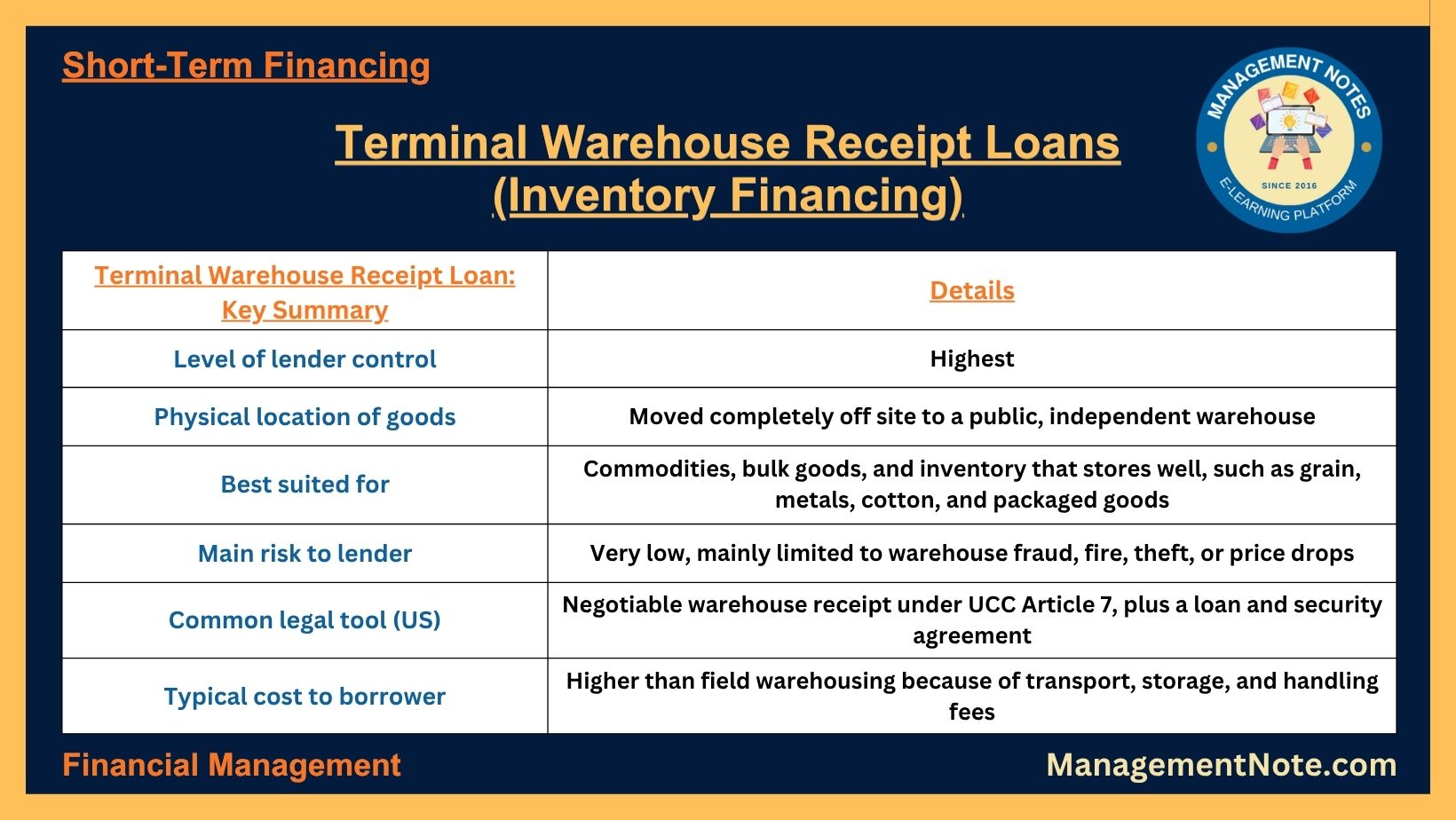
This is the strictest and safest method for the lender. The pledged goods are physically moved away from the borrower’s business and placed inside a public warehouse, also called a terminal warehouse, that has no connection to the borrower’s property.
Because the goods leave the borrower’s control completely, the lender gets the highest level of protection of all the inventory financing methods.
The next full section explains this method step by step.
| Terminal Warehouse Receipt Loan: Key Summary | Details |
|---|---|
| Level of lender control | Highest |
| Physical location of goods | Moved completely off site to a public, independent warehouse |
| Best suited for | Commodities, bulk goods, and inventory that stores well, such as grain, metals, cotton, and packaged goods |
| Main risk to lender | Very low, mainly limited to warehouse fraud, fire, theft, or price drops |
| Common legal tool (US) | Negotiable warehouse receipt under UCC Article 7, plus a loan and security agreement |
| Typical cost to borrower | Higher than field warehousing because of transport, storage, and handling fees |
Terminal Warehouse Receipt Loans Explained in Detail
Definition
A terminal warehouse receipt loan is a secured, short term loan in which the borrower’s inventory is stored in a public warehousing company that is physically separate from the borrower’s business. The public warehouse holds the goods, issues a warehouse receipt, and only releases the goods when the lender says it is allowed.
The terminal warehouse agreement is almost the same as the field warehouse agreement, with one main difference: location. In a field warehouse setup, the goods stay at the borrower’s own site inside a fenced off area. In a terminal warehouse setup, the goods are transported away to an outside, independent warehouse.
Step by Step: How a Terminal Warehouse Receipt Loan Works
1) The borrower chooses goods to pledge. These are usually goods that store well over time, such as grain, cotton, metals, sugar, coffee, timber, or packaged consumer goods.
2) The goods are shipped to a public terminal warehouse. This warehouse is run by an independent company that is not owned by the borrower or the lender.
3) The warehouse inspects, weighs, or grades the goods. This step confirms the quantity and quality of what has actually been stored.
4) The warehouse issues a warehouse receipt. This receipt names the goods, their amount, their grade, and the location where they are held.
5) The borrower gives the warehouse receipt to the lender. The lender now holds legal proof that the goods exist and are safely stored.
6) The lender advances a loan. The loan amount is usually a percentage of the market value of the goods, not the full value, to protect the lender if prices fall.
7) The warehouse will not release any goods without the lender’s written permission. This is the core safety feature of the arrangement.
8) As the borrower repays part of the loan, the lender allows partial release of goods. For example, if a borrower repays 20 percent of the loan, the warehouse may release 20 percent of the stored goods.
9) The loan is fully repaid, and the remaining goods are released, or, if the borrower defaults, the lender can arrange for the goods to be sold to recover the money owed.
10) An insurance policy is normally required, with a loss payable clause naming the lender. This means that if the goods are lost, damaged, or destroyed (for example, in a fire), the insurance payout goes first to protect the lender’s interest in the loan.
Why Lenders Prefer This Method
Because the inventory is removed from the borrower’s site and control, the risk of the borrower secretly selling, using, or hiding the goods is very low. The lender does not have to trust the borrower’s word about how much stock remains. It can rely on the independent warehouse’s records and receipts instead.
Typical Industries That Use Terminal Warehouse Receipt Loans
- Grain and agricultural commodity trading
- Cotton, wool, and textile raw materials
- Metals and mining commodities
- Coffee, cocoa, and sugar trading
- Packaged food and beverage manufacturers
- Import and export companies moving bulk goods through ports
Field Warehouse Receipt Loans Explained
A field warehouse receipt loan works almost the same way as a terminal warehouse loan, but the goods never leave the borrower’s own property. Instead, an outside, licensed warehousing company sets up a controlled area right there on site.
Key features:
- A fence, cage, or separate room marks off the pledged goods from the rest of the borrower’s stock.
- Only staff from the independent field warehousing company can allow goods to move in or out.
- The field warehouse company reports stock levels to the lender.
- Signs are usually posted showing that the goods belong to the warehouse company as agent for the lender, not to the borrower.
This method is cheaper and more convenient than a terminal warehouse loan because there is no need to transport goods off site. However, it gives the lender slightly less protection because the goods are still physically on the borrower’s own land.
Terminal Vs Field Warehouse Loans: Side by Side
| Feature | Field Warehouse Receipt Loan | Terminal Warehouse Receipt Loan |
|---|---|---|
| Location of goods | On the borrower’s own premises, inside a fenced or locked area | Moved off site to an independent public warehouse |
| Level of lender control | High | Highest |
| Cost to set up | Lower, since no transport is needed | Higher, due to transport and outside storage fees |
| Convenience for borrower | Easier, since goods stay close by | Less convenient, since goods must be moved |
| Risk of borrower interference | Slightly higher, since goods remain on borrower’s site | Very low, since goods are fully removed from borrower’s control |
| Best suited for | Bulky raw materials that are expensive or slow to transport | Storable commodities that travel and store well, such as grain or metals |
| Warehouse receipt issued by | Independent field warehousing company on borrower’s site | Independent public or terminal warehousing company off site |
The Law Behind Warehouse Receipt Loans
Warehouse receipt loans in the United States rest on two parts of the Uniform Commercial Code (UCC), a set of business laws adopted across US states:
- UCC Article 7 governs warehouse receipts, bills of lading, and other documents of title. It explains when a receipt is negotiable, how it can be transferred, and how it proves ownership or a claim over goods.
- UCC Article 9 governs secured transactions. It explains how a lender creates and protects (or “perfects”) its legal claim, called a security interest, over a borrower’s property, including inventory. Lenders usually protect their interest by filing a UCC-1 financing statement with the state.
In the United Kingdom, similar protection comes through general contract law and the law of bailment (the legal relationship created when one party holds goods on behalf of another), along with the Sale of Goods Act and standard secured lending practices used in asset based lending.
In Canada, secured lending over movable property, including inventory and warehouse receipts, is generally handled under each province’s Personal Property Security Act (PPSA), which works in a similar way to UCC Article 9 in the US.
In Australia, secured interests in personal property, including inventory, are registered on the Personal Property Securities Register (PPSR) under the Personal Property Securities Act.
Across all four countries, the basic idea stays the same: the lender needs a way to publicly record its claim on the goods, and the warehouse receipt needs to be a reliable, legally recognized proof of what is stored and who controls it.
Costs, Interest Rates, and Loan-to-Value
Terminal and field warehouse receipt loans are not free. Borrowers should expect the following types of costs:
- Interest on the loan amount, which is often higher than a standard bank term loan because of the added handling and monitoring work.
- Warehouse storage and handling fees, paid to the public or field warehousing company.
- Transportation costs, especially for terminal warehouse loans, since goods must be shipped to the outside facility.
- Inspection, grading, and appraisal fees, to confirm the quantity and quality of goods.
- Insurance premiums, since lenders require coverage with a loss payable clause protecting their interest.
Lenders rarely lend 100 percent of the value of the pledged goods. Instead, they apply a loan to value ratio, often lending a percentage of the appraised market value of the inventory, commonly in a broad range depending on the type of commodity, its price stability, and how easily it can be resold. This gap protects the lender if prices fall or if the goods lose some value while in storage.
Advantages and Disadvantages
Advantages
- Access to cash without selling stock. The borrower can unlock working capital while still owning the goods.
- Lower interest rates than unsecured loans. Because the loan is backed by real, verified collateral, lenders often charge less than they would for an unsecured loan.
- Strong protection for the lender. This can make lenders more willing to approve larger loans.
- Helps manage seasonal or cyclical business needs, such as agricultural harvest cycles or seasonal retail stock builds.
- Frees up other assets. The borrower does not need to pledge property, buildings, or other assets as collateral.
Disadvantages
- Higher total cost. Storage, transport, inspection, and insurance fees add up.
- Less flexibility. The borrower cannot freely use or sell the pledged goods without lender approval.
- Logistics burden. Moving goods to a terminal warehouse takes time and adds handling risk.
- Not suited for all goods. Perishable or fast changing inventory does not work well with this method.
- Risk of price drops. If commodity prices fall sharply, the value of the collateral may drop below the loan balance.
Who Uses Terminal Warehouse Receipt Loans?
- Commodity traders and exporters who store grain, cotton, coffee, or metals while waiting for better selling prices.
- Farmers and agricultural cooperatives, especially in warehouse receipt systems used to avoid distress selling right after harvest.
- Manufacturers with large amounts of raw materials or finished goods that store safely for long periods.
- Import and export businesses moving bulk cargo through ports and bonded warehouses.
- Banks, commercial finance companies, and asset based lenders that offer this type of secured financing as part of their corporate lending services.
Master Summary Table of All Inventory Financing Types
| Type of Inventory Financing | Where Goods Are Kept | Lender Control Level | Typical Use Case |
|---|---|---|---|
| Floating Lien (Blanket Lien) | With the borrower, no fixed location | Low | Businesses with many small, fast selling items |
| Chattel Mortgage | With the borrower, item specifically identified | Medium | Machines, vehicles, and equipment |
| Trust Receipt / Floor Plan Financing | With the borrower, each item tagged | Medium to High | Auto, boat, and appliance dealers |
| Field Warehouse Receipt Loan | On borrower’s site, in a fenced or locked area | High | Bulky raw materials and manufacturing stock |
| Terminal Warehouse Receipt Loan | Moved off site to an independent public warehouse | Highest | Storable commodities like grain, metals, and cotton |
Frequently Asked Questions
What is a terminal warehouse receipt loan?
It is a secured, short term loan where a borrower’s inventory is stored in a public warehouse away from the borrower’s own property. The warehouse issues a receipt that the lender holds as proof of the collateral, and the goods are only released with the lender’s approval.
How is a terminal warehouse loan different from a field warehouse loan?
The main difference is location. In a terminal warehouse loan, the goods are moved to an outside public warehouse. In a field warehouse loan, the goods stay on the borrower’s own site but are kept in a locked, controlled area run by an independent warehouse company.
What is a warehouse receipt used for?
A warehouse receipt proves that specific goods are stored in a specific warehouse. It is used as a document of title, meaning it can represent ownership or a legal claim over the goods, and it can be pledged to a lender as loan collateral.
Is a warehouse receipt negotiable?
It can be either negotiable or non-negotiable. A negotiable warehouse receipt can be transferred to another party by endorsement and delivery, similar to a check. A non-negotiable receipt names a specific owner and cannot be freely transferred without notifying the warehouse.
What law covers warehouse receipts in the United States?
Warehouse receipts are covered under Article 7 of the Uniform Commercial Code (UCC). Security interests tied to the loan itself are covered under UCC Article 9.
What percentage of inventory value can I borrow against?
This depends on the lender, the type of goods, and how stable their price is. Lenders usually advance a portion of the appraised market value, not the full value, to protect against price drops or losses.
Is inventory financing the same as warehouse financing?
Warehouse financing is one specific type of inventory financing. Inventory financing is the broader term that also includes floating liens, chattel mortgages, and trust receipt or floor plan financing.
Do I need insurance for a warehouse receipt loan?
Yes. Lenders normally require the borrower to hold an insurance policy on the stored goods, with a loss payable clause that protects the lender’s financial interest if the goods are damaged, lost, or destroyed.
Who typically uses terminal warehouse receipt loans?
Commodity traders, exporters, farmers, agricultural cooperatives, and manufacturers with large volumes of storable raw materials or finished goods commonly use this type of financing.
What happens if I cannot repay a terminal warehouse receipt loan?
The lender can arrange for the warehouse to release the goods for sale, and the proceeds are used to pay off the outstanding loan balance, following the terms set out in the loan and security agreement.
Is warehouse receipt financing available outside agriculture?
Yes. While it is very common in agriculture and commodities, warehouse receipt financing is also used by manufacturers, distributors, and trading companies dealing in metals, textiles, and packaged goods.
How does trust receipt financing differ from a warehouse receipt loan?
In trust receipt financing, the borrower keeps physical possession of the goods and holds them “in trust” for the lender, common in floor plan financing for car dealers. In a warehouse receipt loan, an independent warehouse company holds and controls the goods, not the borrower.
Key Takeaways
- A terminal warehouse receipt loan is the most secure form of inventory financing because the pledged goods are physically moved off the borrower’s site to an independent public warehouse.
- The warehouse receipt is a legal document of title, and it can be negotiable or non-negotiable.
- Terminal warehouse loans differ from field warehouse loans mainly by location: terminal warehouse goods leave the borrower’s property, while field warehouse goods stay on site inside a controlled area.
- Inventory financing also includes floating liens, chattel mortgages, and trust receipt or floor plan financing, each offering a different balance of cost, convenience, and lender control.
- In the US, these loans rely on UCC Article 7 (warehouse receipts) and UCC Article 9 (secured transactions). Canada uses the PPSA, and Australia uses the PPSR, for similar secured lending protections.
- Borrowers should weigh the higher costs and reduced flexibility of terminal warehouse loans against the benefit of easier approval and often better loan terms due to the strong collateral protection they offer lenders.
Terminal Warehouse Receipt Loans MCQs (With Answers and Explanations)
These are the multiple-choice questions most commonly searched by students and finance learners on this topic. Each answer includes a short explanation so you understand the reasoning, not just the letter.
1) Under which type of inventory loan does the lender hold a claim against a borrower’s entire stock, without naming specific items?
A. Chattel mortgage B. Floating lien C. Trust receipt D. Terminal warehouse receipt loan
Answer: B. Floating lien Explanation: A floating lien, also called a blanket inventory lien, covers all of a borrower’s inventory in general. It does not list specific items, and it automatically moves to cover new stock as old stock is sold and replaced. This makes it different from a chattel mortgage, which names specific identified items.
2) What is the main difference between a terminal warehouse receipt loan and a field warehouse receipt loan?
A. The interest rate charged B. The type of goods allowed C. The physical location where the goods are stored D. The lender’s identity
Answer: C. The physical location where the goods are stored Explanation: Both loans work the same legal way and use a warehouse receipt. The only real difference is location. In a field warehouse loan, the goods stay on the borrower’s own site inside a fenced or locked area. In a terminal warehouse loan, the goods are moved completely off site to an independent public warehouse.
3) Under which type of credit arrangement does an independent public warehouse act as a control agent for the lender?
A. Floating lien B. Trust receipt financing C. Field or terminal warehouse financing D. Open account credit
Answer: C. Field or terminal warehouse financing Explanation: In both field and terminal warehouse arrangements, an independent, licensed warehousing company controls the release of goods. It will only release inventory when the lender gives approval, which makes it act as a control agent that protects the lender’s interest.
4) In trust receipt financing, who holds physical possession of the pledged goods?
A. The lender B. An independent warehouse company C. The borrower, in trust for the lender D. A government agency
Answer: C. The borrower, in trust for the lender Explanation: Trust receipt financing, often used in floor plan financing for auto and appliance dealers, allows the borrower to keep physical possession of the goods. The borrower holds them “in trust” and must pay the lender back as each item is sold. This is different from warehouse receipt loans, where an outside warehouse company controls the goods.
5) Which document gives a lender a security interest in goods stored in a warehouse?
A. Bill of lading B. Warehouse receipt C. Invoice D. Purchase order
Answer: B. Warehouse receipt Explanation: A warehouse receipt is a document of title issued by a warehouse company. It proves what goods are stored, in what amount, and where. The lender holds this receipt as proof of its security interest in the goods, and it uses this control to protect the loan.
6) What makes a warehouse receipt “negotiable”?
A. It can never be transferred to anyone else B. It can be transferred to another party by endorsement and delivery, similar to a check made out to bearer C. It must always name one fixed owner D. It is only valid for agricultural goods
Answer: B. It can be transferred to another party by endorsement and delivery, similar to a check made out to bearer Explanation: A negotiable warehouse receipt allows ownership of the stored goods to move to a new holder simply by signing it over and handing it across, without needing to notify the warehouse first. A non-negotiable receipt, by contrast, names one specific owner and requires the warehouse to be told before any transfer.
7) In the United States, which law mainly governs warehouse receipts as documents of title?
A. UCC Article 2 B. UCC Article 7 C. UCC Article 9 D. The Bankruptcy Code
Answer: B. UCC Article 7 Explanation: UCC Article 7 covers warehouse receipts, bills of lading, and other documents of title. UCC Article 9, by comparison, governs secured transactions and how a lender’s security interest is created and protected (perfected). Both articles usually work together in a warehouse receipt loan.
8) Which type of inventory financing is best suited for a company with many small, low value, fast moving items, such as a clothing retailer?
A. Chattel mortgage B. Floating lien C. Terminal warehouse receipt loan D. Field warehouse receipt loan
Answer: B. Floating lien Explanation: A floating lien is designed for situations where it is not practical to track and identify every single item. It covers the whole pool of inventory in general, which fits a business with many small, fast selling items far better than a warehouse receipt or chattel mortgage arrangement.
9) Which type of inventory financing gives the lender the highest level of control and safety?
A. Floating lien B. Chattel mortgage C. Field warehouse receipt loan D. Terminal warehouse receipt loan
Answer: D. Terminal warehouse receipt loan Explanation: Because the pledged goods are moved completely away from the borrower’s premises to an independent public warehouse, the borrower has no physical access to the goods at all. This gives the lender the strongest protection of any inventory financing method.
10) What is the purpose of the insurance policy required in a warehouse receipt loan?
A. To insure the warehouse building only B. To protect the borrower’s profits C. To protect the lender’s financial interest if the goods are lost, damaged, or destroyed D. It is not actually required by most lenders
Answer: C. To protect the lender’s financial interest if the goods are lost, damaged, or destroyed Explanation: Lenders normally require the borrower to carry insurance on the pledged goods, with a loss payable clause naming the lender. This means that if a fire, theft, or other loss happens, insurance money is directed first to cover the lender’s outstanding loan balance.
11) In Canada, secured lending over inventory and other movable property is generally governed by which law?
A. The Uniform Commercial Code (UCC) B. The Personal Property Security Act (PPSA) C. The Sale of Goods Act D. The Personal Property Securities Register (PPSR)
Answer: B. The Personal Property Security Act (PPSA) Explanation: Each Canadian province has its own PPSA, which works in a similar way to UCC Article 9 in the United States. Australia uses a related but separate system called the PPSR (Personal Property Securities Register), which is a public registration system rather than a state level statute.
12) Why do lenders usually advance less than 100 percent of the appraised value of pledged inventory?
A. Because warehouses charge very high storage fees B. To create a safety margin in case the goods lose value or prices fall C. Because it is required by insurance companies D. Because borrowers are not allowed to borrow the full value under any law
Answer: B. To create a safety margin in case the goods lose value or prices fall Explanation: Lenders apply a loan to value ratio and advance only a percentage of the goods’ market value. This gap, sometimes called a margin or haircut, protects the lender if commodity prices drop or if the goods lose quality or value while they are in storage.

MBA- Finance Specialization
I am Smirti Bam, an enthusiastic edu blogger with a passion for sharing insights into the dynamic world of business and management through this website.
I hold a MBA degree from Presidential Business School, Kathmandu, and a BBA degree with a specialization in Finance from Apex College,
- Onboarding Vs. Orientation: Key Differences, Benefits, Process & Best Practices | Human Resource Management (HRM) - September 24, 2026
- Moonlighting Vs Freelancing: Meaning, Differences & Risks Explained | Human Resource Management (HRM) - September 14, 2026
- Employee Retention Vs. Employee Engagement: Key Differences Explained | Human Resource Management - September 6, 2026


