

Guided Media – Types of Guided Media | Management Information System
Guided Media | Types of Guided Media | Guided Transmission Media | Management Information System | Management Notes
Guided Transmission Media: In guided communication media, information is transmitted over a closed path such as a physical wire. So, they are also called wired communication media or bound communication media. For e.g.
- Twisted Pair Cable
- Coaxial Cable
- Optical Fiber
Types of Guided Media
Twisted Pair Cable:
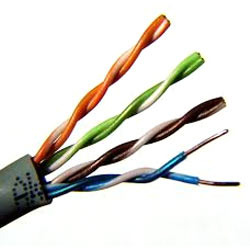 They are the most popular form of communication media having two insulated copper wire insulated in a spiral. It is relatively easy to set up a network using a twisted pair cable. A single twisted pair cable is capable of providing a capacity up to 1 GBPS for short distances (typically not more than 100 to 200 meters). Twisted pair makes the world’s public telephone line communication. Twisted pair cable comes in two forms:
- Shielded twisted pair (STP) Cable
- Unshielded twisted pair (UTP) Cable
Shielded Twisted Pair (STP) Cable:
It consists of one or more twisted pair cables enclosed in a foll warp and woven copper shielding. Caballing is difficult than UTP. It is more expensive than UTP. The data transfer capacity of STP is from 16Mbps to 5000Mbps.
Unshielded Twisted Pair (UTP) Cable:
It is the most popular twisted pair cable. The quality of UTP may vary telephone form grade wire to extremely high-speed cable. It is commonly used for LAN and telephone connection. It is less expensive and easier to work but it does not offer high bandwidth. The data transfer rate in UTP is up to 100 MBPS.
Twisted pair cables are cheap and easy to install and use. However, their use is limited because they easily lose the data when the distance exceeds 100 meters.
Coaxial Cable
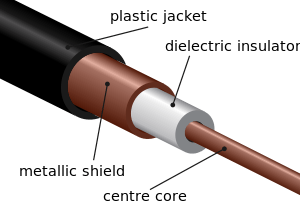 A faster and more reliable alternative to twisted pair cable is a coaxial cable. It is made up of one or more central wire rounded by thick insulation. It is used to connect the cable line on the television. It is capable of carrying 500 Mbps or 15000 voice calls. Because of its particular constructions, coaxial cable is much less susceptive than twisted pair cable to outside interference and information damage. It is more expensive than twisted pair cable and difficult to setup.
Coaxial cable has a copper conductor at its center. A plastic layer provides the insulation between the center conductor and braided metal shield (outer conductor). The metal shield helps to block any outside interference from fluorescent lights, motors, and other computers. Although a coaxial cable is difficult to install, it is highly resistant to signal interference. It can support greater cable length between network devices than twisted pair cable.
Optical Fiber:
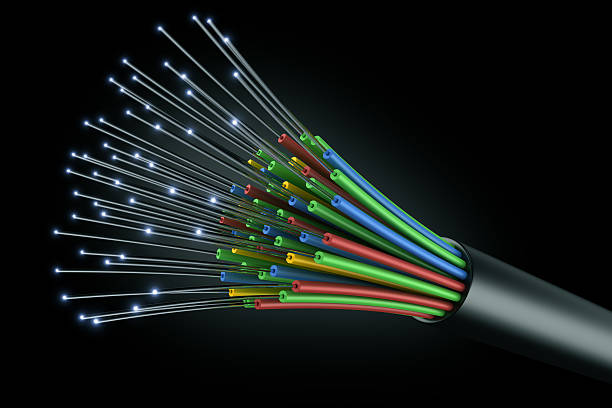 Optical Fiber is the fastest and most reliable communication medium is an optical fiber which uses a very thin glass or plastic fiber through which pulses or light travels. In the optical fiber communication, the sender converts the electrical signals to light waves, and receivers convert light waves back to electrical signals. The optical fiber cable has an outer insulating jacket that is made of Teflon or PVC. At the center of fiber optic cable, a very small glass is found through which the light pulses pass. A plastic coating is used to soften the fiber center.
Optical fiber has the ability to transmit signals over much longer distances than coaxial and twisted-pair cables. It carries the signals at vastly speed (as of speed of light). This capability of optical fiber makes possible services such as video conferencing and interactive services. Optical fiber has an advantage in size (one optical fiber has a diameter of a strand of a human hair), capacity exceeding more than 1400 MBPS), and quality (much greater than others). The disadvantage of optical fiber is that it is very costly and difficult to implement.
Similarly, You may also like:
Types of Unguided Media | Unguided Transmission Medias

MBA- Finance Specialization
I am Smirti Bam, an enthusiastic edu blogger with a passion for sharing insights into the dynamic world of business and management through this website.
I hold a MBA degree from Presidential Business School, Kathmandu, and a BBA degree with a specialization in Finance from Apex College,
- Onboarding Vs. Orientation: Key Differences, Benefits, Process & Best Practices | Human Resource Management (HRM) - September 24, 2026
- Moonlighting Vs Freelancing: Meaning, Differences & Risks Explained | Human Resource Management (HRM) - September 14, 2026
- Employee Retention Vs. Employee Engagement: Key Differences Explained | Human Resource Management - September 6, 2026


Pingback: Transactional Analysis in Communication- TA | Organizational Behaviour
Pingback: Unguided Media - Types of Unguided Media | Communication Media
Pingback: Guided and Unguided media - Transmission Media | MIS | Management Notes
Pingback: Which of the following are characteristics of coaxial network cable?