
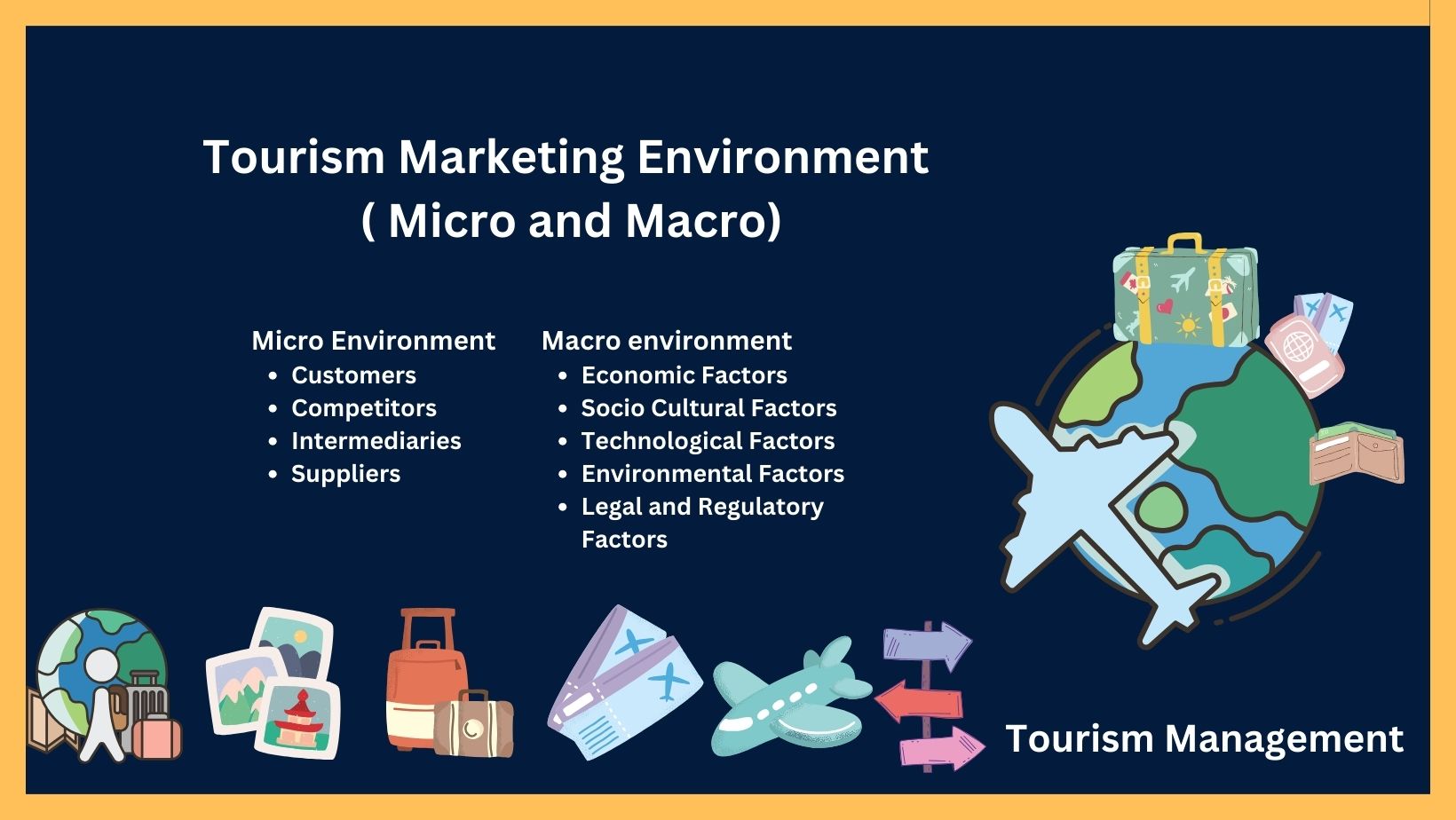
Tourism Marketing Environment ( Micro and Macro)-Explained in Detail | Tourism Management
Tourism Marketing Environment ( Micro and Macro)
Tourism marketing operates within a complex environment influenced by a variety of factors. Tourism marketers need to understand tourism marketing environments (micro and macro) in order to develop strategies that resonate with their target audiences.
These factors can be broadly divided into micro and macro environments. The purpose of this article is to provide detailed insights and examples to illustrate how micro and macro factors influence tourism marketing.
Micro Environment
Microenvironment refers to the internal factors that directly affect a tourism organization’s operations and activities. In order to craft tailored marketing strategies, it is crucial to understand the micro environment.
It includes entities and elements that are within the organization’s control. The major micro environmental factors are explained in detail as follows:
a. Customers
Any successful tourism marketing strategy starts with an understanding of the customer base, which includes:

i. Customer Demographics
In order to provide exceptional customer experiences, companies must consider factors such as age, gender, income levels, and lifestyle. Customers are the lifeblood of any tourism business.
In order to craft effective marketing strategies and create exceptional experiences, it is essential to understand their intricacies and preferences. Here are some of the aspects of understanding customers:
ii. Customer Behavior
In order to tailor promotions and packages to meet the specific needs of your target market, it is essential to analyze travel patterns and behaviors. Knowing whether the target market prefers solo travel, family vacations, or adventure trips can help you tailor them.
Creating tailored offerings can also be achieved by understanding customers’ preferences regarding amenities, pricing, and customer service. Understanding the customer’s preferred destination and timing can help plan marketing activities.
iii. Customer Feedback and Reviews
The opinions and feedback of customers are invaluable. Tourism marketers can not only address concerns but also gain insight into what aspects of their services are well received by monitoring platforms like TripAdvisor and social media channels.
This allows them to make more informed decisions on how to improve their services, resulting in increased customer satisfaction and loyalty.
b. Competitors
Tourism marketers can position their offerings more effectively when they understand the competitive landscape:

i. Market Share and Positioning
Identifying niches or unique selling points that can be capitalized on requires knowing who the major players are and their respective market shares.
When a dominant player specializes in beach resorts, an emerging competitor may specialize in boutique mountain lodges.
ii. Pricing Strategies
By analyzing how competitors charge their services, companies can establish benchmarks for pricing structures, whether to offer premium services or compete on cost.
Taking a look at pricing strategies in other industries, like retail or hospitality, can provide insight and inspiration into how to set prices in your company.
c. Intermediaries
Reaching a wider audience requires establishing and nurturing relationships with intermediaries:

i. Travel Agencies and Online Travel Agents
Tourism businesses can extend their reach by partnering with travel agencies and online travel agents (OTAs). These entities have established networks and platforms for booking and marketing.
Smaller tourism companies can particularly benefit from OTAs since they can reach a wider audience and access the resources of travel agencies. As well as providing valuable customer feedback and reviews, OTAs can also improve the customer experience.
ii. Distribution channels
Choosing the right distribution channels can significantly increase your bookings. You should also consider the cost and potential reach of each channel. Furthermore, it is important to consider how certain channels may affect a customer’s experience.
For instance, a niche adventure travel company might focus on direct client relationships, while a large resort might utilize online travel agencies.
d. Suppliers
When it comes to delivering a seamless experience, being able to find reliable and quality suppliers is essential:

i. Accommodation Providers
It is important to establish strong relationships with hotels, resorts, and alternative lodging options so that customers have a variety of options.
This contributes significantly to their overall satisfaction. The travel agent should, for example, provide the customer with all the details about each option if the customer wants to stay at a hotel.
ii. Transportation Service
It is important to collaborate with airlines, car rental companies, and local transportation services to ensure a seamless transition between destinations.
Providing real-time updates on flight and car availability allows travelers to plan their trips more efficiently. Providing discounts and special promotions on transportation services can also help travelers save money.
Conclusion
Tourism marketing strategies are based on the micro environment, which consists of customers, competitors, intermediaries, and suppliers. Businesses can tailor products, services, and marketing efforts to meet the specific needs and preferences of their target audience by understanding these internal factors.
Businesses gain a deeper understanding of the diverse groups that make up their customer base by diving into customer demographics. Through this knowledge, they are able to design experiences that resonate deeply with various segments, from adventure-seeking millennials to culture-loving seniors.
A comprehensive understanding of competitors allows businesses to identify niches, differentiate themselves, and position their offerings effectively. Developing strong relationships with intermediaries and suppliers ensures customers have a seamless and enriching experience.
Businesses can forge lasting connections with their customers, driving satisfaction, loyalty, and sustainable growth by navigating and leveraging the microenvironment.
Macro environment
There are both internal and external factors that influence the success of any tourism venture. Known as the macro environment, this external environment encompasses a variety of factors that businesses are unable to control.
When crafting robust tourism marketing strategies, it is essential to understand and navigate the macro environment effectively.
Throughout this comprehensive analysis, we will examine the economic, socio-cultural, technological, environmental, and legal factors that shape the tourism industry’s landscape.
a. Economic Factors
Economic factors include following major factors which are mentioned in detail below:

i. Economic Stability
A thriving tourism industry depends on economic stability, which consists of a range of factors such as GDP growth rates, inflation levels, and employment rates.
When economies are stable, consumers feel more confident in their financial well-being, which in turn leads to increased spending on leisure activities, including travel. A volatile economy can adversely affect the industry, causing consumers to cut back on discretionary expenditures.
ii. Disposable Income
The level of disposable income available to individuals directly impacts their travel decisions. Higher disposable incomes allow individuals to allocate more resources toward travel experiences.
Thus, destinations and businesses offering premium or luxury experiences often experience greater demand during periods of high disposable income.
iii. Exchange rates
International tourism depends heavily on exchange rates. Fluctuations in currency values can have a big impact on travel decisions.
When the domestic currency is stronger, it may discourage outbound travel because the foreign destinations are more expensive, but when it is weaker, more international visitors can come, boosting inbound tourism.
b. Socio Cultural Factors
The major socio cultural factors are explained in detail below:

i. Cultural Trends
In order to tailor marketing messages and experiences, it is crucial to understand cultural preferences, values, and customs.
For example, a destination that celebrates its heritage may attract travelers seeking authentic experiences. Tourists looking to immerse themselves in a destination’s unique identity can find cultural experiences, such as local festivals and workshops, to be a powerful draw.
ii. Social Trends
Trends and changes in society can also significantly influence travel behavior. Changes in demographics, lifestyles, and consumer preferences can influence travel behavior.
As an aging population increases, accessible tourism options may become increasingly popular, while a growing interest in health and wellness may increase spa and wellness tourism’s popularity.
iii. Travel Trends
Keeping abreast of emerging travel trends is crucial for remaining competitive in the tourism industry.
Eco-tourism and sustainable travel, for example, have brought a heightened awareness of environmental impact, prompting businesses to adopt eco-friendly practices. Similarly, adventure tourism has created opportunities for destinations with rugged landscapes and outdoor activities.
c. Technological Factors
Technology is an important part of tourism marketing. The major technological factors that has an impact on tourism are explained in detail below:

i. Online Presence and Digital platforms
Research, planning, and booking a trip have been transformed by the advent of the internet and digital platforms.
For attracting and retaining customers, it is essential to establish a strong online presence through an engaging website, active social media profiles, and positive reviews on travel platforms.
ii. Mobile Technology
Travel has been revolutionized by smartphones. Mobile applications, navigation tools, and virtual tours have become integral components of modern travel. For a seamless and convenient experience, it is essential to make a business’s website mobile-friendly and optimize its content for mobile users.
Users should be able to book flights, hotels, and rental cars directly from their smartphones. Providing features like check-in, baggage tracking, and flight status notifications can also help to ensure a stress-free journey.
iii. Artificial Intelligence and Big Data
Businesses can gain a deeper understanding of customer behavior and preferences by combining artificial intelligence and big data analytics. This data-driven approach enables more personalized marketing strategies and the ability to anticipate and meet the evolving needs of travelers.
AI-powered solutions can also be used to identify potential suppliers, optimize pricing strategies, and predict the best times and locations to launch marketing campaigns.
d. Environmental Factors
The major environmental factors affecting tourism marketing are explained below:

i. Natural Attractions and Climate
Natural features of a destination, such as landscapes, climate, and biodiversity, are essential considerations for travelers.
Tourists are attracted to destinations with a wide range of natural attractions, from mountains and beaches to forests and wildlife reserves. By understanding and promoting these natural assets, a destination can significantly increase its attractiveness.
ii. Sustainability and Eco-friendliness
Over the past few years, sustainable and eco-friendly tourism has been on the rise. Travelers are increasingly conscious of their environmental impact and look for destinations and businesses that share their commitment to conservation and responsible tourism practices.
For environmentally-conscious travelers, marketing efforts promoting green initiatives, such as eco-friendly accommodations and carbon offset programs, can be highly effective.
e. Legal and Regulatory Factors
Legal and regulators factors can be explained in detail as following:

i. Visa and Immigration Policies
The ease of traveling to a particular destination is heavily influenced by visa and immigration policies, particularly for international tourists. Entry requirements, visa processes, and immigration policies all impact the ease of travel.
An environment with a lenient visa policy will attract more international visitors, while an environment with a stringent policy will deter them.
ii. Health and Safety Regulation
In light of global health concerns, compliance with health and safety regulations has become paramount. Travelers prioritize destinations and businesses that demonstrate a commitment to their visitors’ well-being.
In addition to rigorous sanitation practices, adherence to health guidelines, and transparent communication regarding safety protocols, these measures are also necessary.
Conclusion
The macro environment, composed of economic, socio-cultural, technological, environmental, and legal factors, represents the external forces that shape the tourism industry. To thrive in the competitive tourism industry, businesses must be able to navigate and leverage these factors.
Tourism marketers can develop strategies that resonate with target audiences and respond to emerging trends by understanding economic stability, sociocultural trends, technological advances, environmental concerns, and legal frameworks.
A successful marketing strategy in the macro environment requires embracing sustainability, adapting to technological advances, and prioritizing health and safety.
It is ultimately through a comprehensive understanding of the macro environment that businesses can anticipate and adapt to industry changes, foster customer loyalty, and achieve sustained success in the ever-evolving world of tourism marketing.
Businesses can establish themselves as industry leaders if they align themselves with macro-level trends, providing experiences that meet the diverse needs and preferences of today’s discerning travelers.
Related Posts
- Evolution of Tourism Marketing – Explained in Detail | Tourism Management
- Modern Era of Tourism – Explained in Detail | Tourism Management
- Importance of Tourism Marketing – 8 Major Importance Explained In Detail | Tourism Management
- Scope of Tourism Marketing – Explained in Detail | Tourism Management.

I am Bibisha Shiwakoti a final year BBS student from Janapremi College. I have completed my higher secondary education at Kalinchowk Secondary School.
- Role and functions of Important Tourism Organizations: (WTO, IATA, PATA, TAAI, WTTC)-Explained in Detail | Tourism Management - September 28, 2023
- Research Methodology in Tourism Industry-Explained in Detail | Tourism Management - September 27, 2023
- Tourism Entrepreneurship-Explained in Detail | Tourism Management - September 27, 2023


