
Liberalization and Privatization Explained: Meaning, Types, Differences | Business Environment in Nepal
Liberalization and privatization are two words people often mix up. Both are economic reforms. Both reduce the government’s grip on the economy. But they are not the same thing.
Liberalization means the government loosens its rules on business, trade, and industry. It does not change who owns a company. It just removes red tape like licenses, tariffs, and price controls.
Privatization means the government sells or hands over ownership of a business, company, or industry to private owners. It changes who controls and owns the asset.
In short: liberalization is about freedom of rules, and privatization is about change of ownership.
What Is Liberalization?
Liberalization is the process of reducing or removing government restrictions on economic activity. It gives private businesses, both local and foreign, more freedom to operate, invest, produce, and trade with fewer rules in their way.
When a government “liberalizes” an economy, it usually:
- Cuts import and export tariffs (taxes on trade)
- Removes licensing requirements needed to start a business
- Ends price controls on goods and services
- Opens sectors to foreign direct investment (FDI)
- Reduces subsidies that protect local industries from competition
- Simplifies tax and regulatory systems
The main idea behind liberalization is simple: let the market, not the government, decide prices, output, and competition. This idea is closely tied to what economists call free-market policy or the Washington Consensus, a set of pro-market reforms promoted from the 1980s onward.
Types of Liberalization

Key Summary Table: Liberalization
| Point | Details |
|---|---|
| Definition | Loosening of government rules on economic activity |
| Focus area | Rules, regulations, and restrictions |
| Ownership change? | No — ownership stays the same |
| Main goal | Increase competition and market efficiency |
| Common tools | Lower tariffs, fewer licenses, open FDI policy |
| First large-scale use | Chile (1970s), UK (1980s), India (1991), China (1978 onward, gradually) |
| Related term | Deregulation (very close in meaning, sometimes used together) |
What Is Privatization?
Privatization is the process of transferring ownership, management, or control of a business or industry from the public sector (government) to the private sector (individuals or private companies).
In simple words: privatization happens when a government-owned company is sold, leased, or handed over so that private owners run it instead of the state.
The goal of privatization is usually to:
- Improve efficiency and professional management
- Reduce the financial burden on the government
- Encourage competition instead of a single government monopoly
- Bring in new capital, technology, and modern practices
- Improve the quality of goods and services for consumers
Types (Methods) of Privatization

Key Summary Table: Privatization
| Point | Details |
|---|---|
| Definition | Transfer of ownership or control from government to private hands |
| Focus area | Ownership and management |
| Ownership change? | Yes — from public sector to private sector |
| Main goal | Improve efficiency, reduce government burden |
| Common tools | Share sale, disinvestment, asset sale, PPP |
| First large-scale use | UK under Margaret Thatcher (1980s), later spread worldwide |
| Related term | Denationalization (opposite of nationalization) |
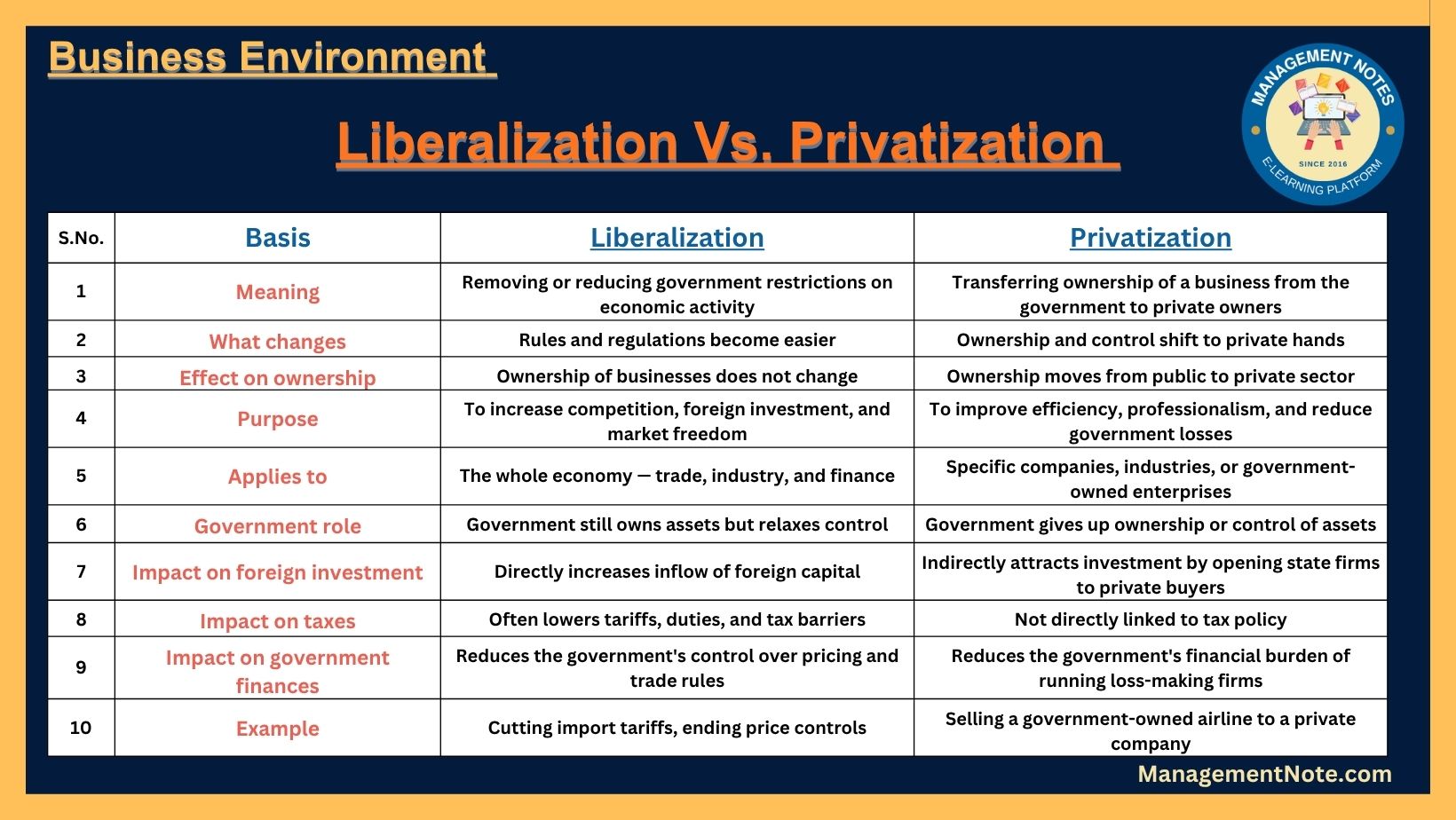
Difference Between Liberalization and Privatization: Full Comparison Table
| S.No. | Basis | Liberalization | Privatization |
|---|---|---|---|
| 1 | Meaning | Removing or reducing government restrictions on economic activity | Transferring ownership of a business from the government to private owners |
| 2 | What changes | Rules and regulations become easier | Ownership and control shift to private hands |
| 3 | Effect on ownership | Ownership of businesses does not change | Ownership moves from public to private sector |
| 4 | Purpose | To increase competition, foreign investment, and market freedom | To improve efficiency, professionalism, and reduce government losses |
| 5 | Applies to | The whole economy — trade, industry, and finance | Specific companies, industries, or government-owned enterprises |
| 6 | Government role | Government still owns assets but relaxes control | Government gives up ownership or control of assets |
| 7 | Impact on foreign investment | Directly increases inflow of foreign capital | Indirectly attracts investment by opening state firms to private buyers |
| 8 | Impact on taxes | Often lowers tariffs, duties, and tax barriers | Not directly linked to tax policy |
| 9 | Impact on government finances | Reduces the government’s control over pricing and trade rules | Reduces the government’s financial burden of running loss-making firms |
| 10 | Example | Cutting import tariffs, ending price controls | Selling a government-owned airline to a private company |
Liberalization vs. Privatization Vs. Deregulation Vs. Globalization
People often search for all four of these terms together, because they are related but different. Here is a simple breakdown.
| Term | Simple Meaning | Key Difference |
|---|---|---|
| Liberalization | Loosening government rules on the economy | Focuses on rules, not ownership |
| Privatization | Transferring ownership from government to private hands | Focuses on ownership, not rules |
| Deregulation | Removing or reducing specific laws and regulations in an industry | Very close to liberalization; often used interchangeably, though deregulation usually targets one sector while liberalization can be economy-wide |
| Globalization | Connecting a country’s economy with the rest of the world through trade, investment, and technology | Focuses on international integration, not domestic rules or ownership |
Together, liberalization, privatization, and globalization are often called the LPG reforms. This term became famous after India’s 1991 economic reforms, when the country moved from a closed, government-controlled economy toward an open, market-based one.
Similar reform waves happened earlier in the UK under Margaret Thatcher (1980s) and in Chile under economic reforms in the 1970s and 1980s.
Advantages and Disadvantages of Liberalization

Advantages and Disadvantages of Privatization

Real-World Examples
United States:
- Liberalization example: Deregulation of the airline industry after the Airline Deregulation Act of 1978, which removed government control over airfares and routes.
- Privatization example: Contracting out government services such as prison management and some postal-adjacent logistics work to private companies.
United Kingdom:
- Liberalization example: Opening the telecom and energy markets to competition in the 1980s and 1990s.
- Privatization example: The sale of British Telecom, British Gas, and British Airways to private shareholders during the 1980s under Margaret Thatcher’s government.
Canada:
- Liberalization example: Trade liberalization through agreements like NAFTA and its successor, USMCA, which reduced tariffs between the US, Canada, and Mexico.
- Privatization example: Sale of government-owned companies such as Air Canada and Petro-Canada to private investors.
Australia:
- Liberalization example: Financial sector reforms in the 1980s that floated the Australian dollar and opened banking to more competition.
- Privatization example: Sale of government-owned Qantas Airways and Telstra (telecom) to private shareholders.
India:
- Liberalization example: The 1991 New Economic Policy, which cut import tariffs, ended industrial licensing for most sectors, and opened doors to foreign investment.
- Privatization example: Disinvestment of government stakes in public sector companies like Air India, which was fully sold to the Tata Group in 2022.
Frequently Asked Questions
1. What is the main difference between liberalization and privatization?
Liberalization removes government restrictions on business activity without changing who owns anything. Privatization changes ownership by moving a business from government hands to private hands.
2. Is privatization a part of liberalization?
No. They are related but separate reforms. A country can liberalize its economy (loosen rules) without privatizing any company, and it can privatize a company without liberalizing the wider economy. However, both are often introduced together as part of pro-market reform packages.
3. What is the difference between liberalization, privatization, and globalization (LPG)?
Liberalization loosens domestic rules, privatization shifts ownership from public to private, and globalization connects a country’s economy with world markets through trade and investment. All three often happen together as part of one reform program.
4. What is the difference between privatization and deregulation?
Privatization changes who owns a business. Deregulation removes or reduces specific rules and laws that control an industry, without necessarily changing ownership. A government-owned company can be deregulated without being privatized, and a private company can also be deregulated.
5. What are examples of privatization in real life?
Common examples include the sale of state airlines, telecom companies, and energy utilities to private owners, such as British Telecom in the UK, Qantas in Australia, and Air India in India.
6. What are examples of liberalization in real life?
Common examples include cutting import tariffs, ending industrial licensing requirements, opening banking to foreign competition, and allowing more foreign direct investment in local industries.
7. Which came first: liberalization or privatization?
It depends on the country. In the UK, privatization under Margaret Thatcher began in the early 1980s. In India, liberalization and privatization both began together as part of the 1991 reforms.
8. Does privatization always improve efficiency?
Not always. While privatization can bring better management and technology, it does not automatically guarantee lower prices or better service, especially in industries with limited competition, such as water or electricity.
9. What is the opposite of privatization?
The opposite of privatization is nationalization, where a government takes over a private company or industry and brings it under public ownership.
10. Why do governments choose liberalization over privatization, or vice versa?
Governments choose liberalization when they want to boost competition and investment without giving up ownership of key industries. They choose privatization when they want to reduce financial losses from running a business and bring in private-sector efficiency.
Final Summary Table: Liberalization vs. Privatization at a Glance
| Category | Liberalization | Privatization |
|---|---|---|
| Core idea | Fewer government rules | Change of ownership |
| What it touches | Trade policy, licensing, tariffs, FDI rules | Companies, industries, government-run enterprises |
| Ownership impact | None | Public sector to private sector |
| Main benefit | More competition and investment | More efficiency and less government burden |
| Main risk | Regional and income inequality | Job losses and reduced public accountability |
| Classic example | Cutting import tariffs | Selling a state-owned airline |
| Related concept | Deregulation | Denationalization |
| Part of LPG reforms? | Yes | Yes |
Conclusion
Liberalization and privatization are both key tools of economic reform, but they work in different ways. Liberalization opens up the rules of the game so more players, both local and foreign, can compete freely. Privatization changes who owns and runs the game itself, moving control from government hands to private hands.
Most modern economies, from the United States and the United Kingdom to India and Australia, have used a mix of both tools, often alongside globalization, to modernize their industries and grow their economies. Understanding the difference between the two helps make sense of major economic policy debates happening around the world today.
- Monopolistic Advantage Theory
- Effects of Liberalization in Nepal – 14 Major Effects of Changing Business Environment | Management Notes

MBA- Finance Specialization
I am Smirti Bam, an enthusiastic edu blogger with a passion for sharing insights into the dynamic world of business and management through this website.
I hold a MBA degree from Presidential Business School, Kathmandu, and a BBA degree with a specialization in Finance from Apex College,
- Moonlighting Vs Freelancing: Meaning, Differences & Risks Explained | Human Resource Management (HRM) - September 14, 2026
- Employee Retention Vs. Employee Engagement: Key Differences Explained | Human Resource Management - September 6, 2026
- Talent Acquisition Vs Talent Management: What Is the Difference? - September 2, 2026


I wanted to thank you for this wonderful read!!I certainly enjoyed every little bit of it. I have you saved as a favoriteto check out new things you post…