
Employee Retention Vs. Employee Engagement: Key Differences Explained | Human Resource Management
Companies often talk about employee retention and employee engagement as if they are the same goal. They are closely connected, but they are not identical.
Understanding the difference helps businesses build a workplace people actually want to stay in, not just one they happen to stay in.
What Is Employee Retention?
Employee retention refers to a company’s ability to keep employees over time, rather than losing them to turnover. It is usually measured as a percentage, comparing how many employees stay with the company over a given period, such as a year.
High retention means fewer people are leaving. Low retention means the company is losing employees faster than it would like.
Retention is the outcome. It is the result of many factors working together, including pay, benefits, management quality, workload, and yes, engagement.
What Is Employee Engagement?
Employee engagement refers to how emotionally invested and motivated employees feel about their work and the company. Engaged employees tend to care about the quality of their work, feel connected to the company’s mission, and are more likely to go beyond the minimum requirements of their job.
Engagement is usually measured through surveys that ask about job satisfaction, motivation, and connection to the team and company. Engagement is more of a driver. It reflects how employees feel day to day, which in turn influences whether they choose to stay or leave.
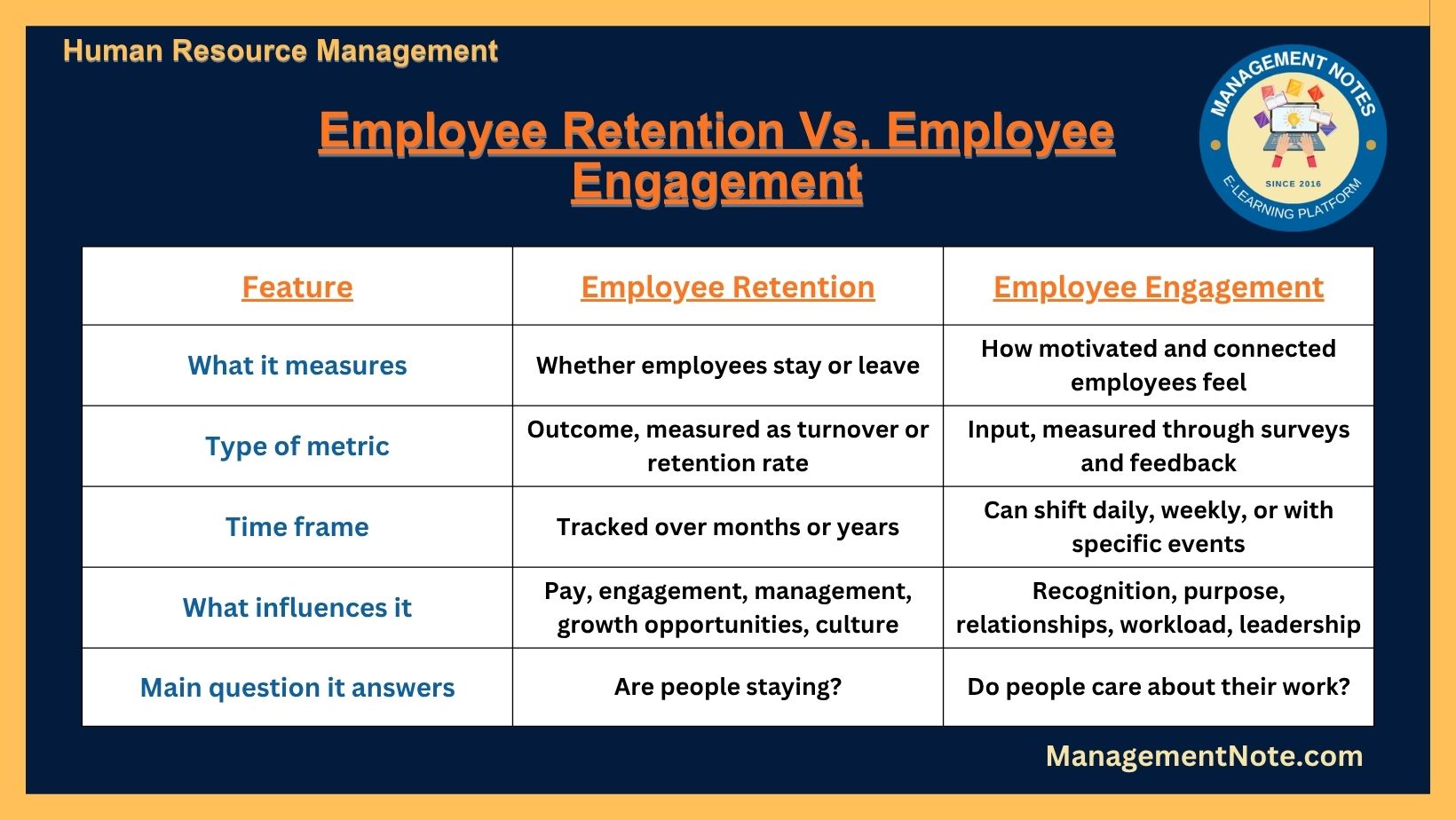
Employee Retention Vs. Employee Engagement: Key Differences
| Feature | Employee Retention | Employee Engagement |
|---|---|---|
| What it measures | Whether employees stay or leave | How motivated and connected employees feel |
| Type of metric | Outcome, measured as turnover or retention rate | Input, measured through surveys and feedback |
| Time frame | Tracked over months or years | Can shift daily, weekly, or with specific events |
| What influences it | Pay, engagement, management, growth opportunities, culture | Recognition, purpose, relationships, workload, leadership |
| Main question it answers | Are people staying? | Do people care about their work? |
Why the Difference Matters
A company can have decent retention numbers while still having low engagement. Some employees stay simply because it is convenient, the pay is fine, or they have not found another opportunity, even though they are not particularly motivated or invested in their work. This is sometimes called quiet quitting, where employees stay employed but do the bare minimum.
On the other hand, engagement tends to predict retention over time. Employees who feel genuinely connected to their work and the company are far less likely to start looking elsewhere.
Because of this, many HR teams treat engagement as an early warning system, a way to spot problems before they show up as turnover.
Real Life Example
A company reviews its yearly numbers and sees that its retention rate has stayed steady at ninety percent for the past two years. On the surface, this looks healthy.
But when the company runs an engagement survey, it finds that a large portion of employees describe themselves as unmotivated, disconnected from leadership, and unclear about how their work matters.
Retention looks fine, but engagement reveals a deeper problem that could eventually show up as turnover once employees find better options elsewhere.
At a different company, employee engagement scores are consistently high. Employees report feeling recognized, supported by their managers, and connected to the company’s mission.
As a result, this company also enjoys strong retention, since engaged employees have less reason to look for something else.
Employee Retention Vs Employee Engagement FAQs
Does higher engagement always lead to higher retention?
Generally, yes. Engaged employees tend to be more satisfied and motivated, which usually leads to lower turnover. However, retention can still be affected by outside factors like pay, location, or personal circumstances, even when engagement is high.
Can a company have good retention but low engagement?
Yes. Employees sometimes stay in a job simply out of convenience or lack of better options, even if they are not particularly engaged or motivated. This is a common blind spot for companies that only track turnover numbers.
How is employee engagement usually measured?
Most companies use employee engagement surveys, which ask questions about job satisfaction, motivation, relationships with managers and coworkers, and connection to the company’s mission.
Which should a company focus on first, retention or engagement?
Since engagement often drives retention, many HR experts recommend focusing on improving engagement first. Addressing the reasons employees feel disconnected tends to naturally improve retention over time.
Key Takeaways
Employee retention measures whether employees stay with a company over time, while employee engagement measures how motivated and emotionally connected employees feel about their work.
Retention is the outcome, and engagement is one of its biggest drivers. Companies that focus only on retention numbers risk missing deeper problems, while those that invest in genuine engagement tend to see stronger retention as a natural result.
You May Also Like:
- Talent Acquisition Vs Talent Management: What Is the Difference?
- Headhunting vs Recruitment: Major Differences Explained | Human Resource Management
- Moonlighting Vs Freelancing: Meaning, Differences & Risks Explained | Human Resource Management (HRM)

MBA- Finance Specialization
I am Smirti Bam, an enthusiastic edu blogger with a passion for sharing insights into the dynamic world of business and management through this website.
I hold a MBA degree from Presidential Business School, Kathmandu, and a BBA degree with a specialization in Finance from Apex College,
- Onboarding Vs. Orientation: Key Differences, Benefits, Process & Best Practices | Human Resource Management (HRM) - September 24, 2026
- Moonlighting Vs Freelancing: Meaning, Differences & Risks Explained | Human Resource Management (HRM) - September 14, 2026
- Employee Retention Vs. Employee Engagement: Key Differences Explained | Human Resource Management - September 6, 2026


