
Headhunting vs Recruitment: Major Differences Explained | Human Resource Management
Hiring the right person can make or break a team. But not all hiring works the same way. Two terms that often get mixed up are headhunting and recruitment. This guide breaks down what each one means, how they differ, and which one might fit a business’s hiring needs.
What Is Recruitment?
Recruitment is the overall process a company uses to find, attract, and hire new employees. It usually starts with posting a job opening, then moves through screening resumes, interviewing candidates, and making an offer. Recruitment can be handled by an in house HR team, a recruitment agency, or a mix of both.
Recruitment is a broad term. It covers everything from entry level hiring to filling leadership roles, and it usually relies on candidates applying to a posted opening. Common recruitment channels include job boards, company career pages, campus hiring, and employee referrals.
What Is Headhunting?
Headhunting is a more targeted form of hiring. Instead of posting a job and waiting for applications, a headhunter identifies specific people, often already employed and not actively job hunting, and reaches out to them directly. Headhunters are usually hired to fill senior, executive, or highly specialized roles where the pool of qualified candidates is small.
Headhunting is sometimes called executive search. It focuses on quality over quantity, aiming to find the one person who fits a very specific set of skills or leadership qualities, rather than sorting through a large stack of applications.
Headhunting vs Recruitment: Key Differences
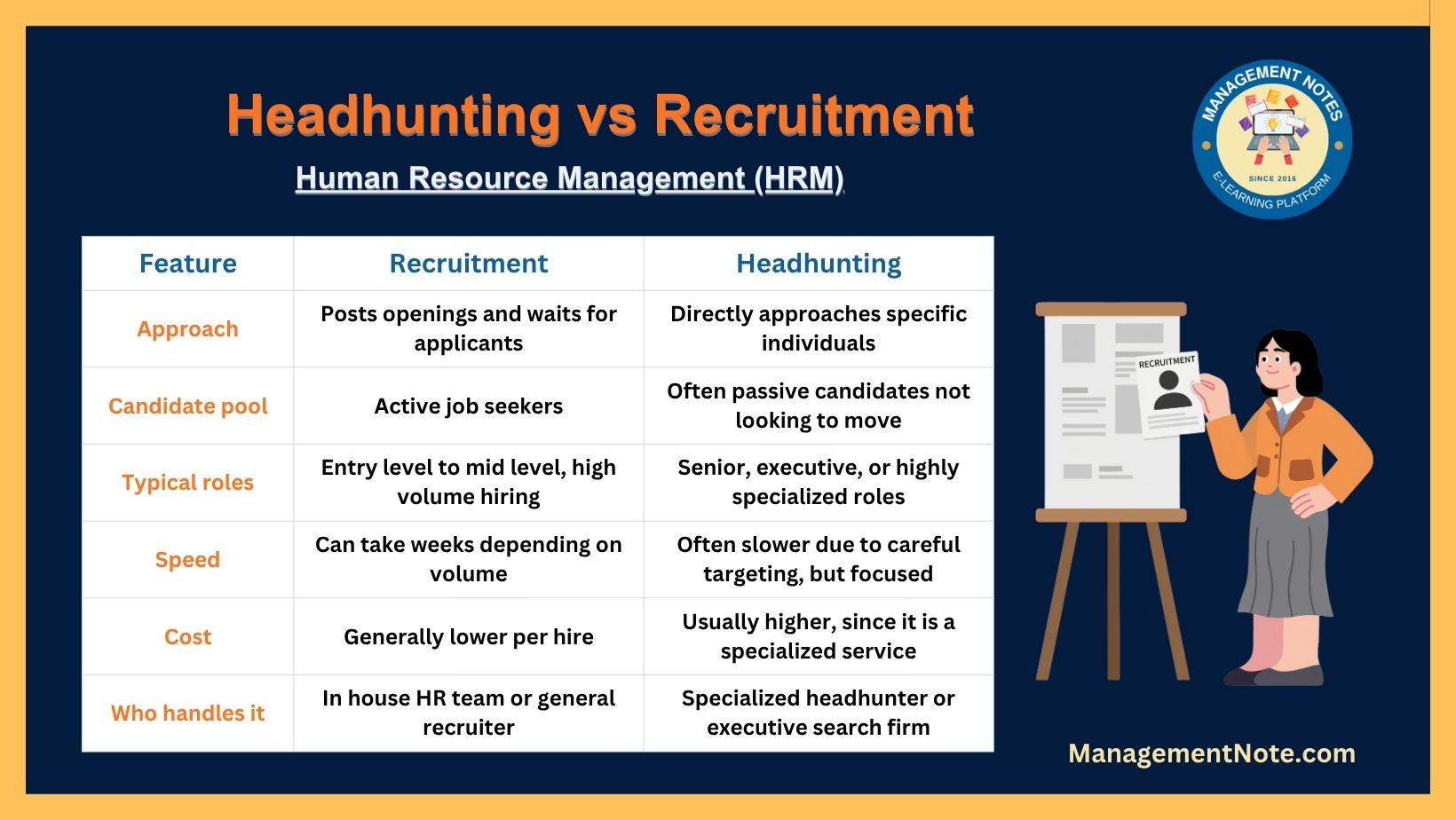
| Feature | Recruitment | Headhunting |
|---|---|---|
| Approach | Posts openings and waits for applicants | Directly approaches specific individuals |
| Candidate pool | Active job seekers | Often passive candidates not looking to move |
| Typical roles | Entry level to mid level, high volume hiring | Senior, executive, or highly specialized roles |
| Speed | Can take weeks depending on volume | Often slower due to careful targeting, but focused |
| Cost | Generally lower per hire | Usually higher, since it is a specialized service |
| Who handles it | In house HR team or general recruiter | Specialized headhunter or executive search firm |
Real Life Example
A retail company opening ten new store locations will likely rely on recruitment. It posts job openings for store associates and managers, collects applications, and interviews candidates in batches to fill roles quickly.
A tech company looking for a new Chief Financial Officer with a very specific background in public offerings will more likely use headhunting. The company hires an executive search firm to quietly approach qualified CFOs who are currently working elsewhere and may not be looking for a new job at all.
When to Use Recruitment vs Headhunting
Use recruitment when:
- Filling multiple openings at once
- Hiring for entry level or mid level roles
- Working with a limited hiring budget
- The role does not require a rare or highly specialized skill set
Use headhunting when:
- Filling a senior leadership or executive role
- The required skills are rare or highly specialized
- Confidentiality matters, such as replacing a current executive
- The best candidates are unlikely to apply on their own
Headhunting vs Recruitment FAQs
Is headhunting a type of recruitment?
Yes. Headhunting is considered a specialized form of recruitment. The main difference is that headhunting targets specific individuals directly, while general recruitment relies on candidates applying to a posted role.
Is headhunting legal?
Yes, headhunting is legal in the United States. Contacting someone who already has a job to see if they are interested in a new opportunity is a normal part of the hiring process, as long as no trade secrets, contracts, or agreements between competing employers are violated.
Why do companies use headhunters instead of hiring internally?
Headhunters often have access to networks and passive candidates that an internal HR team may not reach. This is especially useful for senior roles where the right person is unlikely to be browsing job boards.
Is headhunting more expensive than regular recruitment?
Usually, yes. Headhunting is a specialized service, so it often costs more per hire than standard recruitment. Companies typically use it only for roles where finding the right person is worth the extra cost.
Conclusion:
Recruitment is the broad process of finding and hiring new employees, usually through posted openings and applications. Headhunting is a targeted approach that directly seeks out specific, often passive, candidates, typically for senior or highly specialized roles.
Most companies use both strategies at different times, depending on the role, the budget, and how quickly the position needs to be filled.
You May Also Like:
- What Is Employee Poaching? Meaning, Legal Rules, and How to Stop It (2026) | Human Resource Management
- Headhunting Explained: Process, Cost, Pros & Cons (2026) | Human Resource Management
- Recruitment – Meaning, Objectives, Importance, Factors, Strategies and Checklist of Recruitment | Human Resource Management

MBA- Finance Specialization
I am Smirti Bam, an enthusiastic edu blogger with a passion for sharing insights into the dynamic world of business and management through this website.
I hold a MBA degree from Presidential Business School, Kathmandu, and a BBA degree with a specialization in Finance from Apex College,
- Onboarding Vs. Orientation: Key Differences, Benefits, Process & Best Practices | Human Resource Management (HRM) - September 24, 2026
- Moonlighting Vs Freelancing: Meaning, Differences & Risks Explained | Human Resource Management (HRM) - September 14, 2026
- Employee Retention Vs. Employee Engagement: Key Differences Explained | Human Resource Management - September 6, 2026


