
Talent Acquisition Vs Talent Management: What Is the Difference?
Human resources teams often use the terms talent acquisition and talent management as if they mean the same thing. They do not. One is about finding people. The other is about keeping and growing them once they are hired. Understanding the difference helps businesses build a stronger, more complete people strategy.
What Is Talent Acquisition?
Talent acquisition is the long term, strategic process of identifying, attracting, and hiring skilled people to meet a company’s future workforce needs. It goes beyond simple recruitment.
While recruitment often focuses on filling an open position right now, talent acquisition looks further ahead, building relationships with potential candidates, strengthening the employer brand, and planning for roles the company will need in the future.
Talent acquisition typically includes:
- Employer branding and reputation building
- Building a pipeline of potential candidates before a role even opens
- Workforce planning based on future business goals
- Sourcing, interviewing, and hiring for both current and upcoming roles
What Is Talent Management?
Talent management is everything a company does to develop, engage, and retain employees after they are hired. It covers the full employee lifecycle, from onboarding to performance management, training, career development, succession planning, and eventually offboarding or retirement.
Talent management typically includes:
- Onboarding and early employee support
- Performance reviews and feedback systems
- Learning and development programs
- Succession planning for key roles
- Employee engagement and retention strategies
Talent Acquisition vs Talent Management: Key Differences
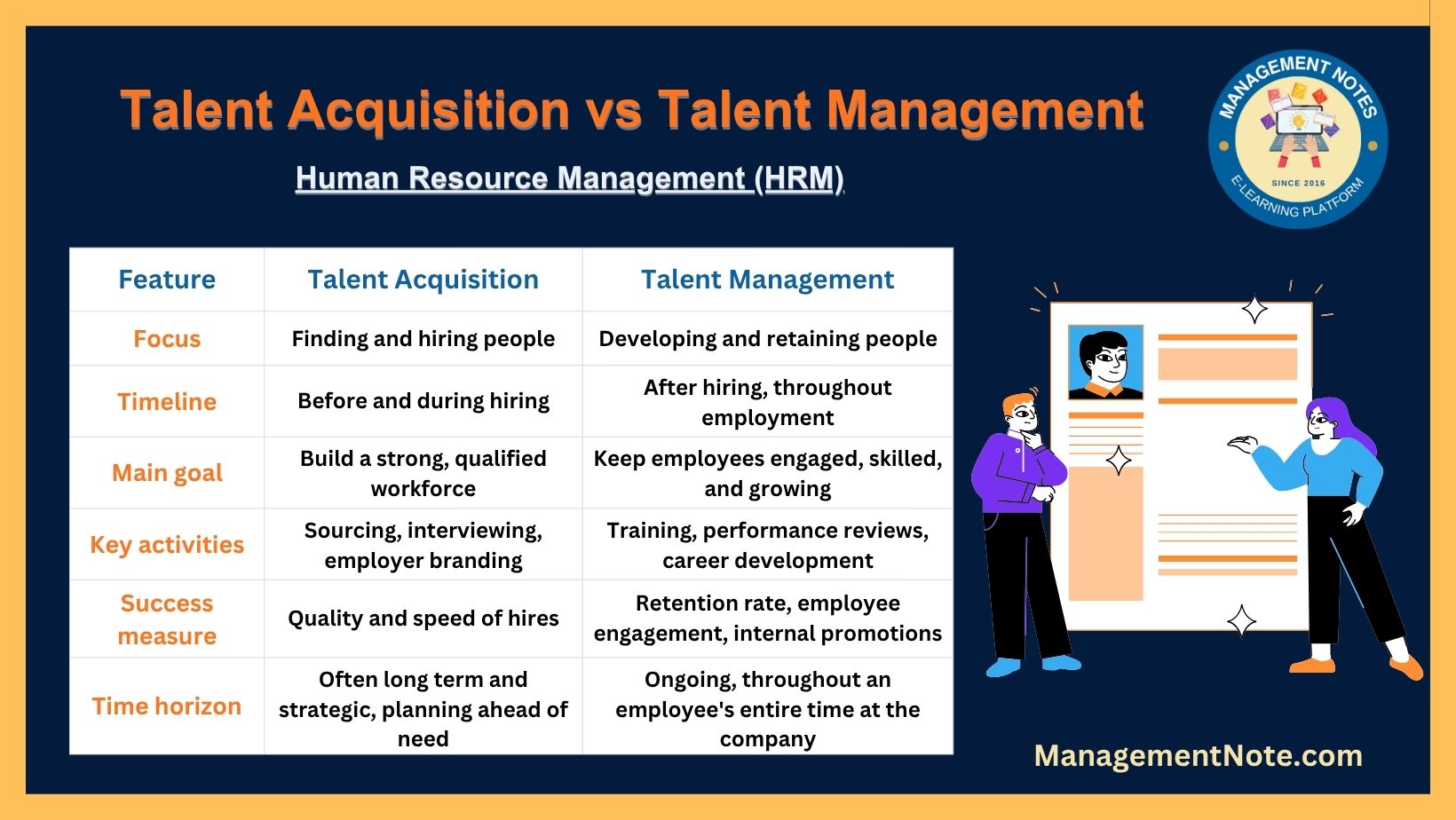
| Feature | Talent Acquisition | Talent Management |
|---|---|---|
| Focus | Finding and hiring people | Developing and retaining people |
| Timeline | Before and during hiring | After hiring, throughout employment |
| Main goal | Build a strong, qualified workforce | Keep employees engaged, skilled, and growing |
| Key activities | Sourcing, interviewing, employer branding | Training, performance reviews, career development |
| Success measure | Quality and speed of hires | Retention rate, employee engagement, internal promotions |
| Time horizon | Often long term and strategic, planning ahead of need | Ongoing, throughout an employee’s entire time at the company |
Why Both Matter
A company can be excellent at talent acquisition and still lose good people if it has weak talent management. Bringing in great hires does little good if they are not supported, trained, or given a clear path to grow.
On the other hand, strong talent management cannot fix a workforce that was never built with the right skills in the first place. The two work together as parts of one larger people strategy.
Real Life Example
A software company wants to expand into artificial intelligence products over the next two years. Its talent acquisition team starts building relationships with machine learning engineers, attending industry conferences, and strengthening the company’s reputation as a good place for AI talent to work, long before any job is officially posted.
Once those engineers are hired, the responsibility shifts to talent management. The company sets up a structured onboarding program, assigns mentors, offers ongoing technical training, and creates a career path so those engineers can see a future at the company rather than looking elsewhere after a year or two.
Talent Acquisition vs Talent Management FAQs
Is talent acquisition the same as recruitment?
Not exactly. Recruitment usually focuses on filling a current opening, while talent acquisition is a broader, longer term strategy that includes employer branding and planning for future workforce needs.
Which comes first, talent acquisition or talent management?
Talent acquisition typically comes first, since it covers finding and hiring employees. Talent management takes over once someone joins the company and continues throughout their entire employment.
Can a small business separate talent acquisition and talent management into different teams?
Not always. Many small businesses combine both functions under one HR person or a small team, while larger companies often have dedicated teams for each.
Why do companies lose employees even with good talent acquisition?
Strong talent acquisition brings in the right people, but if a company has weak talent management, such as poor onboarding, limited growth opportunities, or lack of recognition, those same employees may leave anyway.
Key Takeaways
Talent acquisition is about strategically finding and hiring the right people for current and future roles. Talent management is about developing, engaging, and retaining those people once they join the company. Neither works well without the other, and businesses that invest in both tend to build stronger, more stable teams over time.
You May Also Like:
- Headhunting vs Recruitment: Major Differences Explained | Human Resource Management
- What Is Employee Poaching? Meaning, Legal Rules, and How to Stop It (2026) | Human Resource Management

MBA- Finance Specialization
I am Smirti Bam, an enthusiastic edu blogger with a passion for sharing insights into the dynamic world of business and management through this website.
I hold a MBA degree from Presidential Business School, Kathmandu, and a BBA degree with a specialization in Finance from Apex College,
- Onboarding Vs. Orientation: Key Differences, Benefits, Process & Best Practices | Human Resource Management (HRM) - September 24, 2026
- Moonlighting Vs Freelancing: Meaning, Differences & Risks Explained | Human Resource Management (HRM) - September 14, 2026
- Employee Retention Vs. Employee Engagement: Key Differences Explained | Human Resource Management - September 6, 2026


