
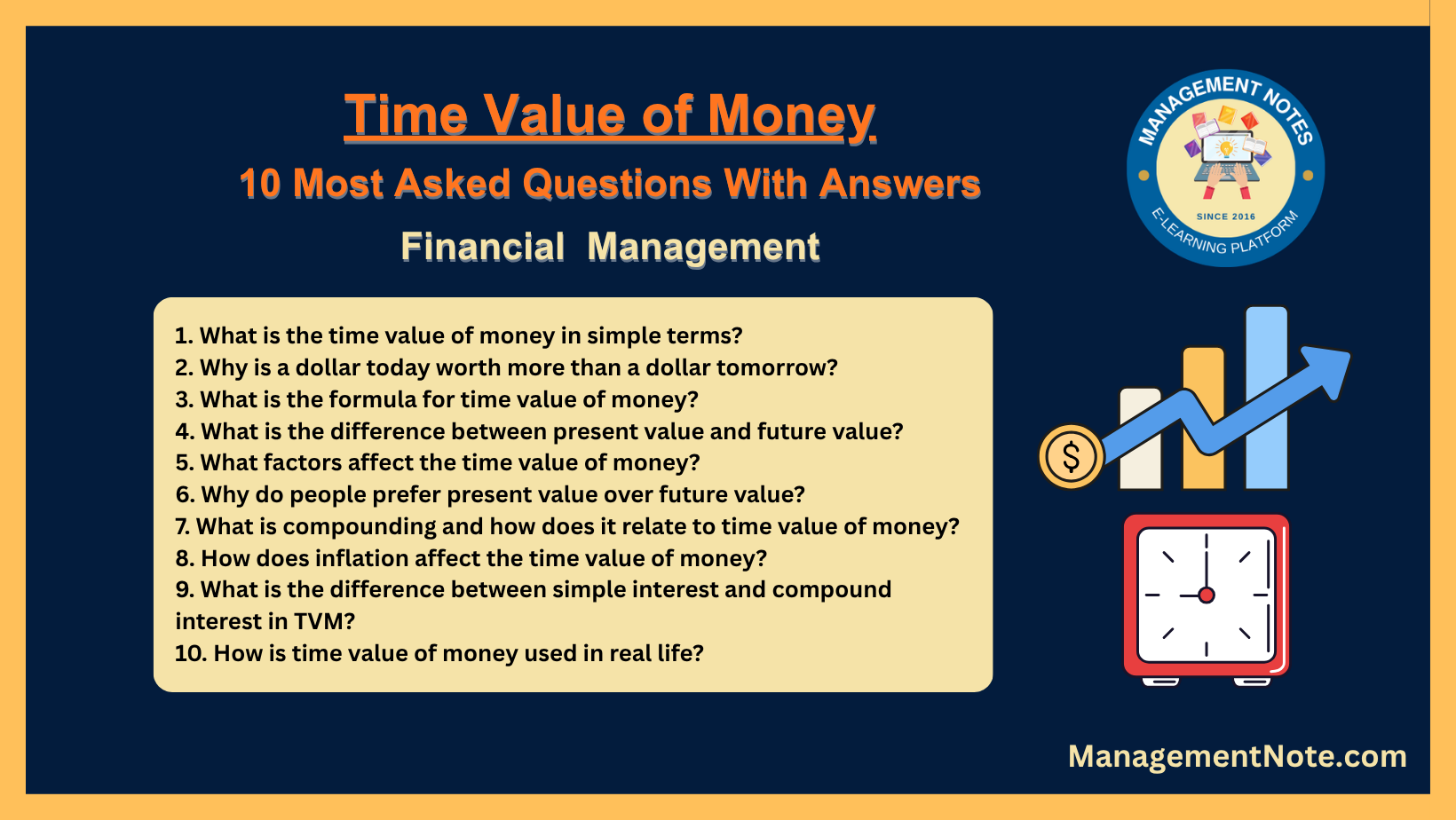
Time Value of Money (TVM): Definition, Formula, Questions & Answers | Financial Management
Time value of money (TVM) is one of the most fundamental ideas in finance. It explains why a dollar today is worth more than a dollar received in the future, and it forms the basis for nearly every financial decision, from savings accounts to major business investments.
What Is Time Value of Money?
Time value of money is the principle that money available now is worth more than the same amount in the future. This is because money in hand can be invested to earn interest or returns over time.
For example, $1,000 today can be invested and grow to $1,050 in a year at a 5% interest rate. That same $1,000 received a year from now would just be $1,000, with no chance to grow. This is why financial analysts always compare cash flows on the same time basis before making decisions.
Why Does Money Have a Time Value?
There are three main reasons money loses value the longer you wait to receive it:
- Opportunity cost: Money in hand today can be invested to earn a return. Money received later misses out on that growth.
- Inflation: Prices tend to rise over time, so the same dollar amount buys less in the future than it does today.
- Risk and uncertainty: A promise of future money carries some risk that it may not be paid at all, while money in hand today is certain.
Present Value and Future Value Explained
TVM calculations generally fall into two categories.
Present Value (PV) is the current worth of a sum of money that will be received in the future, discounted back at a given interest rate. It answers the question, “How much is a future payment worth today?”
Future Value (FV) is the amount a sum of money today will grow to after earning interest over a set period. It answers the question, “How much will today’s money be worth later?”
Basic TVM Formulas
Future Value: FV = PV × (1 + r)ⁿ
Present Value: PV = FV / (1 + r)ⁿ
Where:
- PV is present value
- FV is future value
- r is the interest rate per period
- n is the number of periods
Real-Life Example
Imagine someone offers to pay you $1,000 today or $1,100 one year from now. To decide which is better, you need to know what interest rate you could earn if you invested the $1,000 today.
If you can earn 8% on your money, $1,000 invested today grows to $1,080 in a year, which is less than the $1,100 offered later. In that case, waiting for the $1,100 payment is the better choice.
If you could earn 12% instead, your $1,000 would grow to $1,120, making the money today the better option. This is exactly how time value of money guides real financial decisions.
Present Value vs Future Value: Key Differences
| Concept | What It Answers | Direction of Calculation | Common Use |
|---|---|---|---|
| Present Value (PV) | What is a future amount worth today? | Discounts future money back to today | Valuing bonds, loans, and future payments |
| Future Value (FV) | What will today’s money be worth later? | Grows today’s money forward in time | Planning savings, retirement, and investment growth |
Time Value of Money MCQs
1. What is the time value of money in simple terms?
Time value of money means that a sum of money is worth more today than the same sum in the future. This is because money available now can be invested to earn interest, while money received later misses out on that opportunity to grow.
2. Why is a dollar today worth more than a dollar tomorrow?
A dollar today is worth more because it can be invested immediately and start earning a return. Waiting to receive that same dollar means losing out on potential interest or investment growth, and it also carries the risk of inflation reducing its buying power.
3. What is the formula for time value of money?
The two core formulas are Future Value, FV = PV × (1 + r)ⁿ, and Present Value, PV = FV / (1 + r)ⁿ. In both formulas, PV is present value, FV is future value, r is the interest rate per period, and n is the number of periods.
4. What is the difference between present value and future value?
Present value tells you what a future sum of money is worth today, calculated by discounting it back at a chosen interest rate. Future value tells you what a sum of money today will grow to after earning interest over time. They represent opposite directions of the same calculation.
5. What factors affect the time value of money?
The main factors are the interest rate, the length of time involved, and the compounding frequency. A higher interest rate or a longer time period increases the future value of money and decreases the present value of a future payment.
6. Why do people prefer present value over future value?
People generally prefer receiving money now because the future is uncertain and delayed payments carry more risk. Receiving money today also means it can be invested right away, so it has more earning potential than the same amount received later.
7. What is compounding and how does it relate to time value of money?
Compounding is the process of earning interest on both the original amount of money and on interest that has already been added to it. The more frequently interest compounds, the faster money grows, which is a central part of calculating future value in time value of money problems.
8. How does inflation affect the time value of money?
Inflation reduces the purchasing power of money over time, meaning the same dollar amount buys fewer goods and services in the future. This is one of the key reasons money available today is considered more valuable than the same amount received later.
9. What is the difference between simple interest and compound interest in TVM?
Simple interest is calculated only on the original amount of money, while compound interest is calculated on the original amount plus any interest already earned. Compound interest leads to faster growth over time, which is why most time value of money calculations use compounding.
10. How is time value of money used in real life?
Time value of money is used in everyday financial decisions such as comparing loan offers, valuing retirement savings, deciding between lump sum payments and installments, and evaluating whether an investment or business project is worth pursuing.
Final Thoughts
Time value of money is the foundation for almost every financial calculation, from personal savings goals to major business decisions. Understanding present value and future value helps you compare payments received at different times and make smarter choices with your money.
Sources
- Corporate Finance Institute, “Time Value of Money”
- Harvard Business School Online, “Time Value of Money: Definition, Examples, and Value”
- OpenStax, “Principles of Finance: Methods for Solving Time Value of Money Problems”
Disclaimer: This article is for general informational purposes only and does not constitute financial or investment advice. Always consult a licensed financial advisor before making investment decisions.

MBA- Finance Specialization
I am Smirti Bam, an enthusiastic edu blogger with a passion for sharing insights into the dynamic world of business and management through this website.
I hold a MBA degree from Presidential Business School, Kathmandu, and a BBA degree with a specialization in Finance from Apex College,
- Onboarding Vs. Orientation: Key Differences, Benefits, Process & Best Practices | Human Resource Management (HRM) - September 24, 2026
- Moonlighting Vs Freelancing: Meaning, Differences & Risks Explained | Human Resource Management (HRM) - September 14, 2026
- Employee Retention Vs. Employee Engagement: Key Differences Explained | Human Resource Management - September 6, 2026


