
Functional Management – Concept, Responsibilities, Advantages & Limitations | Principles of Management
Functional Management
The concept of functional management involves grouping employees according to their skills, expertise, and functions within an organization. Work activities are divided into specific areas or functions, such as finance, marketing, operations, and human resources. The activities and resources of each function are overseen by a manager or a team of managers.
According to their expertise areas, employees are usually divided into departments or divisions in functional management. In a marketing department, for example, employees are trained in marketing, whereas in a finance department, employees are trained in financial management, accounting, and related tasks.
A functional management system enhances efficiency, effectiveness, and specialization within a functional area by focusing on its specific tasks and developing deep expertise in those fields. As a result of this specialization, employees can perform better and be more productive.
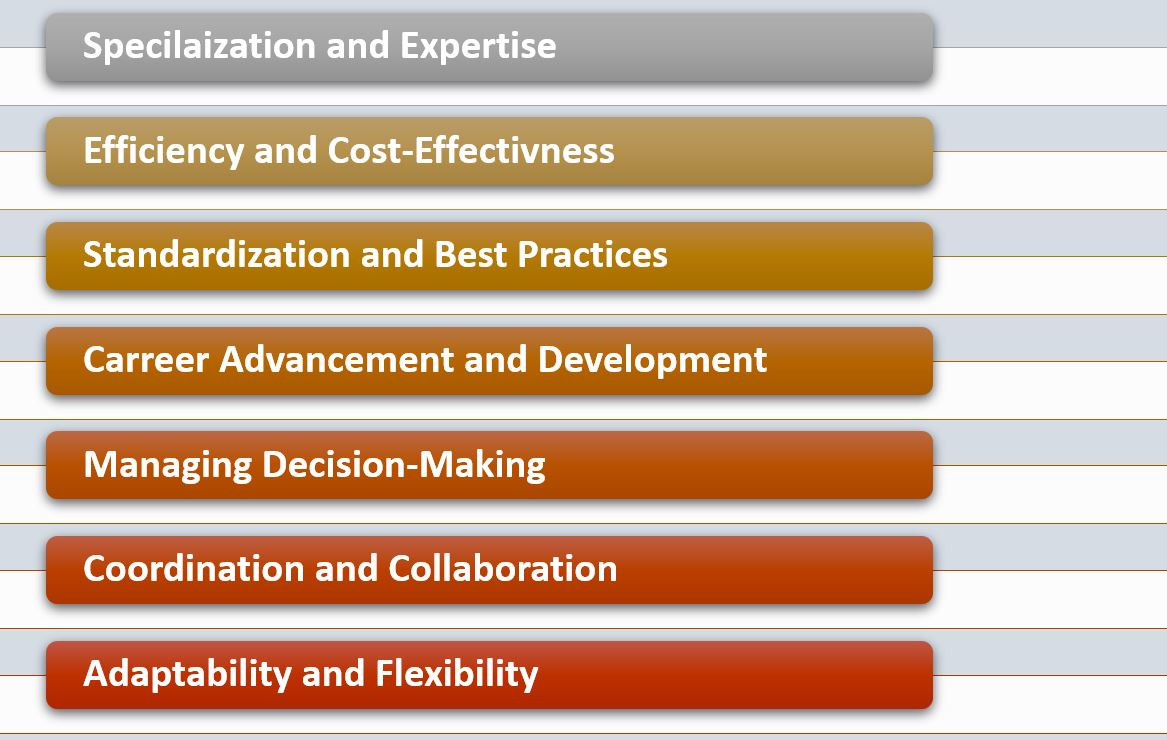
In order to fully understand functional management, we need to explore a few additional aspects described below:

Specialization and Expertise:
Functional management allows employees to specialize in their areas of expertise. Individuals with similar skills and knowledge can be grouped together to develop a deep understanding and proficiency in their functional domain by working together. Employees become highly skilled in performing their specific tasks as a result of this specialization.
Efficiency and Cost-Effectiveness:
Functional management promotes efficiency through economies of scale. It allows organizations to centralize resources, streamline processes, and eliminate duplications of effort by consolidating similar functions. An organization’s finance department, for example, can handle financial transactions, reports, and analysis for the entire organization, reducing redundancies and optimizing resource allocation.
Standardization and Best Practices:
Functional management encourages the development and implementation of standardized procedures and best practices within each function, thereby ensuring quality and consistency of work across the organization. By defining and disseminating these standards, functional managers enable employees to follow established guidelines and achieve their goals.
Career Advancement and Development:
Functional management provides employees with clear career paths and opportunities for growth within their respective functions. An employee can advance from an entry-level position to a managerial or leadership position as their skills and experience increase within their functional area.
Employees are motivated, loyal, and able to retain knowledge because of this career progression.
Managing decision-making:
Functional management enhances decision-making by delegating authority and accountability to functional managers. Managers can make informed decisions about their roles since they possess specialized knowledge in their domains.
As a result of this decentralized decision-making structure, managers are able to act quickly and efficiently, taking into account the unique requirements and constraints of their functional areas.
Coordination and Collaboration:
The goal of functional management is to provide effective coordination and collaboration among departments, but it also focuses on specialized functions. In order to align goals, share information, and resolve interdepartmental issues, functional managers interact with their counterparts in other departments.
Communication and collaboration ensure the organization operates cohesively and that functional goals are aligned with organizational goals.
Adaptability and Flexibility:
Organizations with dynamic and rapidly changing environments may face challenges with functional management. Because functional departments are generally designed to remain stable and consistent over time, organizations often adopt hybrid management approaches, such as matrix structures or cross-functional teams, to address this issue.
As a result of these structures, employees from different functions are able to collaborate on specific projects and initiatives with greater flexibility and adaptability.
In summary, functional management provides a framework for organizing employees according to their specialized skills and functions. As well as facilitating specialization, efficiency, and standardization within each function, it also requires effective coordination and collaboration among them.
Organizations can improve performance, decision-making, and organization effectiveness by leveraging functional manager expertise and promoting clear career paths.
Key Responsibilities of Functional Management
There are several key responsibilities of functional managers, including:
Planning: Functional managers define the scope of their work, set targets, and develop plans to achieve their objectives with their teams.
Organizing: A functional manager sets up organizational structures in their areas, assigns tasks, allocates resources, and establishes relationships of reporting to ensure that workflows and coordination flow smoothly.
Staffing: In the staffing process, functional managers identify skills and qualifications needed for different positions, conduct interviews, and make decisions regarding hiring, training, and development of employees within their department.
Directing: In functional management, managers clarify roles and responsibilities, set performance goals, and ensure that employees have the resources they need to accomplish their responsibilities.
Controlling: The operational manager is responsible for monitoring and evaluating the performance of each of his or her departments. They track progress, set performance metrics, and take corrective action as necessary to make sure goals are met.
Collaboration: Managing functional teams involves collaboration with other departments and teams within an organization. Functional managers align goals, share information, and coordinate efforts to achieve overall organizational objectives with colleagues.
Advantages of Functional Management
There are several advantages to functional management. They are as follows:

Specialization: A specialization strategy allows employees to focus on their areas of expertise, resulting in a higher level of proficiency and productivity.
Efficient Resource Allocation: An efficient resource allocation strategy involves allocating equipment, technology, and personnel in accordance with the needs of specific functional areas.
Clear Reporting Lines: Functional management has a hierarchical structure that facilitates communication and decision-making by clearly defining reporting relationships.
Knowledge Sharing: It is important for functional managers to exchange knowledge and best practices with employees within the same function, as well as learn from each other’s experience.
Limitations of Functional Management
The limitations of functional management should, however, be acknowledged. They are as follows:

Potential Silos:
There can be potential silos within an organization due to functional management. Employees tend to interact with each other within their functional departments. As a result, cross-functional communication and collaboration can be limited. As a result, effective coordination can be hindered and information and resources cannot be shared across functions effectively.
Reduced Organizational Alignment:
Focus on functional goals and priorities may overshadow the larger goals of the organization. Functional departments may pursue their own agendas that do not always align with the organization’s strategic goals. It is essential to strike a balance between functional goals and organizational goals.
Lack of Flexibility:
Functional management can sometimes be rigid and less adaptable to changing environments. A specialized function may make it difficult to respond quickly to market changes, new opportunities, or new challenges because of its specialized nature. A hybrid management approach can allow organizations to collaborate across functions and be more flexible.
Organizations often employ cross-functional teams, matrix structures, and process-oriented approaches to mitigate these limitations. As a result, organizations can leverage the strengths of functional management while overcoming its limitations by improving communication, collaboration, and alignment between different functions.
Functional management is an organizational approach aimed at grouping employees according to their specific skills and functions within a company. As a result, employees are able to concentrate on their areas of expertise through specialization, efficiency, and standardization within each function. Within their respective functions, functional managers plan, organize, direct, and control activities.
Despite its advantages, functional management has limitations as well, including potential silos and limited cross-functional communication, as well as increased specialization, efficient resource allocation, and clear reporting lines. For organizations to overcome these limitations and foster collaboration and adaptability, hybrid management approaches are often adopted.
In a dynamic business environment, organizations can maximize performance, achieve organizational objectives, and stay competitive by leveraging functional management’s benefits and addressing its challenges.

I am Bijisha, an enthusiast with a profound eagerness for learning. I hold a Bachelor’s degree in Business Administration(BBA) from Apex College. I am constantly driven by a relentless curiosity and a genuine desire to expand my knowledge horizons.
- Top 10 Best Books for Hospitality Management - December 9, 2023
- Top 10 Best Sociology Books for Beginners - December 5, 2023
- Top 10 Best Psychology Books on Human Behavior - December 3, 2023


