
Layoff Vs Termination Vs Furlough: What Is the Difference?
Losing a job feels the same no matter what it is called, but the terms layoff, termination, and furlough each mean something different under U.S. employment practices. The difference affects unemployment benefits, rehire possibilities, and how the situation is documented. This guide breaks down all three.
What Is a Layoff?
A layoff happens when a company ends an employee’s job for reasons unrelated to that employee’s performance. Layoffs usually happen because of budget cuts, restructuring, a merger, declining business, or a role being eliminated entirely. Layoffs can affect one person or hundreds of employees at once.
Employees who are laid off are generally eligible for unemployment benefits in the United States, since the job loss was not their fault. Some companies also offer severance pay, though this is not required by federal law in most cases.
What Is Termination?
Termination is a broader legal term that simply means an employee’s job has ended, for any reason. Termination can be voluntary, such as an employee resigning, or involuntary, such as an employee being let go.
In everyday use, termination often refers specifically to being fired for cause, meaning the employee was let go because of poor performance, misconduct, or a policy violation.
This is sometimes called “termination for cause” and is different from a layoff, since it is directly tied to the individual employee’s actions or performance.
What Is a Furlough?
A furlough is a temporary, unpaid or reduced pay leave of absence, but the employee technically remains employed. Furloughed employees usually keep their benefits, such as health insurance, and are expected to return to work once the furlough period ends.
Furloughs are often used during short term financial difficulty, seasonal slowdowns, or unexpected events that temporarily reduce the need for staff.
Unlike a layoff, a furlough is not meant to be permanent, and the employee has not lost their job. It is more like an extended, unpaid pause.
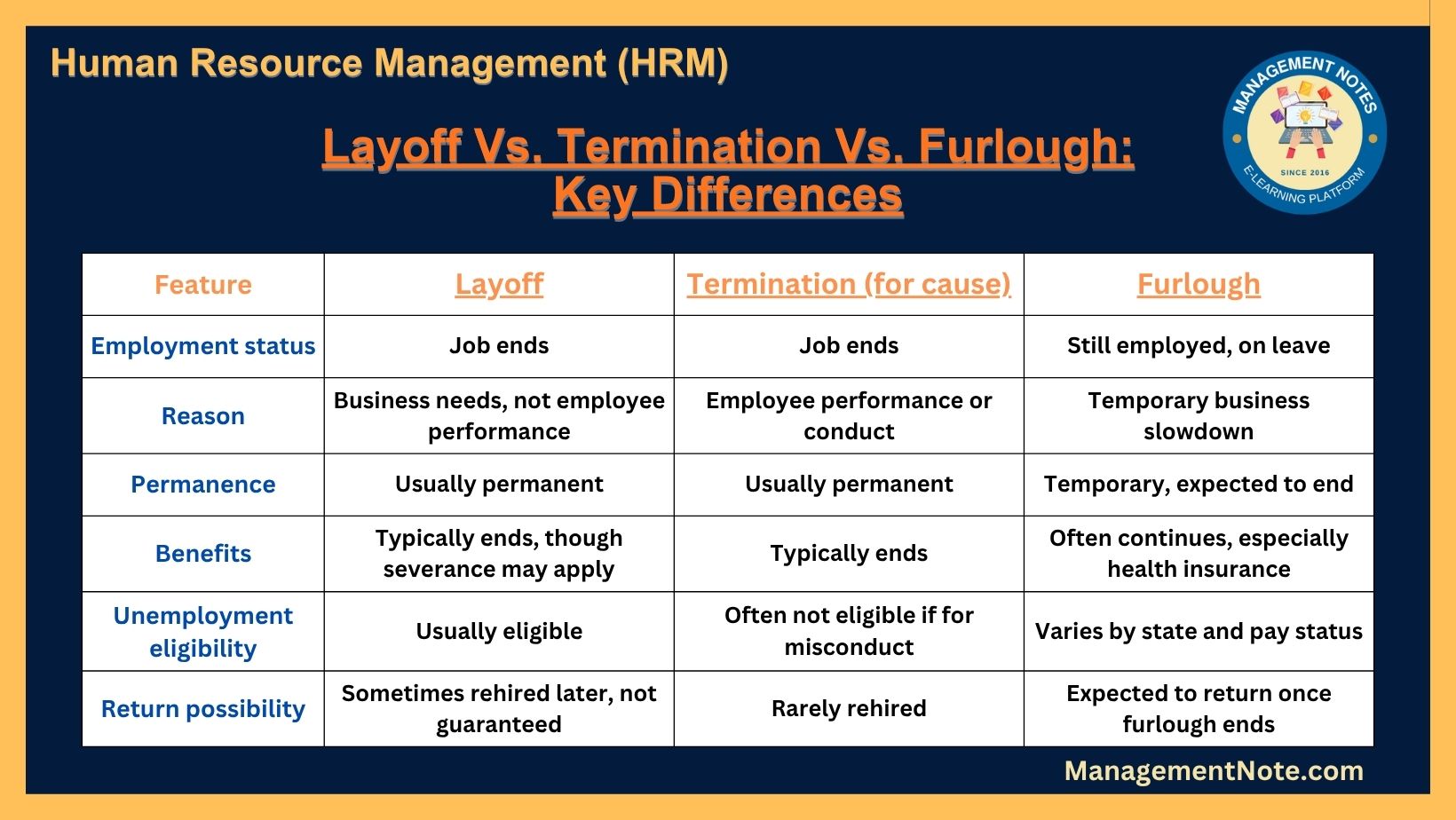
Layoff Vs Termination Vs Furlough: Key Differences
| Feature | Layoff | Termination (for cause) | Furlough |
|---|---|---|---|
| Employment status | Job ends | Job ends | Still employed, on leave |
| Reason | Business needs, not employee performance | Employee performance or conduct | Temporary business slowdown |
| Permanence | Usually permanent | Usually permanent | Temporary, expected to end |
| Benefits | Typically ends, though severance may apply | Typically ends | Often continues, especially health insurance |
| Unemployment eligibility | Usually eligible | Often not eligible if for misconduct | Varies by state and pay status |
| Return possibility | Sometimes rehired later, not guaranteed | Rarely rehired | Expected to return once furlough ends |
Real Life Example
A manufacturing company loses a major client and has to shut down one of its three production lines. Fifty employees who worked on that line lose their jobs through no fault of their own. This is a layoff.
At the same company, a warehouse worker is caught repeatedly violating safety procedures despite multiple warnings. The company ends his employment because of his own actions. This is a termination for cause.
During a slow winter season, a separate department temporarily reduces staff hours and asks ten employees to stay home without pay for six weeks, with a clear plan to bring them back once demand picks up again. This is a furlough.
Layoff vs Termination vs Furlough FAQs
Can a furloughed employee collect unemployment?
In many states, furloughed employees can collect partial or full unemployment benefits, depending on how much their hours or pay were reduced. Rules vary by state, so it is worth checking local unemployment guidelines.
Is a layoff the same as being fired?
No. A layoff happens because of business needs, such as budget cuts or restructuring, and is not related to the employee’s performance. Being fired usually means the job ended because of the employee’s own performance or conduct.
Does a furlough mean someone lost their job?
No. A furlough is a temporary, unpaid or reduced pay leave. The employee remains officially employed and is expected to return once the furlough ends.
Can a laid off employee be rehired later?
Sometimes. If business conditions improve, companies sometimes rehire employees who were laid off, especially if the layoff was due to a temporary downturn. There is no guarantee, though, since the position may no longer exist.
Key Takeaways
A layoff ends employment due to business needs unrelated to the employee’s performance. Termination broadly means employment has ended, and in common use often refers to being fired for cause.
A furlough is a temporary, unpaid or reduced pay leave where the employee keeps their job and is expected to return. Knowing the difference matters for unemployment benefits, rehire chances, and understanding exactly what happened and why.
You May Also Like:
- Onboarding Vs. Orientation: Key Differences, Benefits, Process & Best Practices | Human Resource Management (HRM)
- Moonlighting Vs Freelancing: Meaning, Differences & Risks Explained | Human Resource Management (HRM)

MBA- Finance Specialization
I am Smirti Bam, an enthusiastic edu blogger with a passion for sharing insights into the dynamic world of business and management through this website.
I hold a MBA degree from Presidential Business School, Kathmandu, and a BBA degree with a specialization in Finance from Apex College,
- Layoff Vs Termination Vs Furlough: What Is the Difference? - November 6, 2026
- Onboarding Vs. Orientation: Key Differences, Benefits, Process & Best Practices | Human Resource Management (HRM) - September 24, 2026
- Moonlighting Vs Freelancing: Meaning, Differences & Risks Explained | Human Resource Management (HRM) - September 14, 2026


