
Moonlighting Vs Freelancing: Meaning, Differences & Risks Explained | Human Resource Management (HRM)
More people are earning income outside their main job than ever before. Two common ways this happens are moonlighting and freelancing.
While both involve extra work outside a person’s primary role, they are structured very differently and carry different risks. Here is a clear breakdown of both.
What Is Moonlighting?
Moonlighting means working a second job, often in secret, while still employed full time somewhere else. The term comes from the idea of doing extra work at night, after normal working hours.
Moonlighting can involve any type of work, from a part time retail job to freelance projects, as long as it is happening alongside a full time position.
Moonlighting becomes a workplace issue when it is not disclosed to the primary employer, especially if the second job creates a conflict of interest, uses company time or resources, or involves working for a direct competitor.
What Is Freelancing?
Freelancing means working independently on a project basis for multiple clients, rather than being a permanent employee of any single company.
Freelancers are typically self-employed, set their own rates, choose their own projects, and are responsible for their own taxes and benefits. Common freelance fields include writing, graphic design, web development, consulting, and photography.
Freelancing can be someone’s only source of income, or it can be done alongside a full-time job, which is where it sometimes overlaps with moonlighting.
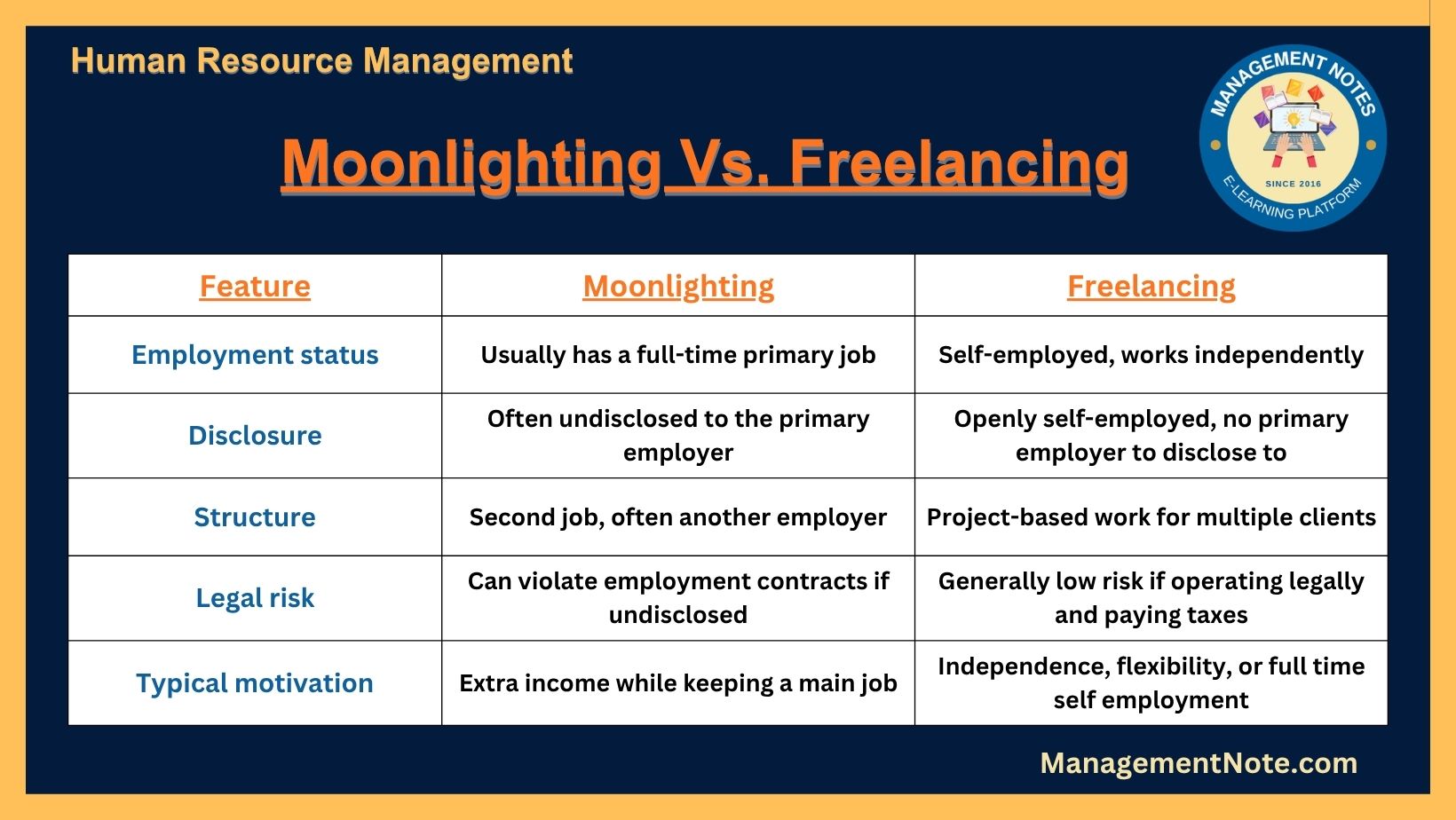
Moonlighting Vs Freelancing: Key Differences
| Feature | Moonlighting | Freelancing |
|---|---|---|
| Employment status | Usually has a full-time primary job | Self-employed, works independently |
| Disclosure | Often undisclosed to the primary employer | Openly self-employed, no primary employer to disclose to |
| Structure | Second job, often another employer | Project-based work for multiple clients |
| Legal risk | Can violate employment contracts if undisclosed | Generally low risk if operating legally and paying taxes |
| Typical motivation | Extra income while keeping a main job | Independence, flexibility, or full time self employment |
Is Moonlighting Legal?
In most of the United States, moonlighting itself is legal. Employees are generally free to work a second job on their own time. The risk comes from employment contracts.
Many jobs include clauses that require employees to disclose outside work, avoid conflicts of interest, or avoid working for a competitor. Violating these terms can lead to disciplinary action or termination, even if the moonlighting itself is not illegal.
Is Freelancing Legal?
Yes, freelancing is legal and common across the United States. Freelancers are considered independent contractors rather than employees, which means they are responsible for paying their own self-employment taxes and do not receive employer provided benefits like health insurance or paid time off.
Some full-time employees freelance on the side, which is legal as long as it does not conflict with their primary employment contract.
Real Life Example
A full-time accountant secretly starts doing bookkeeping for a small local business on weekends without telling her employer. She is not violating any law, but if her employment contract requires disclosure of outside work, she could face consequences at her main job if it is discovered. This is moonlighting.
A graphic designer leaves her full-time job to work independently, taking on logo design and branding projects for five different small businesses at once, setting her own hours and rates. This is freelancing, and since she has no single employer, there is no conflict of interest to worry about.
Moonlighting Vs Freelancing FAQs
Can someone moonlight and freelance at the same time?
Yes. A person with a full-time job who takes on freelance projects on the side is technically moonlighting through freelance work. The key issue is whether their main employer allows outside work under their contract.
Do freelancers need to tell their full-time employer?
It depends on the employment contract. Some contracts require disclosure of any outside work, especially if it could create a conflict of interest, while others place no restrictions on side work done on personal time.
Is moonlighting always risky?
Not always, but it depends on the employment agreement. Moonlighting becomes risky when it is undisclosed and violates a contract, involves a competitor, or uses company time and resources.
Do freelancers pay different taxes than employees?
Yes. Freelancers are considered self-employed and are typically responsible for paying self-employment tax, which covers Social Security and Medicare contributions usually split between an employer and employee in traditional jobs.
Key Takeaways
Moonlighting means working a second job, often undisclosed, while holding a full-time position elsewhere. Freelancing means working independently on a project basis for multiple clients as a self-employed professional.
The two can overlap, since freelance work can be a form of moonlighting, but the biggest difference comes down to employment status and whether outside work has been properly disclosed under an employment contract.
You May Also Like:
- Employee Retention Vs. Employee Engagement: Key Differences Explained | Human Resource Management
- Talent Acquisition Vs Talent Management: What Is the Difference?
- Headhunting vs Recruitment: Major Differences Explained | Human Resource Management

MBA- Finance Specialization
I am Smirti Bam, an enthusiastic edu blogger with a passion for sharing insights into the dynamic world of business and management through this website.
I hold a MBA degree from Presidential Business School, Kathmandu, and a BBA degree with a specialization in Finance from Apex College,
- Moonlighting Vs Freelancing: Meaning, Differences & Risks Explained | Human Resource Management (HRM) - September 14, 2026
- Employee Retention Vs. Employee Engagement: Key Differences Explained | Human Resource Management - September 6, 2026
- Talent Acquisition Vs Talent Management: What Is the Difference? - September 2, 2026


