
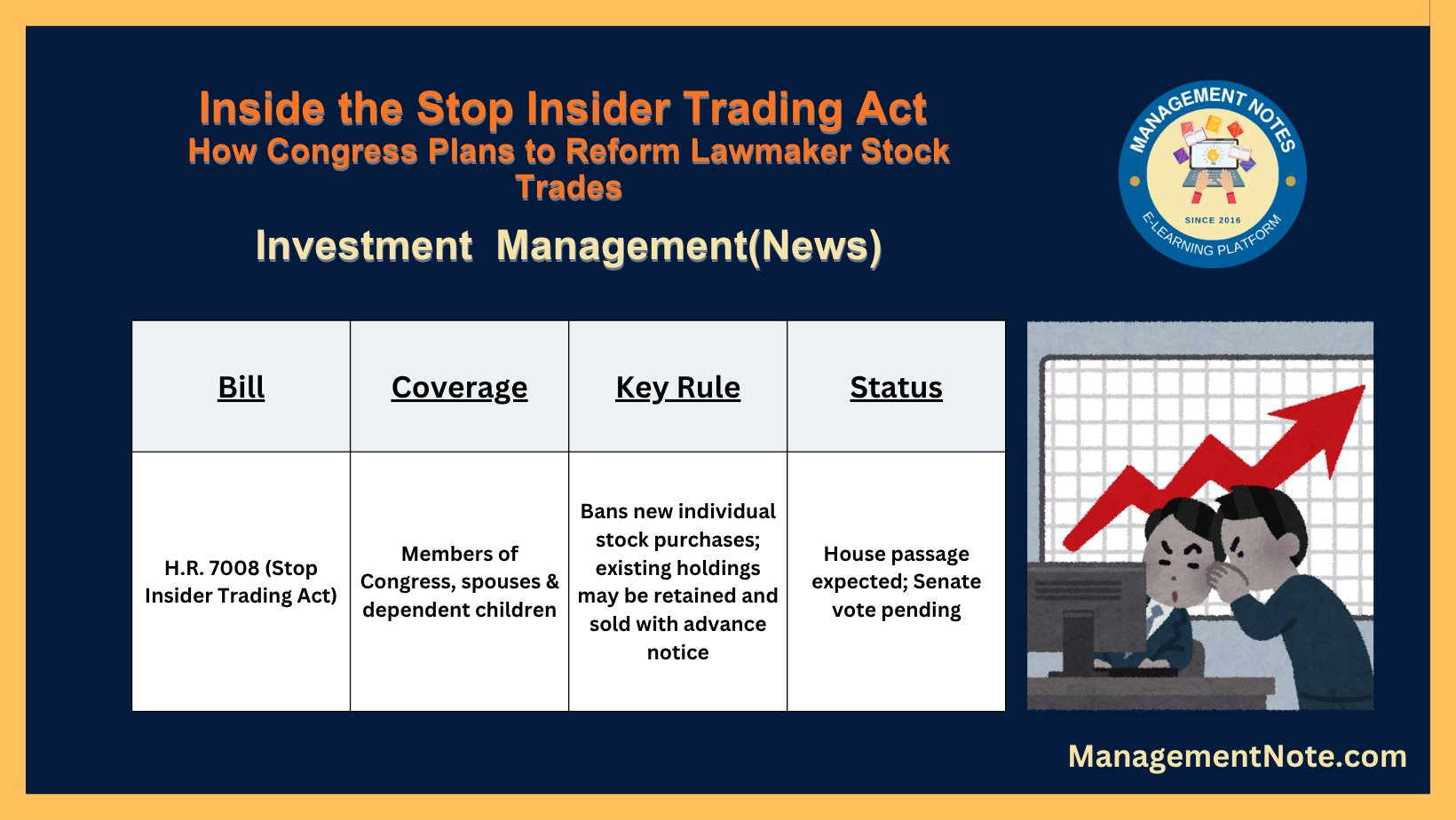
Inside the Stop Insider Trading Act : How Congress Plans to Reform Lawmaker Stock Trades | Investment News
After years of failed attempts, the U.S. House of Representatives has brought the Stop Insider Trading Act (H.R. 7008) to the House floor. The legislation represents the most significant congressional effort in years to restrict lawmakers from trading individual stocks while in office.
Supporters argue it is a meaningful step toward restoring public trust, while critics say it leaves major loopholes that fail to address the core issue of insider trading.
What Is Insider Trading?
Insider trading is the buying or selling of securities using material, non-public information (MNPI) that could influence an investor’s decision. Under U.S. securities law, trading on confidential information obtained through a position of trust is illegal because it gives an unfair advantage over ordinary investors.
Material information includes:
- Upcoming mergers or acquisitions
- Quarterly earnings before public release
- Major government contracts
- Regulatory decisions
- Drug approvals
- National emergencies affecting financial markets
For example, if a company executive purchases company shares after learning that earnings will significantly exceed expectations before the information becomes public, that constitutes illegal insider trading.
Legal Vs. Illegal Insider Trading
Not all insider trading is unlawful.
Legal insider trading
- Corporate executives may buy or sell shares of their companies.
- Transactions must be disclosed to the U.S. Securities and Exchange Commission (SEC).
- Trades must comply with SEC reporting rules and trading windows.
Illegal insider trading
- Trading based on confidential information unavailable to the public.
- Sharing confidential information so another person can trade.
- Using government or corporate information for personal financial gain.
Violations may result in civil penalties, criminal fines, disgorgement of profits, and imprisonment.
Why Congressional Stock Trading Is Different
Members of Congress routinely receive classified intelligence briefings, confidential economic forecasts, and advance knowledge of legislation that can influence entire industries.
Although they are already prohibited from trading on material non-public information under existing law, critics argue that allowing lawmakers to own and actively trade individual stocks creates unavoidable conflicts of interest.
Examples include:
- Defense appropriations
- Banking regulation
- Healthcare legislation
- Technology regulation
- Tariffs
- Pandemic response planning
Even when no law is broken, public confidence may be undermined if lawmakers appear to profit from information unavailable to ordinary investors.
Existing Law: The STOCK Act of 2012
Congress passed the STOCK Act (Stop Trading on Congressional Knowledge Act) in 2012 following widespread criticism of congressional trading practices.
The law:
- Prohibits members from using non-public government information for financial gain.
- Requires disclosure of stock trades within 45 days.
- Makes financial disclosures publicly accessible.
However, the law does not prohibit lawmakers from owning or trading individual stocks, and penalties for late disclosure are generally limited to a modest fine, leading many observers to argue that enforcement has been weak [6][17].
What the Stop Insider Trading Act Would Do
| Provision | Details |
|---|---|
| New stock purchases | Prohibited for members, spouses, and dependent children |
| Existing holdings | May continue to be owned |
| Selling existing holdings | Permitted with 7 to 14 days advance public notice |
| Diversified funds | Exempt |
| Penalties | Greater of $2,000 or 10% of transaction value, plus forfeiture of gains |
| Enforcement | Ethics offices may refer cases to the Department of Justice |
| Estimated federal cost | Less than $500,000 through 2031 |
(Source: Congressional Budget Office and House Committee Report)
Legislative Timeline
| Date | Event |
|---|---|
| Jan. 12, 2026 | Bill introduced |
| Jan. 14, 2026 | Committee approval |
| Mar. 18, 2026 | Senate companion introduced |
| Jul. 20, 2026 | Rules Committee approval |
| Jul. 21, 2026 | Debate rule adopted |
| Jul. 22, 2026 | House vote expected |
Political Controversy
Republican leadership combined the Stop Insider Trading Act with voter identification legislation aligned with President Donald Trump’s SAVE America Act priorities.
Democratic lawmakers argued that the pairing complicated bipartisan ethics reform and renewed calls for a broader prohibition covering the President, Vice President, Cabinet officials, and federal judges.
Competing Proposals
| Bill | Main Proposal | Status |
|---|---|---|
| Stop Insider Trading Act | Ban future purchases | House consideration |
| Restore Trust in Congress Act | Requires divestment | 141 co-sponsors |
| End Congressional Stock Trading Act | Complete ownership ban | Discharge petition pending |
| HONEST Act | Senate proposal | Awaiting vote |
Supporters’ View
Supporters contend that the legislation:
- Creates the first meaningful restriction on congressional stock purchases.
- Applies to spouses and dependent children.
- Strengthens financial penalties.
- Improves transparency through advance notice requirements.
- Enjoys bipartisan support.
Representative Chip Roy described the legislation as “a giant step forward”.
Critics’ View
Critics argue that the bill:
- Allows lawmakers to retain existing stocks.
- Permits strategic timing of stock sales.
- Leaves significant exemptions.
- Excludes the President and senior executive officials.
- Would not have prevented previous controversial congressional trades.
The Campaign Legal Center maintains that the bill’s exceptions substantially weaken its effectiveness.
Major Real-Life Insider Trading Cases
Martha Stewart (2001)
Martha Stewart sold approximately 4,000 shares of ImClone Systems after receiving confidential information before adverse FDA news became public. She was convicted of conspiracy, obstruction of justice, and making false statements in 2004, though not insider trading itself.
Raj Rajaratnam (Galleon Group)
Raj Rajaratnam orchestrated one of the largest insider trading conspiracies in U.S. history by obtaining confidential corporate information from insiders at companies including Intel and Goldman Sachs. He was sentenced to 11 years in federal prison in 2011.
SAC Capital Advisors
Federal prosecutors alleged that employees at SAC Capital repeatedly traded using confidential corporate information. The hedge fund pleaded guilty in 2013 and paid approximately $1.8 billion in criminal and civil penalties.
Congressional COVID-19 Trading Controversy (2020)
Several senators, including Richard Burr, Kelly Loeffler, James Inhofe, and Dianne Feinstein, came under investigation after selling stocks shortly before COVID-19 triggered a market collapse.
Although no criminal charges resulted, the controversy intensified calls for stronger congressional ethics laws.
Chris Collins
Former Representative Chris Collins tipped confidential information about a failed biotechnology drug trial to his son, who sold stock before the news became public. Collins pleaded guilty in 2019 and was sentenced to prison before later receiving a presidential pardon [26][27].
Senate Outlook
The legislation still faces substantial hurdles in the Senate. Passage will likely require bipartisan support to overcome the Senate filibuster, and no floor vote has yet been scheduled despite sponsors expressing optimism.
Conclusion
The Stop Insider Trading Act represents the most serious congressional effort in years to restrict lawmakers’ individual stock trading.
While it would prohibit future stock purchases by members of Congress and their immediate families, it does not require divestment of existing holdings, leaving critics unconvinced that it fully addresses conflicts of interest.
Whether the bill ultimately becomes law or not, it has renewed national debate over ethics, transparency, and public trust in government.
References
- Campaign Legal Center. (2026, January 13). CLC urges House Administration Committee to vote no on Stop Insider Trading Act. https://campaignlegal.org/document/clc-urges-house-administration-committee-vote-no-stop-insider-trading-act
- Campaign Legal Center. (2026, January 30). How the Stop Insider Trading Act fails to solve the congressional stock trading problem. https://campaignlegal.org/document/how-stop-insider-trading-act-fails-solve-congressional-stock-trading-problem
- CNBC. (2026, July 22). Congressional stock trading curb due to get House vote amid public support for a ban. https://www.cnbc.com/2026/07/22/house-congressional-stock-trading.html
- Colorado Public Radio. (2026, July 22). Good faith effort or ploy? U.S. House expected to vote on stock trading ban. https://www.cpr.org/2026/07/22/congress-stock-trading-ban-bill/
- Congress.gov. (2026). H.R. 7008: Stop Insider Trading Act. Library of Congress. https://www.congress.gov/bill/119th-congress/house-bill/7008
- Congress.gov. (2012). Stop Trading on Congressional Knowledge (STOCK) Act of 2012. Library of Congress. https://www.congress.gov
- Congressional Budget Office. (2026). H.R. 7008, Stop Insider Trading Act: Cost estimate. https://www.cbo.gov/publication/62243
- Federal Bureau of Investigation. (2020). Congressional COVID-19 stock trading investigations. https://www.fbi.gov
- House Committee on House Administration. (2026). H. Rept. 119-479: Stop Insider Trading Act. https://www.congress.gov/committee-report/119th-congress/house-report/479/1
- House Republican Cloakroom. (2026, July 21). Tuesday July 21st, 2026 floor summary. https://repcloakroom.house.gov/floor/tuesday-july-21st-2026/
- Martha Stewart Living Omnimedia, Inc. v. Securities and Exchange Commission. (2004). https://www.sec.gov
- NOTUS. (2026, July 21). A House stock-trade ban may finally advance. The Senate might squash it. https://www.notus.org/congress/congressional-stock-trade-ban-bill-house-senate-advances
- Office of Senator Bill Cassidy. (2026, March 18). Cassidy, Ricketts introduce bill to ban congressional stock trading, restore trust in Congress. https://www.cassidy.senate.gov/newsroom/press-releases/cassidy-ricketts-introduce-bill-to-ban-congressional-stock-trading-restore-trust-in-congress/
- Office of Representative Nick Begich. (2026, January 15). Congressman Begich co-sponsors Stop Insider Trading Act to restore trust in Congress. https://begich.house.gov/media/press-releases/congressman-begich-co-sponsors-stop-insider-trading-act-restore-trust-congress
- Roll Call. (2026, March 31). Lawmakers said they wanted to rein in their own stock trading. What happened? https://rollcall.com/2026/03/31/congress-stock-trading-ban-what-happened/
- Securities and Exchange Commission. (n.d.). Insider trading. https://www.sec.gov/about/what-we-do/enforce/insider-trading
- Securities and Exchange Commission. (2013). SAC Capital Advisors agrees to plead guilty and pay $1.8 billion. https://www.sec.gov
- Securities and Exchange Commission. (2011). SEC v. Raj Rajaratnam. https://www.sec.gov
- The Epoch Times. (2026, July 21). What to know about the Stop Insider Trading Act. https://www.theepochtimes.com/us/what-to-know-about-the-stop-insider-trading-act-6064775
- U.S. Department of Justice. (2004). United States v. Martha Stewart. https://www.justice.gov
- U.S. Department of Justice. (2011). United States v. Raj Rajaratnam. https://www.justice.gov
- U.S. Department of Justice. (2019). United States v. Christopher Collins. https://www.justice.gov
- U.S. House Committee on Rules. (2026). H.R. 7008: Stop Insider Trading Act. https://rules.house.gov/bill/119/hr-7008

MBA- Finance Specialization
I am Smirti Bam, an enthusiastic edu blogger with a passion for sharing insights into the dynamic world of business and management through this website.
I hold a MBA degree from Presidential Business School, Kathmandu, and a BBA degree with a specialization in Finance from Apex College,
- Onboarding Vs. Orientation: Key Differences, Benefits, Process & Best Practices | Human Resource Management (HRM) - September 24, 2026
- Moonlighting Vs Freelancing: Meaning, Differences & Risks Explained | Human Resource Management (HRM) - September 14, 2026
- Employee Retention Vs. Employee Engagement: Key Differences Explained | Human Resource Management - September 6, 2026


