
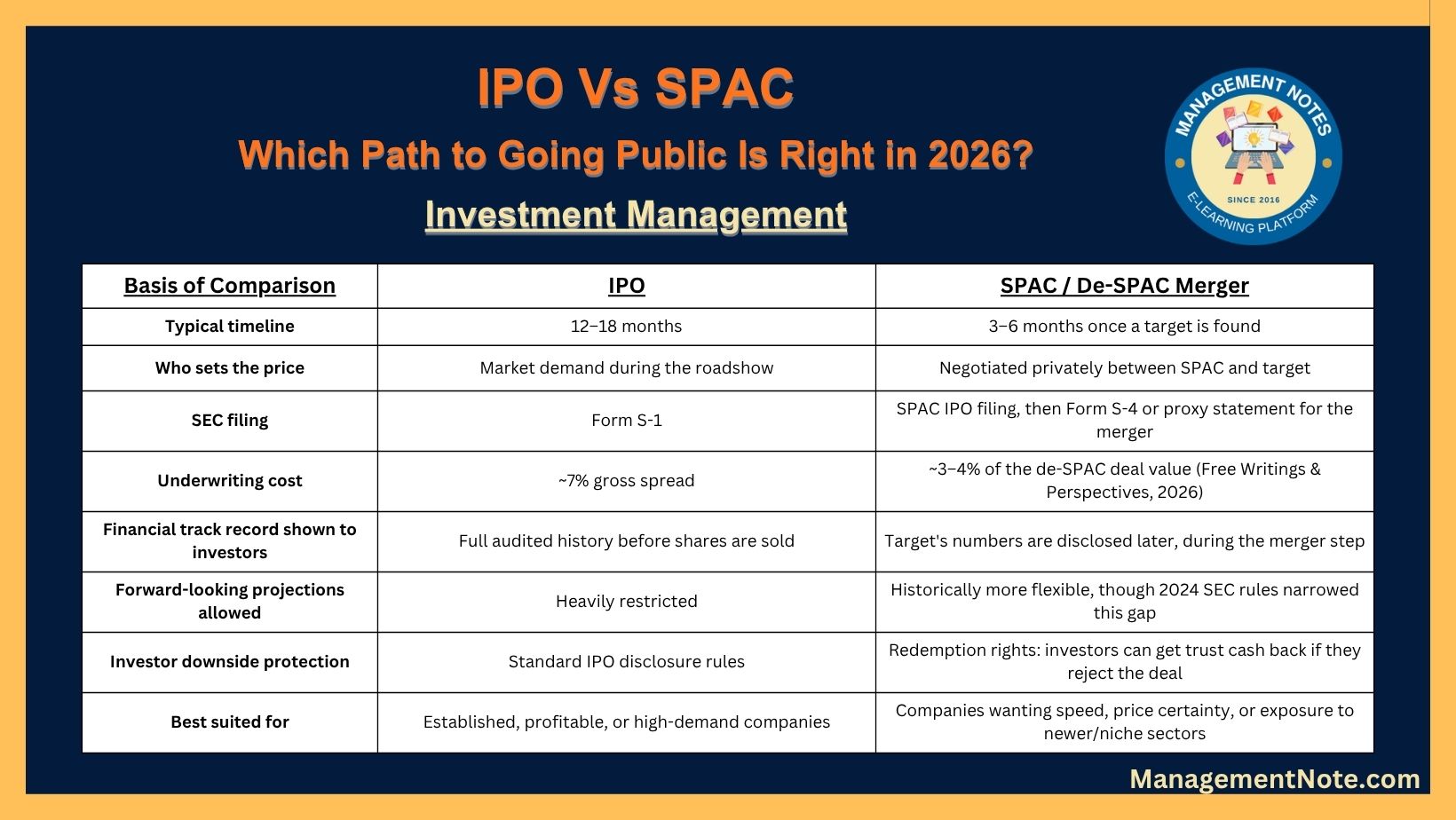
IPO Vs SPAC: Which Path to Going Public Is Right in 2026? | Investment Management
An IPO (Initial Public Offering) is when a private company sells new shares to the public for the first time, usually with help from investment banks. A SPAC (Special Purpose Acquisition Company) is a shell company that raises money first, then goes looking for a private business to merge with.
Once the merger closes, the private company becomes public without running a traditional IPO. IPOs tend to offer more investor protection and price stability. SPACs tend to be faster and give the target company more control over its valuation.
Both roads lead to the same place: a company’s stock trading on a public exchange. But how each company gets there, how long it takes, and how much risk investors take on are very different.
Introduction: IPO and SPAC, Two Paths to Going Public
Every year, private companies decide it’s time to sell shares to the public. This move is called “going public.” There are two main ways to do it: the traditional IPO route, or the newer SPAC route.
For most of stock market history, the IPO was the only real option. That changed around 2020, when SPACs suddenly became a fast, popular shortcut.
The SPAC boom peaked in 2021, cooled off sharply through 2022–2024, and then came roaring back in 2025 and 2026 alongside a strong traditional IPO market too, with a total of 1,268 SPAC IPOs priced between 2020 and 2026, raising a combined $288.81 billion (Boardroom Alpha, 2026).
Meanwhile, traditional IPOs also had their best run since 2021, raising around $44 billion across 202 deals in 2025 alone (Renaissance Capital, 2026).
So in 2026, both paths are active at the same time. That makes the IPO vs. SPAC choice more relevant than ever, for companies deciding how to go public, and for everyday investors deciding where to put their money.
What Is an IPO? (Process, Underwriters, Timeline)
An IPO is the classic way a private company becomes a public one. The company hires investment banks (called underwriters) to help set a fair share price, market the stock to big investors, and handle the legal filings.
How a typical IPO works, step by step:

A traditional IPO usually takes twelve to eighteen months from start to finish (KPMG, 2022). It gives investors detailed financial history and audited numbers before they buy in. The tradeoff is cost and time: underwriters typically charge a gross spread of around 7% of the money raised (Free Writings & Perspectives, 2026).
Real-world example: In 2025, stablecoin company Circle went public through a traditional IPO. Shares priced at $31 and jumped as high as $103 on the very first trading day, later touching nearly $299 before settling lower, a reminder that even “safe” IPOs can be highly volatile (Immergrow, 2026).
What Is a SPAC? (Blank-Check Structure, Trust Account, Sponsors)
A SPAC, also called a “blank check company,” is a shell company with no products, no revenue, and no operations. Its only job is to raise cash from investors, hold that cash in a trust account, and then find a private company to merge with.
How a SPAC works, step by step:

This last step is called a de-SPAC transaction. If sponsors can’t find and close a deal in time, the SPAC must return the trust money to shareholders (U.S. Securities and Exchange Commission, 2024a).
Real-world example: In 2020, sports-betting company DraftKings merged with a SPAC called Diamond Eagle Acquisition Corp. The SPAC had raised $350 million, and the completed merger valued DraftKings at about $3.3 billion, all without DraftKings running a traditional IPO roadshow (IG International, 2022).
IPO vs SPAC: Comparison Table
| Basis of Comparison | Traditional IPO | SPAC / De-SPAC Merger |
|---|---|---|
| Typical timeline | 12–18 months | 3–6 months once a target is found |
| Who sets the price | Market demand during the roadshow | Negotiated privately between SPAC and target |
| SEC filing | Form S-1 | SPAC IPO filing, then Form S-4 or proxy statement for the merger |
| Underwriting cost | ~7% gross spread | ~3–4% of the de-SPAC deal value (Free Writings & Perspectives, 2026) |
| Financial track record shown to investors | Full audited history before shares are sold | Target’s numbers are disclosed later, during the merger step |
| Forward-looking projections allowed | Heavily restricted | Historically more flexible, though 2024 SEC rules narrowed this gap |
| Investor downside protection | Standard IPO disclosure rules | Redemption rights: investors can get trust cash back if they reject the deal |
| Best suited for | Established, profitable, or high-demand companies | Companies wanting speed, price certainty, or exposure to newer/niche sectors |
The De-SPAC Merger Process Explained
The “de-SPAC” is the moment a shell company actually becomes a real, operating public company. Here’s what makes it different from a normal IPO:
PIPE financing: Many SPAC deals raise extra money through a Private Investment in Public Equity (PIPE), where institutional investors buy shares at a set price to help fund the merger. In 2025, SPAC PIPE deals raised over $907 million in additional capital (Free Writings & Perspectives, 2026).
Redemptions: Before the merger closes, SPAC shareholders can choose to redeem their shares for a pro-rata share of the trust account instead of joining the merged company. Redemption rates were extremely high (often over 90%) in 2023–2024, though they have moderated since (Free Writings & Perspectives, 2026).
The “clock problem”: Because SPACs have a hard deadline to find a target, sponsors that are running out of time can feel pressure to accept a weaker deal just to avoid returning the cash (Bernstein, 2026).
Pros and Cons for Companies Going Public
| Pros | Cons | |
|---|---|---|
| IPO | Broad investor base; strong credibility signal; usually raises more total capital | Slower; expensive; exposed to market timing risk during the roadshow |
| SPAC | Faster; negotiated (not market-set) valuation; access to experienced sponsors | Dilution from sponsor “promote” shares and warrants; can face high redemptions; more regulatory scrutiny since 2024 |
SPAC sponsors typically keep about 20% of the shell company’s equity as compensation, known as the “promote” (Columbia Law School Blue Sky Blog, n.d.). This is a real cost that dilutes the value going to the operating company and its shareholders after the merger.
Pros and Cons for Investors (Risk, Returns, Dilution)
Buying into a SPAC is not the same as buying into an IPO, and the SEC has specifically warned retail investors about the differences (U.S. Securities and Exchange Commission, 2024a).
Before a merger: SPAC shares are backed by cash in trust, so downside risk is limited; investors can usually redeem for close to their original investment.
After a merger: Once the de-SPAC deal closes, the stock behaves like any other public company stock. Many post-merger SPAC companies have historically underperformed the broader market, partly due to dilution from sponsor shares and warrants.
IPO investors: Take on more “pop or drop” risk on day one, since the price is set by market demand rather than a negotiated deal.
In 2024, the SEC adopted new rules requiring SPACs to disclose more information about sponsor compensation, dilution, and conflicts of interest, bringing SPAC investor protections closer in line with traditional IPOs (U.S. Securities and Exchange Commission, 2024b).
Market Trends: SPAC Boom, Bust, and 2026 Resurgence
The numbers tell the story of a wild few years:
| Year | SPAC IPOs | Capital Raised | Notes |
|---|---|---|---|
| 2021 | 614 | $144.9 billion | All-time peak (Boardroom Alpha, 2026) |
| 2022–2024 | Sharp decline | N/A | Higher interest rates and new SEC scrutiny cooled the market |
| 2025 | 144 | $30+ billion | Recovery begins (Free Writings & Perspectives, 2026) |
| 2026 (through late June) | 116 | $22.7 billion | “Second act” led by experienced, repeat sponsors (Bernstein, 2026) |
Traditional IPOs bounced back too. Renaissance Capital (2026) counted 88 IPOs in the first half of 2026, following the strongest year for new listings since 2021 in 2025. Notably, SPACs made up about 69% of total U.S.
IPO deal volume by count in the first quarter of 2026, even as traditional IPOs brought in far more total dollars thanks to a handful of giant listings (FTI Consulting, 2026). Deal flow in 2026 is concentrated in AI, semiconductors, quantum computing, critical minerals, and infrastructure and power (EY, 2026; ICR, 2026).
As of mid-2026, roughly 251 SPACs were still searching for acquisition targets, holding close to $47 billion in trust, meaning plenty of deals are still to come (Free Writings & Perspectives, 2026).
How to Invest in an IPO vs a SPAC (Practical Steps)
To invest in an IPO:
- Open a brokerage account that offers IPO access (some brokers require a minimum account balance or history).
- Watch for the company’s SEC filing (Form S-1) and roadshow news.
- Submit an indication of interest before pricing, or buy shares on the open market once trading begins.
To invest in a SPAC:
- Buy SPAC “units” (usually priced around $10) on a major exchange like any other stock, either during the SPAC’s own IPO or afterward.
- Track SEC filings and news for the announced merger target.
- Decide whether to hold through the merger, sell beforehand, or redeem your shares for trust cash if you vote against the deal.
Either way, read the company’s SEC filings before investing, since they contain the clearest picture of risk, sponsor compensation, and dilution.
FAQs and Conclusion: Which Route Is Right for You?
Is a SPAC riskier than an IPO?
After the merger, yes: SPAC-merged companies have often carried more dilution and shown weaker average post-deal performance than traditional IPO companies. Before the merger, SPAC shares are relatively low-risk because of the trust account.
Can you lose money in a SPAC?
Yes, once the de-SPAC merger closes and the stock trades on its own fundamentals. Before the merger, losses are limited because investors can usually redeem shares for close to the trust value.
How long does each process take?
A traditional IPO usually takes 12–18 months. A SPAC merger can close in 3–6 months once a target is chosen, though finding that target can take up to three years.
Are SPACs making a comeback in 2026?
Yes. SPAC IPO activity in 2026 has returned to levels not seen since early 2022, led by experienced “serial” sponsors and renewed institutional PIPE funding (ICR, 2026).
Which one should a company choose?
There’s no single right answer. Mature, profitable companies with strong investor demand often prefer the traditional IPO route for its credibility and larger capital raise.
Companies that want speed, price certainty, or access to sectors that are harder to value with standard IPO metrics, like early-stage AI, biotech, or critical minerals firms, often lean toward a SPAC merger.
Both paths get a company to the same finish line: a public listing. The right choice comes down to timeline, cost, valuation certainty, and how much regulatory and market risk each side is willing to accept.
(Disclaimer: This article is for educational purposes only and is not investment or legal advice. Always consult a licensed financial advisor before making investment decisions.)
References
Bernstein, D. (2026, June 30). The SPAC party is in full swing, but is it different this time? I’m cautiously optimistic. Forbes. https://www.forbes.com/sites/drewbernstein/2026/06/30/the-spac-party-is-in-full-swing-but-is-it-different-this-time-im-cautiously-optimistic/
Boardroom Alpha. (2026, May 20). SPAC statistics. https://www.boardroomalpha.com/spac-statistics/
Centric Consulting. (2025, July 14). SPAC vs IPO vs direct listing: Comparing ways to go public. https://centriconsulting.com/news/blog/spac-vs-ipo-vs-direct-listing/
Columbia Law School Blue Sky Blog. (n.d.). SPAC vs. IPO: Is there a difference in executive compensation? https://clsbluesky.law.columbia.edu/?p=46469
DFIN. (2021, May 3). SPAC vs. traditional IPO, comparing differences. https://www.dfinsolutions.com/knowledge-hub/blog/spac-vs-ipo-breaking-down-differences
EY. (2026). Global IPO trends Q2 2026. https://www.ey.com/en_us/insights/ipo/trends
Fidelity. (2026, February 12). SPACs explained. https://www.fidelity.com/learning-center/trading-investing/SPACs
Free Writings & Perspectives. (2026, June 26). The resurgence of SPACs: Key trends, market data, and what’s ahead. https://www.freewritings.law/2026/06/the-resurgence-of-spacs-key-trends-market-data-and-whats-ahead/
FTI Consulting. (2026, May 11). IPO & SPAC market update: Q1 2026. https://www.fticonsulting.com/insights/reports/ipo-spac-market-update-q1-2026
ICR. (2026, July 1). ICR publishes its Q2 2026 SPAC market update & outlook [Press release]. Business Wire. https://www.businesswire.com/news/home/20260701217632/en/
IG International. (2022, January 19). SPAC vs traditional IPO: How to take a company public and key differences. https://www.ig.com/en/trading-strategies/spacs-vs-ipos–what-are-the-differences–220110
Immergrow. (2026, June 25). 14 biggest IPOs of 2025 + the most anticipated IPOs for 2026. Medium. https://medium.com/@immergrow/14-biggest-ipos-of-2025-anticipated-2026-ipos-included-30db1bec4d3f
KPMG. (2022). Why choosing SPAC over IPO. https://kpmg.com/us/en/articles/2022/why-choosing-spac-over-ipo.html
PwC. (2026). US capital markets watch: Q2 2026. https://www.pwc.com/us/en/services/consulting/deals/us-capital-markets-watch.html
Renaissance Capital. (2026). 2026 IPO market stats. https://www.renaissancecapital.com/IPO-Center/Stats
U.S. Securities and Exchange Commission. (2024a, August 21). What you need to know about SPACs, updated investor bulletin. Investor.gov. https://www.investor.gov/introduction-investing/general-resources/news-alerts/alerts-bulletins/investor-bulletins/what-you
U.S. Securities and Exchange Commission. (2024b, January 24). SEC adopts rules to enhance investor protections relating to SPACs, shell companies, and projections [Press release]. https://www.sec.gov/newsroom/press-releases/2024-8

MBA- Finance Specialization
I am Smirti Bam, an enthusiastic edu blogger with a passion for sharing insights into the dynamic world of business and management through this website.
I hold a MBA degree from Presidential Business School, Kathmandu, and a BBA degree with a specialization in Finance from Apex College,
- Employee Retention Vs. Employee Engagement: Key Differences Explained | A Complete Guide - September 6, 2026
- Talent Acquisition Vs Talent Management: What Is the Difference? - September 2, 2026
- Headhunting vs Recruitment: Major Differences Explained | Human Resource Management - August 31, 2026


