
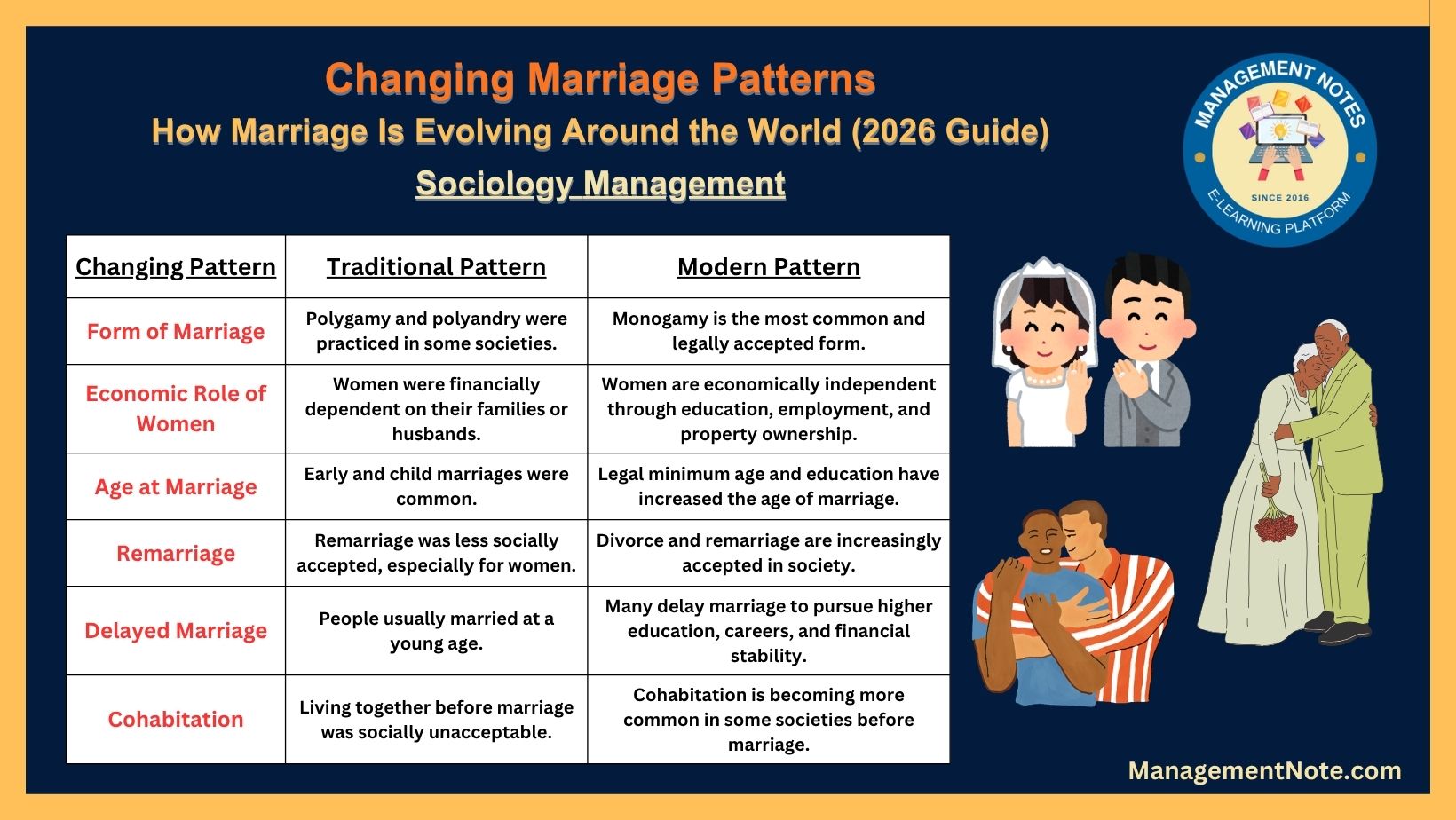
Changing Marriage Patterns: How Marriage Is Evolving Around the World (2026 Guide) | Sociology Management
Marriage looks very different today than it did 50 years ago. People are marrying later, living together before marriage, and choosing partners in new ways.
Marriage patterns are changing because of industrialization, education, urbanization, and new laws. The biggest shifts are later marriage age, more cohabitation, more remarriage after divorce, stronger economic roles for women, and a global move away from polygamy toward monogamy.
In the United States, the average age of first marriage is now about 30 for men and 28 for women, up from 22 and 20 in 1950 (U.S. Census Bureau, 2024).
Why Is Marriage Changing? A Quick History
The world has moved from farm-based, pre-industrial societies to modern, industrial ones. This shift changed how people live, work, and form families. Better technology, more schools, new laws, and city growth (urbanization) all pushed marriage customs to change.
Practices that were normal 100 years ago, such as arranged marriage, child marriage, or having multiple spouses, are now rare or against the law in most countries.
Below are the main changing marriage patterns seen in Nepal and across the world today.
1) Change in the Form of Marriage: From Polygamy to Monogamy

In the past, some societies practiced polygamy (one husband, many wives) or polyandry (one wife, many husbands). Today, most countries ban these practices by law.
Monogamy, marriage between two people, is now the most common and legally accepted form of marriage worldwide.
This shift happened for a few reasons:
- Modern law treats spouses as equal partners with shared legal rights.
- Religious and civil marriage laws in most countries only recognize one spouse at a time.
- Monogamy fits better with smaller, nuclear-family households in cities.
Polygamy still exists in parts of the world where it is legal or culturally accepted, but the global trend is clearly toward one spouse at a time.
Related: Polygyny Marriage: Fundamentals in Sociology
2) Change in the Economic Role of Women

In earlier societies, women often depended fully on their husbands or families for money and had little say in household decisions. Today, women:
- Own property and businesses
- Earn college and university degrees
- Hold leadership roles in government and companies
- Support their households financially, sometimes as the main earner
This economic independence has changed how and when women choose to marry. Many women now marry as equal financial partners instead of depending on a husband for survival.
This is one of the biggest drivers of delayed marriage and lower marriage rates worldwide (Pew Research Center, 2025).
3) Change in the Legal Age of Marriage
Older societies had few laws about marriage age, so child marriage was common. Today, most countries set a legal minimum age and enforce it with fines or jail time.

In Nepal, the Civil Code 2074 (2017) sets the legal marriage age at 20 years for both men and women, one of the highest minimum ages in South Asia (Government of Nepal, Civil Code 2074, Section 70).
Marrying below this age is a criminal offense. In early 2025, a parliamentary subcommittee proposed lowering the age to 18, but as of 2026 this bill has not passed, and the legal age remains 20 (OHRH, 2025).
In the United States, marriage age laws vary by state, but 18 is the standard legal minimum without parental consent in most states.
Globally, child marriage is still a serious problem. UNICEF (2025) reports that about 19% of women worldwide were married before age 18, and roughly 12 million girls are still married as children every year. Ending child marriage by 2030 is one of the United Nations Sustainable Development Goals.
4) Remarriage Is More Common Than Ever
Divorce is more socially accepted today than in the past, and most people who divorce do not stay single. According to Pew Research Center (2025), about two thirds of divorced Americans remarry.

Divorced men remarry slightly more often than divorced women, and men are more likely to marry a partner who is considerably younger than they are.
Key U.S. remarriage facts:
- About 40% of all U.S. marriages include at least one partner who was married before (Pew Research Center, 2025).
- Roughly 15% of divorced women and 19% of divorced men live with an unmarried partner instead of remarrying right away.
- Second marriages carry a higher risk of divorce than first marriages, though exact “second marriage divorce rate” figures vary by source and should be read with caution (Modern Family Law, 2026).
5) Delayed Marriage: People Are Waiting Longer to Say “I Do”
Marrying young used to be the norm. Now, most people finish their education and build a career before marrying. This is one of the clearest global trends.

In the United States, the median age at first marriage has climbed steadily:
| Year | Men | Women |
|---|---|---|
| 1950 | 22.5 | 20.1 |
| 2000 | 26.8 | 25.1 |
| 2024 | 30.2 | 28.6 |
(Source: U.S. Census Bureau, Current Population Survey, Table MS-2, 2024)
Why are people delaying marriage?
- More years spent in school and college
- Career building and financial independence, especially among women
- Rising cost of living and housing, making young couples wait until they are financially stable
- Greater acceptance of staying single or cohabiting long term
In fact, Pew Research Center (2023) found that 1 in 4 Americans age 40 have never been married, up from 1 in 5 in 2010.
6) Cohabitation: Living Together Before (or Instead of) Marriage
Cohabitation means an unmarried couple lives together in an emotional and often sexual relationship without a legal marriage. This was rare and even stigmatized in earlier generations. Today it is mainstream in many countries.

U.S. cohabitation data shows how big this shift has been:
- 59% of American adults ages 18 to 44 have lived with an unmarried partner at some point, compared with 50% who have ever married (Pew Research Center, 2019; National Survey of Family Growth data).
- About 20.3 million U.S. adults were cohabiting in 2024, up from 14 million in 2009 (National Center for Family and Marriage Research, 2024).
- 69% of Americans say cohabitation is acceptable even if the couple never plans to marry (Pew Research Center, 2019).
- About 3.2 million U.S. children under 18 now live with cohabiting parents, up from 2.2 million in 2007 (U.S. Census Bureau, cited in Connected Couples, 2026).
For many couples, cohabitation works like a trial period. If the relationship works well, they may marry later. If not, they separate without the legal and financial complications of divorce. This pattern is sometimes called a “living relationship.”
Other Modern Marriage Trends Worth Knowing
These trends are searched often but were missing from older discussions of marriage patterns:
- Falling marriage rates overall: Only 53% of U.S. adults are currently married, down from 58% in 1995 (Pew Research Center, 2025).
- Gray divorce: Divorce among adults over age 50 has tripled since 1990, from about 5% to 15% (National Center for Family and Marriage Research, 2024).
- Interfaith and interracial marriage: Legal and social barriers to marrying across religion, caste, or race have weakened in most countries, leading to more diverse marriages than in past generations.
- Same-sex marriage: Legal recognition of same-sex marriage has expanded in dozens of countries over the past two decades, changing the legal definition of marriage itself in many places.
- Smaller, later families: Because people marry later, they also tend to have fewer children and have them later in life.
Changing Marriage Patterns at a Glance
| Pattern | Past | Present |
|---|---|---|
| Form of marriage | Polygamy/polyandry common | Monogamy is standard and legally required in most countries |
| Women’s economic role | Financially dependent | Financially independent, equal earners |
| Marriage age | No fixed age; child marriage common | Legal minimum age enforced (20 in Nepal, 18 in most U.S. states) |
| After divorce | Remarriage less common/accepted | About 2 in 3 divorced Americans remarry |
| Timing of marriage | Early marriage right after schooling | Delayed marriage; U.S. average age near 30 |
| Living arrangement before marriage | Rare, often stigmatized | Cohabitation is common and widely accepted |
Frequently Asked Questions
What are the main changing patterns of marriage?
The main changes are a shift from polygamy to monogamy, greater economic independence for women, later marriage ages, more remarriage after divorce, delayed marriage overall, and a rise in cohabitation before or instead of marriage.
Why are people getting married later now?
People marry later mainly because they spend more years in school, focus on building a career first, want financial stability before marriage, and face higher living costs. Greater social acceptance of staying single or living together unmarried also plays a role.
What is the average age of marriage in the U.S. in 2026?
The median age at first marriage in the United States is about 30.2 years for men and 28.6 years for women, based on the latest Census Bureau data (2024 estimates).
What is the legal age of marriage in Nepal?
The legal age of marriage in Nepal is 20 years for both men and women, under Section 70 of the Civil Code 2074 (2017). A 2025 proposal to lower it to 18 has not been passed into law as of 2026.
Is cohabitation replacing marriage?
Not fully, but it is now more common than marriage among young adults. In the U.S., 59% of adults ages 18 to 44 have cohabited at some point, compared with 50% who have ever married. Many couples still marry eventually, but cohabitation often comes first.
Do most divorced people remarry?
Yes. About two thirds of divorced Americans go on to remarry, according to Pew Research Center. Divorced men remarry slightly more often than divorced women.
Why has polygamy declined worldwide?
Polygamy has declined because most modern legal systems recognize only one spouse at a time, religious and civil marriage codes were reformed, and monogamy fits better with smaller, nuclear-family households and gender equality laws.
How common is child marriage today?
Child marriage is declining but still widespread. UNICEF (2025) estimates that 19% of women alive today were married before age 18, and about 12 million girls marry as children every year worldwide.
What causes remarriage after divorce?
Common reasons include wanting companionship, financial partnership, co-parenting support, and simply finding a new compatible partner. Men are somewhat more likely than women to remarry, and often marry younger partners.
What is the difference between cohabitation and marriage?
Cohabitation is an informal living arrangement between an unmarried couple, with no legal marriage contract. Marriage is a legally and often religiously recognized union that comes with specific legal rights and responsibilities, such as inheritance and spousal benefits.
References
National Center for Family and Marriage Research. (2024). Marriage and divorce trends. Bowling Green State University. https://www.bgsu.edu/ncfmr
Pew Research Center. (2019, November 6). Key findings on marriage and cohabitation in the U.S. https://www.pewresearch.org/short-reads/2019/11/06/key-findings-on-marriage-and-cohabitation-in-the-u-s/
Pew Research Center. (2023). Rising share of U.S. adults are living without a spouse or partner. https://www.pewresearch.org
Pew Research Center. (2025, January 8). Share of US adults living without a romantic partner declines slightly. https://www.pewresearch.org/short-reads/2025/01/08/share-of-us-adults-living-without-a-romantic-partner-has-ticked-down-in-recent-years/
Pew Research Center. (2025, October 16). 8 facts about divorce, marriage and remarriage in the United States. https://www.pewresearch.org/short-reads/2025/10/16/8-facts-about-divorce-in-the-united-states/
U.S. Census Bureau. (2024). Median age at first marriage, 1890 to present (Figure MS-2, Current Population Survey). https://www.census.gov
UNICEF. (2025). Child marriage data. UNICEF Data. https://data.unicef.org/topic/child-protection/child-marriage/
Government of Nepal. (2017). National Civil Code (Muluki Dewani Samhita), 2074, Section 70.
OHRH. (2025, April 16). Lowering the marital age of Nepal: Controversy estopped on protection against child marriages? Oxford Human Rights Hub. https://ohrh.law.ox.ac.uk
Modern Family Law. (2026). U.S. divorce statistics 2026: Rates, trends & key facts. https://www.modernfamilylaw.com
Connected Couples. (2026). Cohabitation statistics 2026: Trends and data. https://www.connectedcouples.app/blog/cohabitation-statistics
Similarly,

MBA- Finance Specialization
I am Smirti Bam, an enthusiastic edu blogger with a passion for sharing insights into the dynamic world of business and management through this website.
I hold a MBA degree from Presidential Business School, Kathmandu, and a BBA degree with a specialization in Finance from Apex College,
- Employee Retention Vs. Employee Engagement: Key Differences Explained | A Complete Guide - September 6, 2026
- Talent Acquisition Vs Talent Management: What Is the Difference? - September 2, 2026
- Headhunting vs Recruitment: Major Differences Explained | Human Resource Management - August 31, 2026


This design is incredible! You definitely know how to keep a
reader entertained. Between your wit and your videos, I was almost moved to start my own blog
(well, almost…HaHa!) Wonderful job. I really loved what you had to say,
and more than that, how you presented it. Too cool!