
Financial Accounting Vs Management Accounting: A Complete Guide for Students and Professionals | Accounting Management
If you are studying accounting in the United States or planning a career in finance, you will quickly come across two important types: financial accounting and management accounting. While both deal with money and numbers, they serve very different purposes.
Think of it this way: financial accounting tells the outside world how a business is doing, while management accounting helps people inside the business make smarter decisions.
For example, when Amazon publishes its annual report for shareholders, that is financial accounting at work. But when Amazon’s leadership team analyzes which product categories are most profitable to decide where to invest next year, that is management accounting.
This guide breaks down everything you need to know about both types, written in plain English. Whether you are a high school student, a college freshman, or someone preparing for a career in business, this article has you covered.
What Is Financial Accounting?
Financial accounting is the process of recording, summarizing, and reporting a company’s financial transactions to people outside the organization. This includes shareholders, banks, government agencies like the IRS, and the general public.
In the US, financial accounting must follow a strict set of rules called GAAP, which stands for Generally Accepted Accounting Principles. These rules are set by the Financial Accounting Standards Board (FASB) and are required for all publicly traded companies registered with the Securities and Exchange Commission (SEC).
Key Features of Financial Accounting
- Audience: Outside users such as investors, creditors, and the IRS
- Time Frame: Focuses on past transactions (what already happened)
- Rules: Must follow GAAP as set by FASB
- Format: Standardized reports including income statements, balance sheets, and cash flow statements
- Frequency: Quarterly (10-Q) and annual (10-K) filings with the SEC
- Legal Requirement: Required by law for all publicly held US companies
Real-Life Example: Tesla’s Annual Report
Every year, Tesla, Inc. files a Form 10-K with the SEC. This document tells the public how much revenue the company earned, what it spent, and how much profit it made.
In its 2023 annual report, Tesla reported total revenues of $96.8 billion. This report is a product of financial accounting and is used by Wall Street analysts, investors, and lenders to evaluate the company.
What Is Management Accounting?
Management accounting (also called managerial accounting) is the process of collecting and analyzing financial information to help managers make better business decisions. Unlike financial accounting, this information is only used inside the company and does not need to follow GAAP.
Think of it as a company’s internal compass. It helps leaders plan budgets, control costs, and figure out which products or services make the most money.
Key Features of Management Accounting
- Audience: Internal users such as managers, executives, and department heads
- Time Frame: Focuses on the future (budgets, forecasts, projections)
- Rules: No mandatory standards; flexible and customized
- Format: Flexible reports like dashboards, budget variance reports, and cost analyses
- Frequency: As often as needed: daily, weekly, monthly, or project-specific
- Legal Requirement: Not required by law; used voluntarily
Real-Life Example: Walmart’s Inventory Decisions
When Walmart decides how much inventory to stock in its stores across different states, it uses management accounting data. Internal reports show which products sell fastest in which regions, helping store managers order the right amount of stock. None of this data is shared publicly. It is purely for internal decision-making.
Key Differences at a Glance
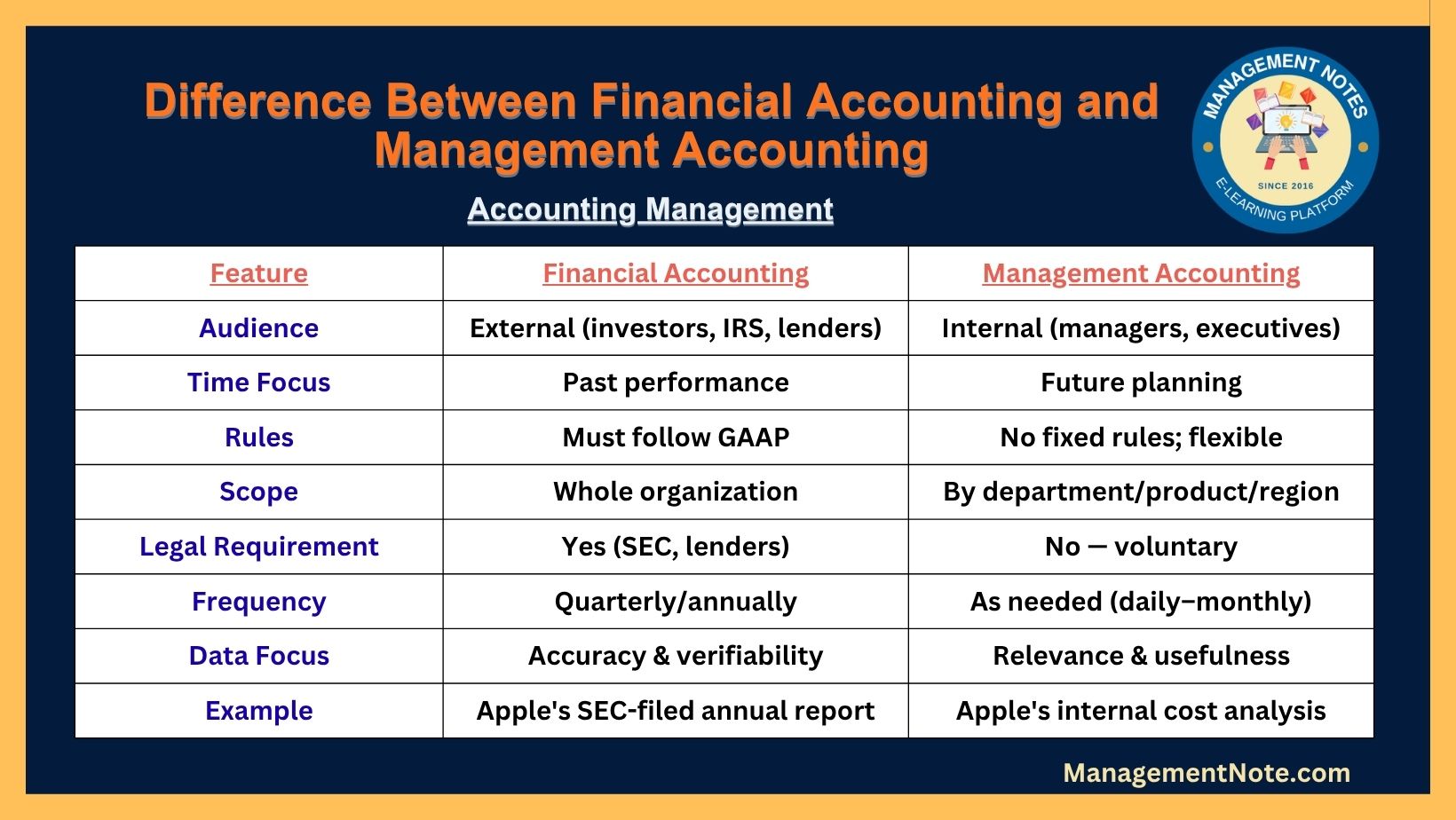
The table below compares both types of accounting across the most important factors. This is especially useful if you are studying for a US accounting exam or preparing for a job interview.
| Feature | Financial Accounting | Management Accounting |
| Audience | External users: investors, lenders, the IRS, and stockholders | Internal users: managers, department heads, and executives |
| Time Focus | Past performance (last quarter, last fiscal year) | Future planning (next budget cycle, upcoming product launch) |
| Governing Rules | Must follow GAAP (Generally Accepted Accounting Principles) | No mandatory standards; flexible and customized to company needs |
| Scope | Covers the entire organization as one unit | Breaks down data by department, product line, or region |
| Required by Law | Yes, for publicly traded companies (SEC requirement) and lenders | No legal requirement; used voluntarily for better decision-making |
| Report Frequency | Quarterly and annually (e.g., 10-Q and 10-K filings) | As needed: daily, weekly, monthly, or project-based |
| Data Emphasis | Accuracy, precision, and verifiability of numbers | Relevance, flexibility, and usefulness for decisions |
| Real-Life Example | Apple’s annual report filed with the SEC showing total revenue of $383 billion in FY2023 | Apple’s internal cost analysis to decide whether to manufacture the iPhone chip in-house |
Source: Adapted from FASB (Financial Accounting Standards Board) guidelines and IMA (Institute of Management Accountants) standards, 2024.
Real-Life Examples
Example 1: A Small Business Owner in Texas
Financial Accounting: A small bakery in Austin, Texas, prepares a year-end income statement to file taxes with the IRS and apply for a Small Business Administration (SBA) loan. This statement shows total sales, cost of goods sold, and net profit.
Management Accounting: The same bakery owner tracks which items, such as croissants versus muffins, bring in the most profit each week. She uses this data to decide what to bake more of during the holiday season.
Example 2: A Large Corporation Like Johnson and Johnson
Financial Accounting: Johnson and Johnson files its 10-K annual report with the SEC each year, disclosing revenue, liabilities, and earnings per share to its millions of shareholders.
Management Accounting: Internally, J&J’s management team uses cost-benefit analysis to decide whether to launch a new drug product or discontinue an underperforming medical device line. This analysis never appears in the public annual report.
Example 3: A University Finance Department
Financial Accounting: A state university prepares financial statements for government oversight bodies and bond rating agencies.
Management Accounting: The same university uses internal budget reports to decide how to allocate funds between the engineering department and the arts program for the upcoming academic year.
Which Type Is Right for Your Career?
Choosing between financial accounting and management accounting depends on what kind of work you enjoy and what goals you have.
Choose Financial Accounting if you:
- Like working with standardized rules and regulations
- Want to work at a public accounting firm like Deloitte, PwC, EY, or KPMG
- Are interested in auditing, tax preparation, or compliance
- Plan to get your CPA (Certified Public Accountant) license
Choose Management Accounting if you:
- Enjoy strategic thinking and problem-solving
- Want to work directly with a company’s leadership team
- Are interested in budgeting, forecasting, and cost analysis
- Plan to get your CMA (Certified Management Accountant) credential
US Certifications: CPA vs CMA
In the United States, accounting professionals typically pursue one of two major certifications depending on their specialty.
- CPA (Certified Public Accountant): Issued by the AICPA (American Institute of CPAs). Required for signing off on public company audits. Covers financial reporting, taxation, and auditing. This is the gold standard for financial accountants in the US.
- CMA (Certified Management Accountant): Issued by the IMA (Institute of Management Accountants). Focuses on financial planning, analysis, control, and decision support. This is the top credential for management accountants.
Both exams are rigorous, but they test very different skills. The CPA exam is known for its focus on external reporting and tax law, while the CMA exam emphasizes business strategy and internal financial management.
Salaries and Job Outlook in the US
Both types of accounting offer strong career prospects in the United States. According to the US Bureau of Labor Statistics, accounting and auditing jobs are expected to grow steadily through 2030. Here is a look at typical salaries.
| Role | Average US Salary (2024) | Certification |
| Financial Accountant | $65,000 to $90,000/year | CPA (Certified Public Accountant) |
| Management Accountant | $70,000 to $100,000/year | CMA (Certified Management Accountant) |
| Controller | $100,000 to $140,000/year | CPA or CMA |
| CFO (Chief Financial Officer) | $150,000 to $300,000+/year | MBA, CPA, or CMA |
Source: US Bureau of Labor Statistics (BLS), Occupational Outlook Handbook, 2023-2024 Edition. Salary ranges vary by state, industry, and experience level.
Similarities Between Financial and Management Accounting
Even though these two types of accounting serve different purposes, they share important connections.
- Same Data Source: Both use the same core financial data from the company’s accounting system.
- Common Goal: Both aim to give an accurate picture of the company’s financial health.
- Overlap in Tools: Both use software like QuickBooks, SAP, or Oracle for data collection.
- Part of the Same Team: In most US companies, financial accountants and management accountants work in the same finance department.
- Ethical Standards: Both types are expected to follow the code of ethics set by professional bodies like AICPA and IMA.
Quick-Reference Comparison Table
Use this table for quick review when studying for exams or preparing for interviews.
| Aspect | Financial Accounting | Management Accounting |
| Primary Goal | Report financial results to outsiders | Support internal decisions and strategy |
| Who Reads It | Shareholders, IRS, creditors, SEC | CEOs, department managers, CFOs |
| Format | Standardized (balance sheet, income statement, cash flow) | Flexible (dashboards, budget variance reports, forecasts) |
| US Law Requirement | Required for public companies under SEC rules | Not required; used at company discretion |
Frequently Asked Questions (FAQs)
These are the most commonly asked questions in the US about financial accounting versus management accounting.
Q1: Is management accounting the same as managerial accounting?
Yes. The terms are used interchangeably in the United States. Both refer to the same discipline of using internal financial data to help managers make business decisions.
Q2: Which type of accounting pays more in the US?
On average, management accounting roles such as controllers and CFOs tend to pay more, especially at the senior level. However, CPAs working at Big Four accounting firms can also command very high salaries, particularly in tax advisory and forensic accounting.
Q3: Do I need to know GAAP for management accounting?
No. Management accounting does not require GAAP compliance. However, having a solid understanding of GAAP is helpful because it gives you a stronger foundation for understanding the financial data you will work with.
Q4: Can one accountant do both financial and management accounting?
Yes. In small businesses, especially startups and small to mid-size companies across the US, one accountant often handles both functions. However, in large corporations, these are typically two separate roles or even two separate departments.
Q5: Is financial accounting required for all US businesses?
Not for all businesses. Only publicly traded companies are required by the SEC to file financial reports following GAAP. Private companies, small businesses, and sole proprietors have more flexibility, though lenders and investors may still require formal financial statements.
Q6: What is the difference between financial accounting and bookkeeping?
Bookkeeping is the process of recording daily financial transactions (like sales and expenses). Financial accounting goes a step further by organizing those records into formal financial statements and reports. Think of bookkeeping as collecting the raw data, and financial accounting as making sense of it.
Q7: Which is harder, the CPA exam or the CMA exam?
Both are challenging. The CPA exam has four sections and takes most candidates 12 to 18 months to complete. The CMA exam has two parts and is generally considered slightly easier to pass in less time, but the strategic content can be just as demanding for those without a business background.
References and Citations
The following sources were used to write and verify the information in this article:
- Financial Accounting Standards Board (FASB). (2024). Conceptual Framework for Financial Reporting. Retrieved from https://www.fasb.org
- Institute of Management Accountants (IMA). (2024). What Is Management Accounting? Retrieved from https://www.imanet.org
- US Bureau of Labor Statistics. (2023-2024). Occupational Outlook Handbook: Accountants and Auditors. Retrieved from https://www.bls.gov/ooh/business-and-financial/accountants-and-auditors.htm
- American Institute of CPAs (AICPA). (2024). CPA Exam Overview. Retrieved from https://www.aicpa.org
- US Securities and Exchange Commission (SEC). (2024). Guide to Financial Statements. Retrieved from https://www.sec.gov/reportspubs/investor-publications/investorpubsbegfinstmtguidehtm.html
- Garrison, R. H., Noreen, E. W., and Brewer, P. C. (2021). Managerial Accounting (17th ed.). McGraw-Hill Education.
- Weygandt, J. J., Kimmel, P. D., and Kieso, D. E. (2022). Financial Accounting: IFRS Edition (4th ed.). Wiley.
- Tesla, Inc. (2023). Annual Report on Form 10-K. Filed with the US Securities and Exchange Commission.
- Johnson and Johnson. (2023). 2023 Annual Report. Retrieved from https://www.jnj.com
(Disclaimer: This article is intended for educational purposes and provides a general overview. Always consult a licensed CPA or financial advisor for advice specific to your situation.)
You may also like:

MBA- Finance Specialization
I am Smirti Bam, an enthusiastic edu blogger with a passion for sharing insights into the dynamic world of business and management through this website.
I hold a MBA degree from Presidential Business School, Kathmandu, and a BBA degree with a specialization in Finance from Apex College,
- Onboarding Vs. Orientation: Key Differences, Benefits, Process & Best Practices | Human Resource Management (HRM) - September 24, 2026
- Moonlighting Vs Freelancing: Meaning, Differences & Risks Explained | Human Resource Management (HRM) - September 14, 2026
- Employee Retention Vs. Employee Engagement: Key Differences Explained | Human Resource Management - September 6, 2026


I cannot thank you enough for the post.Really looking forward to read more. Cool.
After reading your blog post, I browsed your website a bit and noticed you aren’t ranking nearly as well in Google as you could be. I possess a handful of blogs myself, and I think you should take a look at “seowebsitetrafficnettools”, just google it. You’ll find it’s a very lovely SEO tool that can bring you a lot more visitors and improve your ranking. They have more than 30+ tools only 20$. Very cheap right? Keep up the quality posts