
What Is Raiding in Recruitment? Meaning, Legal Rules, and How to Prevent It (2026) | Human Resource Management
Losing a good employee to another company is never easy. It costs time, money, and sometimes team morale. One reason this happens is a hiring practice called raiding.
What Does Raiding Mean in Recruitment?
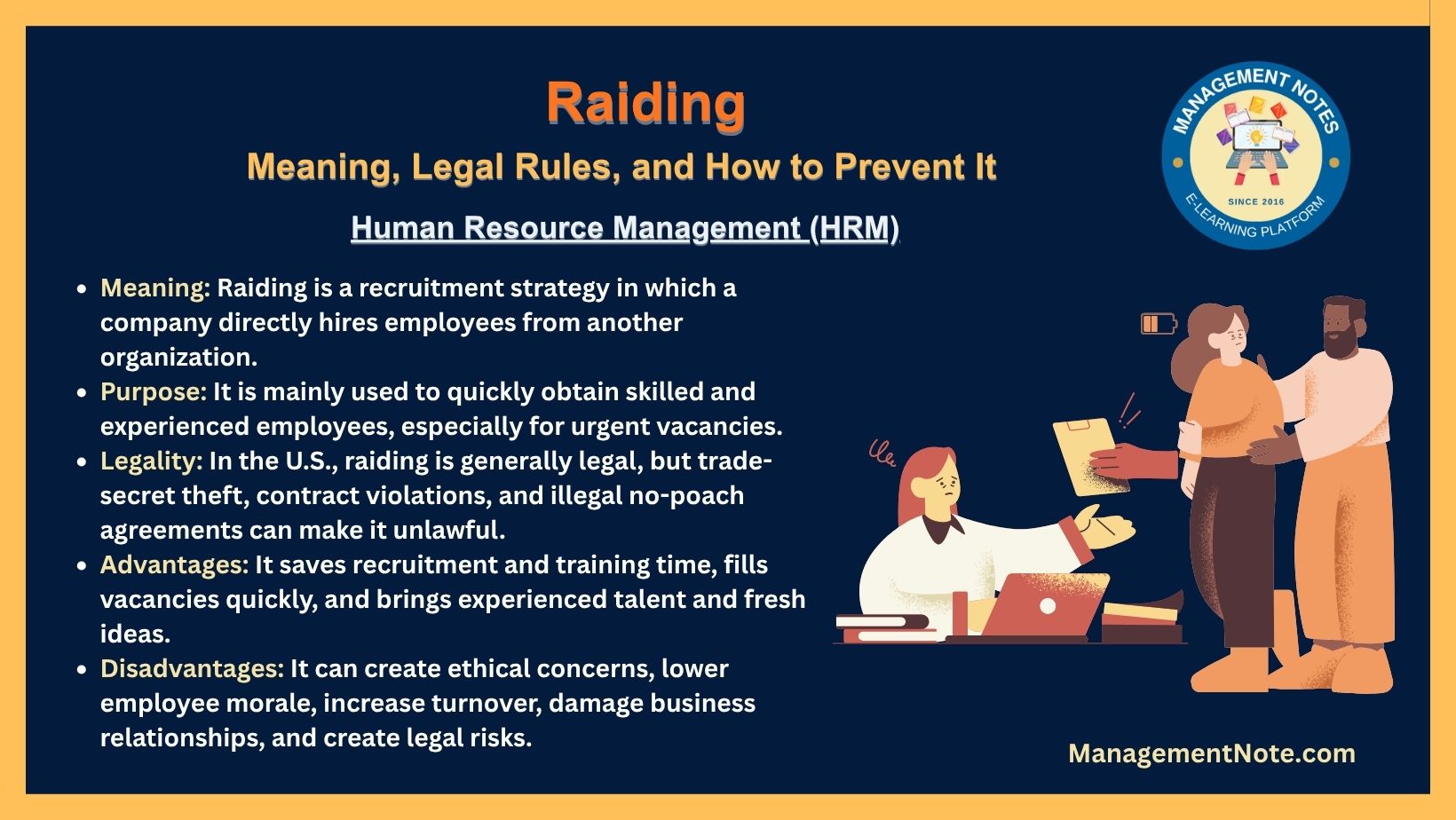
Raiding is a recruitment strategy where a company reaches out directly to employees who already work for another organization and tries to convince them to switch jobs.
It is one of the external sources of recruitment used in human resource management (HRM), alongside job boards, campus hiring, and employment agencies. Many recruiters see direct raiding as a gray area. Some HR professionals call it unethical because it targets people who never applied for the job in the first place.
Even so, raiding is common, especially when a company needs to fill a role fast or cannot find the right skills through normal hiring channels. Both public sector and private sector organizations use this method when the need is urgent.
Raiding is often confused with poaching, a related term. The simple way to think about it: raiding is the broad practice of hiring away workers from other companies, while poaching usually means targeting specific, highly skilled individuals, often from a direct competitor.
Is Raiding Legal in the United States?
This is one of the most common questions about the topic.
In most parts of the United States, it is legal for one company to contact and hire an employee who works for another company, even a direct competitor.
Recruiters make this kind of outreach every day as part of normal business. Free movement of labor is protected, and workers are allowed to look for better jobs whenever they choose.
Raiding can turn into a legal problem in a few situations:
Trade secret theft. If a new hire brings confidential client lists, pricing data, or product plans from their old employer, that can lead to a lawsuit.
Breach of contract. If the employee signed a valid non solicitation agreement, leaving early or recruiting old coworkers can break that contract.
Tortious interference. A company can face legal trouble if it knowingly convinces a worker to break a valid employment contract.
Illegal no poach agreements. This is different from one company hiring from another. It happens when two or more competing employers secretly agree not to hire or recruit each other’s staff.
Courts and regulators generally view these deals as anti competitive, and companies that use them risk serious civil and criminal penalties.
What About Non Compete Clauses?
Many companies used to rely on non compete agreements to stop workers from joining a rival. That landscape has changed a lot recently. In 2024, the Federal Trade Commission voted to ban most non compete clauses nationwide, making them unenforceable outside a few narrow situations.
Because of this, more employers now lean on non solicitation clauses and retention strategies instead of trying to legally lock workers in.
Real Life Example: The Silicon Valley No Poach Case
One of the most well known cases involving illegal talent agreements involves some of the biggest names in tech. Starting in 2011, more than 64,000 employees sued several major technology companies, including Apple, Google, Adobe, Intel, Intuit, Lucasfilm, and Pixar, claiming these companies had secretly agreed not to recruit each other’s engineers between 2005 and 2010.
News reports from that time claimed Apple co founder Steve Jobs warned Google’s Sergey Brin that hiring even one Apple employee would mean trouble between the two companies.
The case ended in a major settlement. Apple, Google, Intel, and Adobe agreed to pay $415 million to settle the claims, and smaller settlements came from Intuit, Pixar, and Lucasfilm.
This case is now a textbook example used to explain why illegal agreements between employers not to hire each other’s staff are treated so seriously under U.S. antitrust law.
Everyday raiding looks far less dramatic. A retail chain calling store managers at a competing chain, a staffing agency reaching out to an entire department at once, or a hospital system cold calling nurses from a rival hospital are all normal, legal examples seen across American industries.
Advantages of Raiding
| Advantage | Why It Matters |
|---|---|
| Saves time | Skips long training periods since the person already knows the job |
| Fills bulk openings fast | Useful when a company needs many roles filled at once |
| No need for internal career planning | The company does not have to build a talent pipeline from scratch |
| Often cheaper than internal development | Training existing staff for years can cost more than hiring ready talent |
| Brings fresh ideas | New hires bring outside knowledge and different ways of solving problems |
Disadvantages of Raiding
Ethical concerns. Even though it may be fully legal, many people see it as an unfair hiring practice.
Lower morale among current staff. When employees see coworkers leave for a rival, or realize the company relies on outside hires instead of promoting from within, it can hurt trust and motivation.
Higher turnover risk later. A worker who was raided with a big offer can just as easily be raided again by someone else.
Strained industry relationships. Companies known for aggressive raiding can damage their reputation with partners and rivals in the same field.
Legal exposure. Trade secret disputes, breach of contract claims, and antitrust risk can all lead to costly litigation.
Cultural mismatch. A hire chosen mainly to fill a seat quickly may not fit the new company’s values or work style, which can affect long term performance.
How Companies Can Prevent Employee Raiding
No company can stop competitors from making offers, but every company can make it harder for those offers to work.
- Pay fair, competitive wages, and review salaries regularly against the market
- Build real career paths so employees can see a future at the company
- Improve workplace culture with a respectful, supportive environment
- Use stay interviews, not just exit interviews, to ask top performers what they need
- Offer flexible work options such as remote work and flexible hours
- Recognize good work through simple recognition programs
- Use narrow, legal non solicitation agreements, reviewed by an employment lawyer since rules differ by state
- Watch for warning signs like sudden changes in behavior or reduced engagement
Raiding FAQs
What is raiding in HR?
Raiding is a recruitment strategy where a company directly contacts employees at another organization to convince them to switch jobs, rather than waiting for them to apply.
Is raiding employees illegal in the US?
No, in most cases it is legal for one employer to hire a worker from another company. It becomes a legal issue only if trade secrets are stolen, a valid contract is broken, or two competing companies illegally agree not to hire from each other.
Is raiding the same as poaching?
They are closely related. Raiding is the broader practice of hiring away workers from other companies. Poaching usually refers to a more targeted version, aimed at specific, highly skilled, or senior employees.
Why do companies use raiding instead of normal hiring?
Raiding lets a company fill roles quickly with people who already have proven experience, which is especially useful when a role must be filled urgently or when the right skills are hard to find through normal job postings.
Can raiding hurt a company in the long run?
Yes. It can lower morale among remaining staff, damage industry relationships, and lead to legal disputes. A worker hired mainly through an aggressive approach can also leave just as fast for the next offer.
Conclusion:
Raiding is a recruitment strategy built around hiring people who already have jobs elsewhere, rather than waiting for applications. It is legal in most of the United States as long as no trade secrets are stolen, no valid contract is broken, and no illegal agreement exists between competing employers.
Raiding can save time and bring in ready made talent, but it carries real risks, including lower morale, legal exposure, and damaged trust. The strongest long term defense against losing talent to raiding is not a legal contract. It is a workplace people do not want to leave.
Similarly, You May Also Like:
- Human Resources Diagram – Human Resource Management (HRM) | Management Notes
- Headhunting Explained: Process, Cost, Pros & Cons (2026) | Human Resource Management

MBA- Finance Specialization
I am Smirti Bam, an enthusiastic edu blogger with a passion for sharing insights into the dynamic world of business and management through this website.
I hold a MBA degree from Presidential Business School, Kathmandu, and a BBA degree with a specialization in Finance from Apex College,
- Onboarding Vs. Orientation: Key Differences, Benefits, Process & Best Practices | Human Resource Management (HRM) - September 24, 2026
- Moonlighting Vs Freelancing: Meaning, Differences & Risks Explained | Human Resource Management (HRM) - September 14, 2026
- Employee Retention Vs. Employee Engagement: Key Differences Explained | Human Resource Management - September 6, 2026


