
Applications of Person Perception in Organizations – Organizational Behaviour | Management Notes
Applications of Person Perception in Organizations
In organizations, people always tend to judge each other as these judgments have important consequences for the organization. Person perception plays a crucial role in various aspects of organizations, helping managers and employees make informed decisions and navigate workplace dynamics effectively.
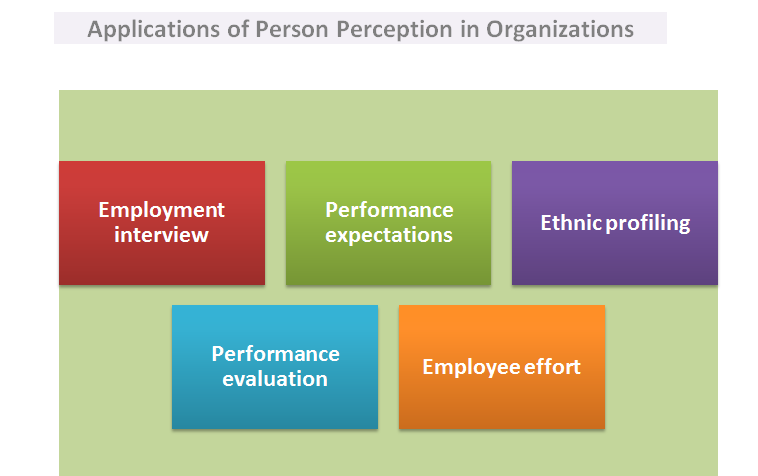
Here, we’ll explore five key applications of person perception in organizations, highlighting their significance and impact: The important applications of person perception in organizations are as follows:
Employment interview
The employment interview is a major input into who is hired and who is rejected in any organization is the employment interview. There is lot of evidence indicating that interviewers make perceptual judgments that are often inaccurate. Interviewers generally draw early impressions (negative or positive) to accept or reject.
- During the hiring process, employers rely on person perception to assess candidates’ qualifications, skills, and suitability for a role.
- Interviewers make judgments about a candidate’s competence, personality, and cultural fit based on their behavior, appearance, and responses.
- Effective person perception in interviews helps organizations select the right individuals, ensuring a more productive and harmonious work environment.
Performance expectations
There are lot of evidence that indicates that people attempt to validate their perceptions of reality, even when those perceptions are faulty. For example, if a manager expects big things from his people, they are not likely to let him down.
Similarly, if a manager expects people to perform minimally, they will tend to behave so as to meet those low expectations. The result then is that the expectations become reality.
- Managers often form expectations about employees’ performance based on their previous work, communication style, and past achievements.
- Person perception guides supervisors in setting appropriate performance standards and expectations for their team members.
- Clear performance expectations facilitate goal alignment, increasing the likelihood of employees meeting or exceeding them.
Ethnic profiling
Ethnic profiling is a form of stereotyping in which a group of individuals is singled out typically on the basis of race or ethnicity for intensive inquiry, scrutinizing, or investigation.
For example, Muslim ethnic communities are tightly observed and/or negatively seen especially by American and European organizations after the September 11 attack on the World Trade Center, in USA.
- Ethnic profiling, or making judgments about individuals based on their ethnic or racial background, should be avoided in organizations as it can lead to discrimination and bias.
- Promoting fair person perception ensures that employees are evaluated based on their skills, qualifications, and performance rather than their ethnicity or background.
Performance evaluation
An employee’s performance appraisal person is very much dependent on the perceptual process. Although i. Factor appraisal can be objective, many jobs are evaluated in subjective terms. Subjective measures are easier to implement. They provide managers with greater discretion, and many jobs do not readily provide themselves with objective measures.
- Person perception plays a significant role in performance evaluations, where managers assess employees’ job performance and contributions.
- Evaluators use their perceptions of an employee’s behavior, attitude, and achievements to assign ratings and make decisions regarding promotions, raises, or terminations.
- Accurate person perception in performance evaluations is crucial for fair and constructive feedback.
Employee effort
An individual’s future in an organization is usually not dependent on performance alone. It also depends on their level of effort. An assessment of an individual’s effort is subjective. The judgments are susceptible to perceptual distortions and bias.
- Managers gauge employee effort by observing their commitment, dedication, and enthusiasm in completing tasks and achieving goals.
- Person perception helps leaders identify motivated employees who go above and beyond to contribute to the organization’s success.
- Recognizing and rewarding employees for their efforts can boost morale and encourage continued high performance.
In summary, person perception in organizations influences decision-making processes, impacts workplace relationships, and shapes overall organizational culture.
When used ethically and without bias, person perception can contribute to the success of the organization by ensuring the right people are hired, performance expectations are set appropriately, evaluations are fair, and employees are recognized for their efforts.
However, it is vital for organizations to promote diversity, equity, and inclusion to avoid harmful practices like ethnic profiling and ensure that person perception is based on merit rather than stereotypes or biases.
Similarly, You may also like :

MBA,BBA.
I am Smirti Bam, an enthusiastic edu blogger with a passion for sharing insights into the dynamic world of business and management through this website.
I hold a MBA degree from Presidential Business School, Kathmandu, and a BBA degree with a specialization in Finance from Apex College,
- Frictional Unemployment: Meaning, Causes, Examples & Why It Happens - December 5, 2025
- How Business Law Shapes Everyday Business Decisions? - August 28, 2025
- Multi-Channel Inventory Management: Strategies, Tools, and Best Practices for Success - March 26, 2025


your notes is valuable. but i find problem in downloading your notes. please suggest me how to download your notes which are important to me.
Pingback: Levels of Organizational Behavior - OB | Management Notes